
The average restaurant net profit margin sits between 3% and 9%. For most operators, that means the business works hard all month and keeps very little when the bills are paid.
If your sales look decent but cash still feels tight, your problem usually isn't revenue alone. It's margin discipline. I've seen plenty of restaurants post busy dining rooms, full weekend books, and solid top-line sales while still bleeding profit through weak pricing, sloppy labor planning, low-margin menu mix, and outdated ordering systems.
This is why restaurant profit margins deserve more attention than vanity metrics like covers or gross sales. A full dining room can still be a low-quality revenue machine. A quieter operation with tighter controls and smarter menu strategy can outperform it.
Most owners start by cutting costs. That helps, but it's reactive. The stronger move is revenue engineering. Build a menu and ordering experience that pushes better item mix, higher average order value, cleaner operations, and less staff friction. That's how you protect margin without stripping the guest experience.
Table of Contents
- Why Your Restaurant Profit Margin Matters More Than Revenue
- The Three Core Profit Margins Explained
- Calculating Your Margins A Simple Walkthrough
- Profit Margin Benchmarks by Restaurant Type
- The Four Levers That Control Your Profitability
- Smart Strategies to Engineer Higher Margins
Why Your Restaurant Profit Margin Matters More Than Revenue
Friday night is slammed. The dining room is full, third-party orders keep printing, and sales look strong. Then the month closes and cash is tight, payroll is stressful, and the owner still cannot take a real draw.
That is a margin problem, not a sales problem.
Restaurants usually operate on thin net profit. A store can post impressive top-line revenue and still underperform because the wrong items sell, discounting gets loose, delivery mix gets too heavy, or labor rises faster than demand. More volume only accelerates the problem when the model is weak.
High sales often cover up bad economics
A busy service can hide a lot of mistakes. Popular dishes may carry mediocre contribution. Add-ons may be missing at the point of sale. Servers may sell what is easy to describe instead of what produces the best return. Delivery channels may bring in orders that look good in gross sales and disappoint after fees, packaging, and remake risk.
Plenty of owners read a packed house as proof the business is healthy. It is only proof that people showed up.
What matters is whether each sales channel, menu category, daypart, and shift produces acceptable profit after food, labor, and operating costs. If you do not track that level of performance, you are reacting to activity instead of managing economics.
Practical rule: Review contribution by item, labor by shift, and channel mix every week. Sales totals alone will not protect margin.
Margin shows whether the business model works
Profit margin answers the questions revenue cannot. Are your prices keeping up with supplier increases. Is your menu steering guests toward high-contribution items. Are you scheduling to demand or repeating last month's habits. Can the business handle a slow Tuesday without giving back the entire week's profit.
Those are operating questions. They decide whether growth creates cash or just creates stress.
This is why smart operators stop treating margin as the result of cost cuts after the fact. They treat it as something they build on purpose.
Profit should be engineered through revenue decisions
Cutting waste matters. Tight purchasing matters. But the fastest margin gains often come from better revenue design, not smaller portions and panic cuts.
Operators who outperform the market do four things consistently:
- They price with intent. They fix underpriced winners and stop letting popularity excuse bad margins.
- They manage menu mix. They feature items that produce stronger contribution, not just higher unit counts.
- They use ordering systems to raise average check. Smart prompts, modifiers, bundles, and add-ons increase revenue quality on every ticket.
- They manage demand by channel and daypart. They push guests toward the times, products, and ordering paths that leave more profit behind.
That is the right mindset. Revenue is not the goal by itself. Profitable revenue is the goal.
The Three Core Profit Margins Explained
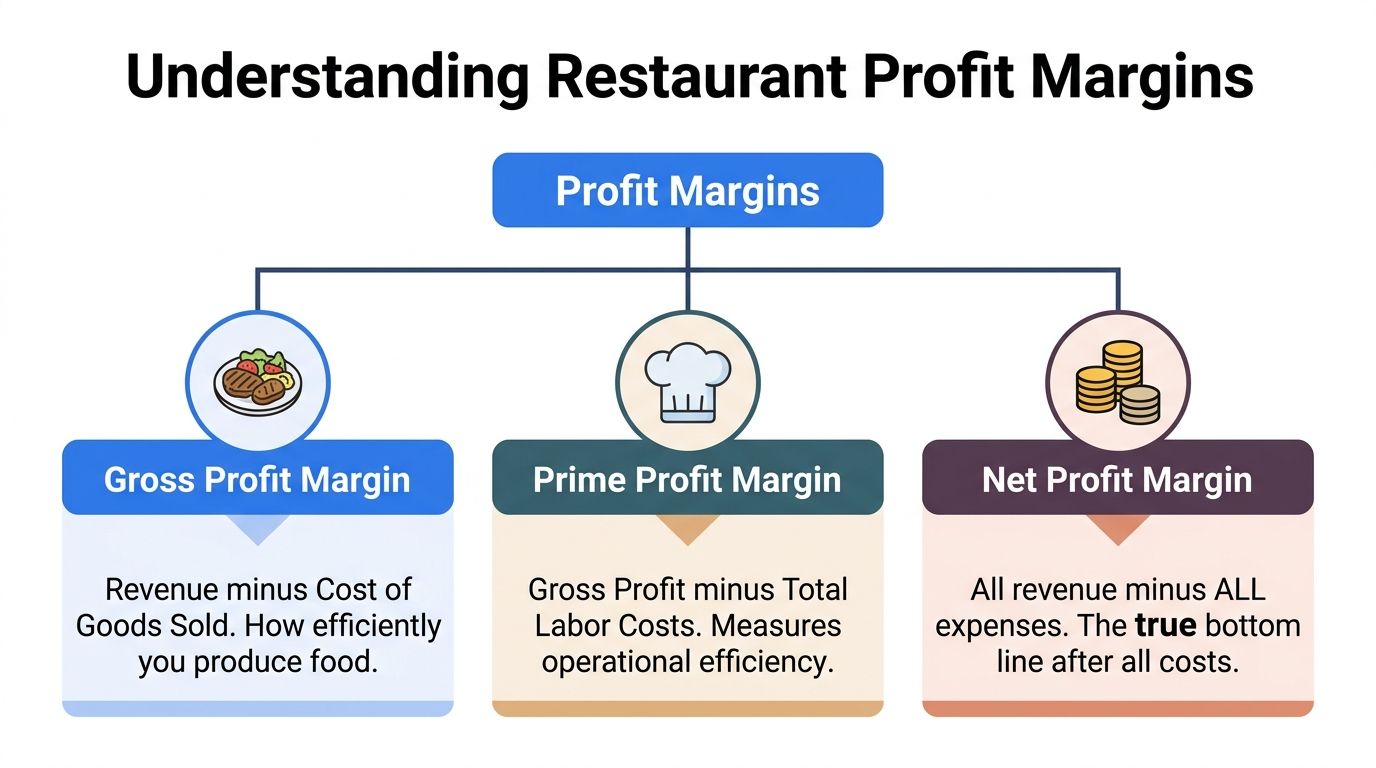
Friday night is full, the kitchen is buried, and sales look strong. Then the month closes and profit is thin. That usually means the owner tracked revenue and missed the three margins that explain performance: gross margin, prime cost, and net margin.
Each one answers a different question. Read them together and you can see whether the problem is pricing, menu mix, labor, or the basic economics of the model. If you want a cleaner foundation for that analysis, use a consistent restaurant P&L structure.
Gross margin tells you whether your sales are worth having
Gross margin is revenue minus cost of goods sold, expressed as a percentage of sales. It shows how much money is left after ingredients and beverages are paid for.
This is the first test of menu quality. If gross margin is weak, volume will not save you. More covers just push more low-quality revenue through the building.
Common gross margin problems are easy to spot:
- Popular items priced too low: High unit sales can hide weak contribution.
- Menu mix drifting the wrong way: Guests choose items with low margin because those are the ones you promote, bundle, or place most visibly.
- Portion creep and recipe inconsistency: A few extra ounces per plate can erase profit fast.
- Slow response to vendor increases: Costs move up. Your menu stays the same.
Gross margin is also where proactive operators gain ground. They do not just cut portions and argue with suppliers. They redesign menus, reprice winners, and use digital ordering, prompts, and placement to push demand toward higher-contribution items.
Prime cost shows whether the operation can support profit
Prime cost combines COGS and labor, the two biggest controllable costs in most restaurants. It is the operating number that deserves daily attention because small misses here wreck the month.
A restaurant can post decent gross margin and still struggle because labor scheduling is sloppy, prep is inefficient, or overtime is ignored. Analysts in a restaurant margin analysis by the UK's Commercial Lenders & Finance Institute, CLFI, note that independent operators often work on thin net margins, which is exactly why prime cost discipline matters so much when sales dip or input costs rise.
Prime cost problems usually come from execution:
- Labor scheduled to habit instead of demand
- Prep hours that do not match menu complexity
- Low-productivity dayparts
- Waste, comps, and remakes that never get fixed
Watch prime cost closely, but do not treat it as a cost-cutting exercise only. The strongest operators improve it from both sides. They tighten labor and food control, then increase sales quality with better pricing, better mix, and better check-building so prime cost falls as a percentage of revenue.
Net margin is the final verdict
Net margin is what remains after every expense is paid. Rent, utilities, software, fees, marketing, repairs, admin, all of it.
This is the score. It tells you whether the restaurant keeps cash or just stays busy.
A full dining room can still produce a weak net margin if fixed costs are heavy, third-party fees are high, or too much revenue comes through low-profit channels. That is why owners need all three views at once:
| Margin | What it tells you |
|---|---|
| Gross | Are you selling items with enough contribution to support the business? |
| Prime | Are food and labor disciplined enough to protect profit? |
| Net | After everything is paid, is the model actually worth scaling? |
Use the three margins as a diagnostic set. Gross tells you what to fix in pricing and menu mix. Prime shows whether operations are converting sales efficiently. Net confirms whether your revenue strategy and cost structure are producing real profit.
Calculating Your Margins A Simple Walkthrough
You don't need a finance team to calculate restaurant profit margins. You need a clean monthly P&L and the discipline to use the same method every period.

Start with clean numbers from your P and L
Pull four inputs:
- Total sales: All revenue for the period.
- Cost of goods sold: Food and beverage cost used to generate those sales.
- Labor cost: Wages and related labor expense.
- Operating expenses: Rent, utilities, software, marketing, repairs, admin, and everything else.
If your reporting is messy, fix that first. A margin review built on bad categorization is a waste of time. If you need a cleaner framework, this guide to a restaurant P&L is a useful starting point.
A simple monthly example
Use this format every month.
Calculate gross profit
- Formula: Revenue minus COGS
- Then divide gross profit by revenue to get gross margin
Calculate prime cost
- Formula: COGS plus labor cost
- Then divide prime cost by revenue to get prime cost percentage
Calculate net profit
- Formula: Revenue minus all expenses
- Then divide net profit by revenue to get net profit margin
Here's a simple café example without using fixed sample amounts.
| Step | Formula | What you're checking |
|---|---|---|
| Gross profit | Revenue – COGS | Is the menu itself profitable enough? |
| Gross margin | Gross profit / Revenue | How much revenue remains after direct product cost? |
| Prime cost | COGS + Labor | Are your two biggest controllable costs in line? |
| Prime cost percentage | Prime cost / Revenue | Are operations efficient enough to support profit? |
| Net profit | Revenue – All expenses | What did the business actually keep? |
| Net margin | Net profit / Revenue | Is the month financially healthy? |
Let's make it practical. Say your café has a month where sales look strong, but your net result disappoints. If gross margin is solid, the problem likely sits in labor deployment or overhead. If gross margin is soft from the start, fix pricing, product mix, recipe costing, or waste before touching anything else.
The point of the calculation isn't to impress your accountant. It's to find the first leak fast.
What operators usually get wrong
Most mistakes are basic, and expensive.
- They use sales data without category detail: Food and beverage behave differently. Don't lump them together if one category carries the margin.
- They ignore timing: Monthly averages hide ugly weekends, weak lunches, and overstaffed dead zones.
- They trust old recipe costs: If ingredient costs changed, your margin view is already stale.
- They calculate net margin and stop there: Net tells you what happened. Gross and prime tell you why.
The best habit is simple. Run the same margin review at the same cadence, compare against the prior period, and look for movement before it becomes damage.
Profit Margin Benchmarks by Restaurant Type
Friday night. The dining room is full, tickets are flying, and sales look great. Then the month closes and the profit line barely moves. That usually comes down to one thing. Operators judge performance against the wrong benchmark.
Benchmarks only matter if they match your model. A full-service restaurant, a fast-casual counter concept, a café, and a ghost kitchen do not earn money the same way. They have different labor structures, different occupancy pressure, different check averages, and different capacity limits. Use the wrong comparison set and you will chase the wrong fix.
What a healthy margin range looks like by model
As noted earlier, industry benchmarks often place overall restaurant net margins in the low single digits up to high single digits, with full-service usually on the lower end and more efficient models on the higher end. Delivery-first concepts can post stronger net margins when they keep occupancy and front-of-house costs low, but plenty of them give that advantage away through discounting, third-party fees, and weak repeat ordering.
Use these ranges as operating context, not a permission slip.
| Restaurant Type | Typical Net Profit Margin Range |
|---|---|
| Full-service restaurant | Lower range |
| Quick-service or fast casual | Mid to higher range |
| Delivery-first or ghost kitchen | Potentially higher, if fees and discounts stay controlled |
| Cafés and bars | Highly dependent on beverage mix, labor model, and daypart strength |
Why the model sets the ceiling
Full-service has the hardest path to strong net margin. Service labor is heavier. Seat turnover is slower. Rent usually eats a bigger share of sales because the guest experience depends on the room, not just the food.
Quick-service and fast-casual concepts have a cleaner engine. They can push more transactions through the same footprint, simplify labor deployment, and build profit through speed, volume, and add-ons.
Ghost kitchens and delivery-first brands remove part of the occupancy burden, but lower overhead does not guarantee better margins. Packaging, marketplace commissions, promos, refunds, and poor menu design can erase the advantage fast.
Cafés and bars sit in the middle. A coffee program or beverage-led concept can produce strong contribution margins. A food-heavy café with long prep times and weak afternoon traffic usually struggles.
The benchmark mistake that hurts operators
Plenty of owners use benchmarks as a defense mechanism. "We're full-service, so margins are always thin." That mindset keeps weak operators stuck.
Use your benchmark to set the right strategy. If you run full-service, your biggest opportunity usually is not broad cost-cutting. It is revenue engineering. Raise contribution per seat, per hour, and per labor hour. Fix menu mix. Push higher-margin modifiers. Tighten daypart offers. Build better drink attachment. Improve table pacing without rushing guests.
If you run delivery-first, protect direct demand and item contribution. Do not let third-party channels train customers to buy only discounted bundles. Track packaging cost by item. Cut menu clutter. A tighter menu with stronger contribution beats a bigger menu with weak repeat performance every time. Better restaurant inventory management processes also matter here because dead stock and low-volume SKUs erode margin.
The right benchmark tells you what your model should be capable of. The right response is to redesign revenue around that ceiling, not just trim expenses after the damage is done.
The operators who consistently beat their category do two things well. They control obvious cost leaks, and they treat pricing, mix, channel strategy, and demand shaping as the main profit tools. That is how you move from "busy" to profitable.
The Four Levers That Control Your Profitability
Friday night. The dining room is full, tickets are flying, and sales look strong. Then the month closes and profit is weak again.
That result usually comes from four levers: food cost, labor cost, overhead, and menu mix with pricing. Owners obsess over the first three and underuse the fourth. That is a mistake. Cost control protects margin. Revenue engineering expands it.
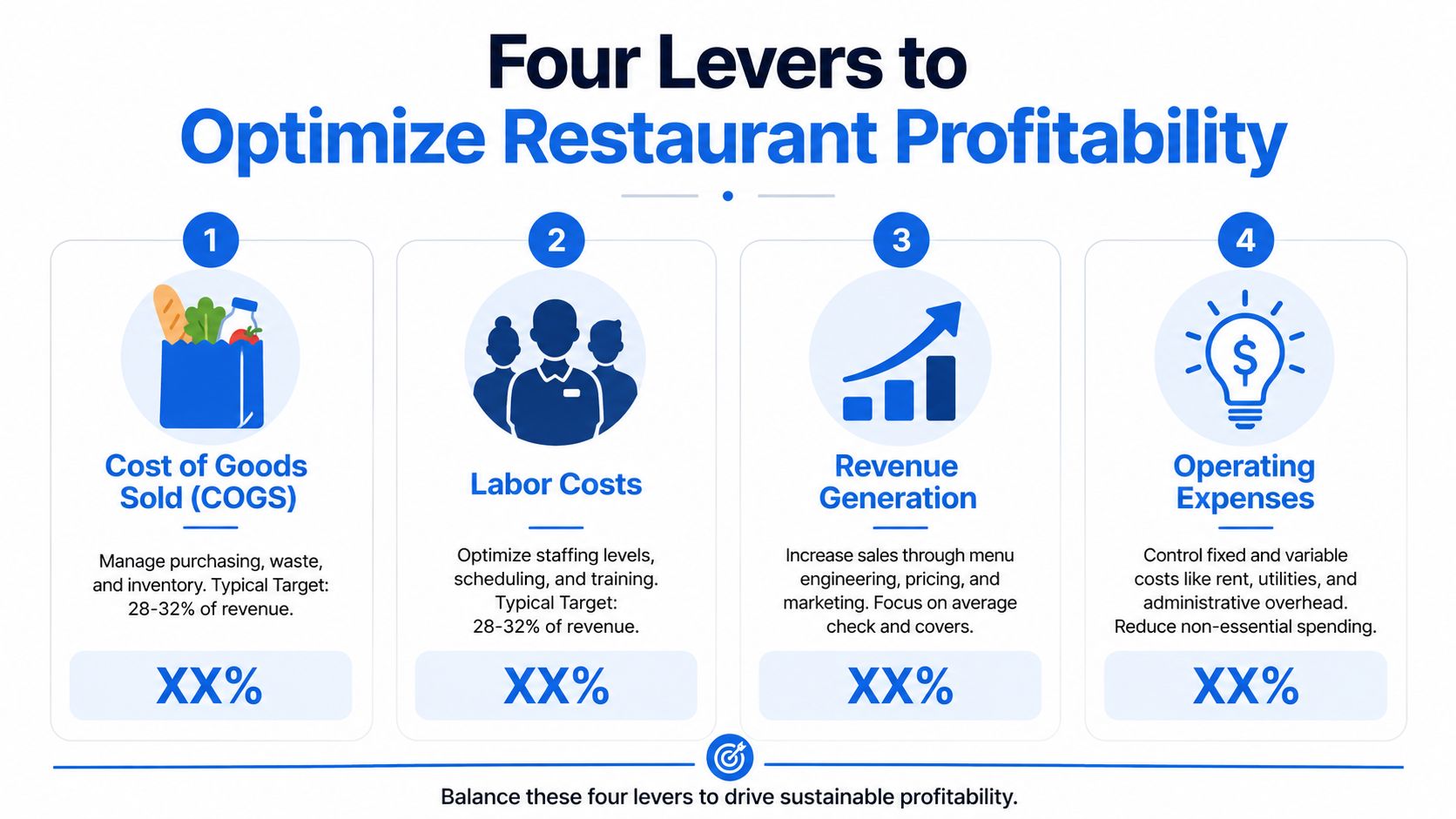
As noted earlier, healthy operations keep a close watch on food cost, labor cost, and total prime cost. But the operators who pull ahead do more than defend those targets. They shape what guests buy, when they buy it, and how profitably each sales channel performs.
Food cost and purchasing discipline
Food cost drifts for boring reasons. Over-portioning. Bad yields. Loose receiving. Forgotten prep. Dead stock in the walk-in.
Start with control, not guesswork.
- Standardize recipes and portions: Every core item needs a current recipe card, portion spec, and plating standard.
- Count inventory on a fixed schedule: Weekly counts expose waste faster than month-end surprises. A disciplined restaurant inventory management system makes over-ordering, theft, and slow-moving stock easier to spot.
- Review vendor pricing regularly: If you have not checked pack sizes, substitutions, and line-item increases lately, margin has already slipped.
- Cut low-volume ingredients: Menu clutter raises waste and makes purchasing harder than it should be.
Labor deployment and workload design
Labor problems usually show up on the schedule, but the cause sits inside the operation.
Poor station design, long ticket times, messy handoffs, and confusing ordering flows all inflate labor. Managers end up plugging holes instead of leading shifts. Staff spend time fixing preventable errors instead of serving guests.
Use labor better by asking direct questions:
- Does staffing match sales by hour, not by habit?
- Which tasks create no guest value and should be removed, simplified, or automated?
- Which menu items slow production without delivering enough contribution?
- Are managers free to manage, or are they acting as permanent backup staff?
Strong labor control comes from better workflows, cleaner prep systems, and tighter demand planning.
Overhead and silent margin erosion
Overhead strips profit in small pieces. Packaging. card fees. linen. software seats no one uses. emergency repairs caused by delayed maintenance.
One bad expense rarely sinks the month. Ten lazy ones do.
Run a short overhead audit every month:
| Expense area | What to check |
|---|---|
| Utilities | Equipment running unnecessarily, poor maintenance, avoidable peak usage |
| Software | Duplicate tools, inactive users, overlapping features |
| Packaging and disposables | Overbuilt packaging, custom items with weak ROI, poor item fit |
| Repairs and maintenance | Repeat breakdowns, delayed fixes, replacement vs repair decisions |
Menu mix pricing and sales design
This is the profit lever with the most upside.
A lot of restaurants try to save their way to better margins. The faster path is to sell smarter. If your best-selling items have weak contribution, your menu is doing damage even when traffic is strong. If guests skip drinks, modifiers, desserts, and bundles, you are leaving margin on the table every shift.
Treat menu mix and pricing like a revenue system:
- Feature high-contribution items first: Put them where guests look, especially on mobile and third-party menus.
- Build add-ons into the ordering path: Sauces, sides, premium drinks, and dessert attachments should be easy to say yes to.
- Price based on contribution and demand: Stop protecting low prices that no longer fit your costs or your market position.
- Trim weak sellers that slow the line: A smaller menu with better mix usually produces stronger margins than a large menu full of distractions.
- Use daypart and channel strategy deliberately: Different offers should serve different margin goals, not just chase volume.
Profitability improves fastest when you stop treating margin as a cleanup exercise. Control costs hard. Then put real effort into pricing, mix, and demand shaping, because that is where the strongest gains usually come from.
Smart Strategies to Engineer Higher Margins
Most operators attack margin problems too late. Sales soften, costs creep, cash gets tight, then the response is panic cutting.
That approach is weak. Better operators engineer margin before the problem lands.

The biggest shift is this. Stop treating profit as a byproduct of cost control. Start treating it as a design target. According to MBE's guide to boosting restaurant profit margins, restaurants that adopt a revenue management mindset and optimize sales streams with demand-based pricing achieve 10%+ margins. That's 2-3x better than operations focused mainly on expense control, where margins often stall at 3% to 5%.
Build the menu around margin not habit
A lot of menus are built around chef preference, legacy dishes, or what has "always been on there." That's how low-margin clutter survives for years.
Build around contribution and guest behavior instead.
- Promote high-margin add-ons naturally: Sides, sauces, premium drinks, desserts, and extras need better visibility.
- Reduce decision friction: Tight categories and clear bundles improve conversion.
- Trim items that drain execution: If a dish is annoying to produce, inconsistent in quality, and weak in contribution, stop defending it.
- Use menu psychology carefully: Placement, naming, visual hierarchy, and smart defaults influence what people order.
This matters even more on mobile. A guest scrolling a QR menu doesn't behave like someone holding a printed booklet. Screen order, image use, category structure, and add-on timing all affect average order value.
Use digital ordering to raise average order value
Digital ordering should do more than replace paper. It should sell better than paper.
That means using QR menus and ordering flows to:
- Surface relevant pairings: A burger should lead naturally to fries, sauces, and a drink.
- Suggest premium swaps: Upgrade paths should feel helpful, not aggressive.
- Feature bundles: Set meals and combos simplify choice while improving contribution.
- Reduce staff workload: When the menu answers common questions and captures modifiers clearly, the team spends less time firefighting.
According to Evergreen's restaurant profitability advice, strategically spotlighting high-margin beverages via digital menus can increase beverage sales by 10% to 20% during peak hours. That's a clear example of revenue engineering in practice. No extra seats. No extra rent. Better menu design.
A strong digital setup also helps with restaurant menu optimization because you can test placement, promotions, and bundles faster than with static print menus.
If your QR menu is just a PDF on a phone screen, you're leaving money on the table.
Run revenue management like an operator not an accountant
Revenue management sounds technical, but the practical version is simple. Start with the margin you need, then work backward into product mix, pricing, daypart strategy, and channel design.
Think in streams, not just sales.
A few examples:
- Lunch vs dinner: If lunch check averages are weak, create cleaner bundles and faster add-on paths.
- Dine-in vs pickup: Offer different hero items where guest behavior differs.
- Private dining or events: Build offers that improve contribution instead of filling dates with discounted packages.
- Slow periods: Don't default to blanket discounts. Use targeted bundles, limited menus, or high-margin promos.
This short video gives a useful operating lens on improving restaurant profitability:
Quick win checklist for this week
You don't need a full rebrand to improve restaurant profit margins. Start with moves you can make now.
- Audit your top sellers: Check whether your best-selling items are also your best margin items.
- Rework one digital upsell path: Add one relevant side, drink, or dessert prompt to a core category.
- Fix one underpriced item: If cost drift has made a dish weak, reprice it.
- Cut one low-value menu item: Remove the product that creates prep pain and weak contribution.
- Review one dead shift: Match staffing to actual demand, not routine.
- Improve menu layout: Put star items where guests see them first.
- Push direct digital behavior: Make ordering easier through your own guest flow, not harder.
The restaurants that improve margins fastest usually don't make louder decisions. They make sharper ones.
RevMenue helps restaurants, cafés, and hospitality groups turn menu traffic into stronger margins with QR menus, smarter upsells, real-time analytics, and faster menu control that works alongside existing POS and payment systems. If you want a more commercial menu experience without adding staff pressure, take a look at RevMenue.