
Your walk-in is packed. Your dry storage is crowded. Your team still 86s items in the middle of service, and your food cost keeps drifting the wrong way.
That's not a purchasing problem. It's a restaurant inventory management problem.
I've seen this pattern in independents, cafés, bars, and multi-unit groups. The kitchen orders “just to be safe.” Deliveries get shoved wherever there's room. Prep happens without tight yield control. Managers count when they have time, which usually means late, rushed, or not at all. Then owners wonder why cash is tight even when sales look decent.
Inventory isn't a back-office admin task. It decides whether your money is sitting in the walk-in, rotting in the prep cooler, or turning into profitable menu sales. If you treat it like a weekly chore, it will punish you daily.
Table of Contents
- Your Walk-In Is Full But Your Profits Are Empty
- Why Inventory Control Is Your Margin Protector
- The Core Processes for Accurate Inventory Tracking
- KPIs That Show if Your Inventory System Is Working
- How to Implement an Inventory Management System
- Common Inventory Management Pitfalls and How to Avoid Them
- Connecting Inventory Data to a Smarter Menu
Your Walk-In Is Full But Your Profits Are Empty
A bistro I advised had beautiful fridges. Everything was full, labeled, and expensive. The owner thought that meant the kitchen was “covered.”
It wasn't covered. It was bloated.
They had too much money tied up in ingredients that moved slowly, not enough discipline around prep, and no clean line between what was bought, what was used, and what was sold. The result was familiar. Premium proteins sat too long, produce got over-ordered before busy weekends that never materialized, and the items guests wanted weren't always available at the right moment.
That's how restaurants end up with the worst combination possible:
- Overstocked on the wrong items so cash gets trapped in stock
- Understocked on the right items so sales get missed
- Blind to waste because nobody records spoilage, over-prep, or staff meals properly
- Constantly reacting with emergency orders, substitutions, and rushed decisions
You don't lose margin only when food hits the bin. You lose it when inventory sits too long, gets bought too early, or blocks you from buying what actually sells.
This is why restaurant inventory management has to be treated as an operating system, not a count sheet. Every ingredient should have a job. Every purchase should tie back to menu demand. Every count should tell you whether the kitchen is tight, sloppy, or leaking money.
If your shelves are full but your bank balance feels thin, your inventory isn't supporting the business. It's suffocating it.
Why Inventory Control Is Your Margin Protector
Inventory control protects margin in three places at once. It cuts waste, keeps food cost in line, and stops you from parking too much cash in perishable stock.
That matters because stock only helps you when it turns into sales. Until then, it's cost, risk, and clutter.
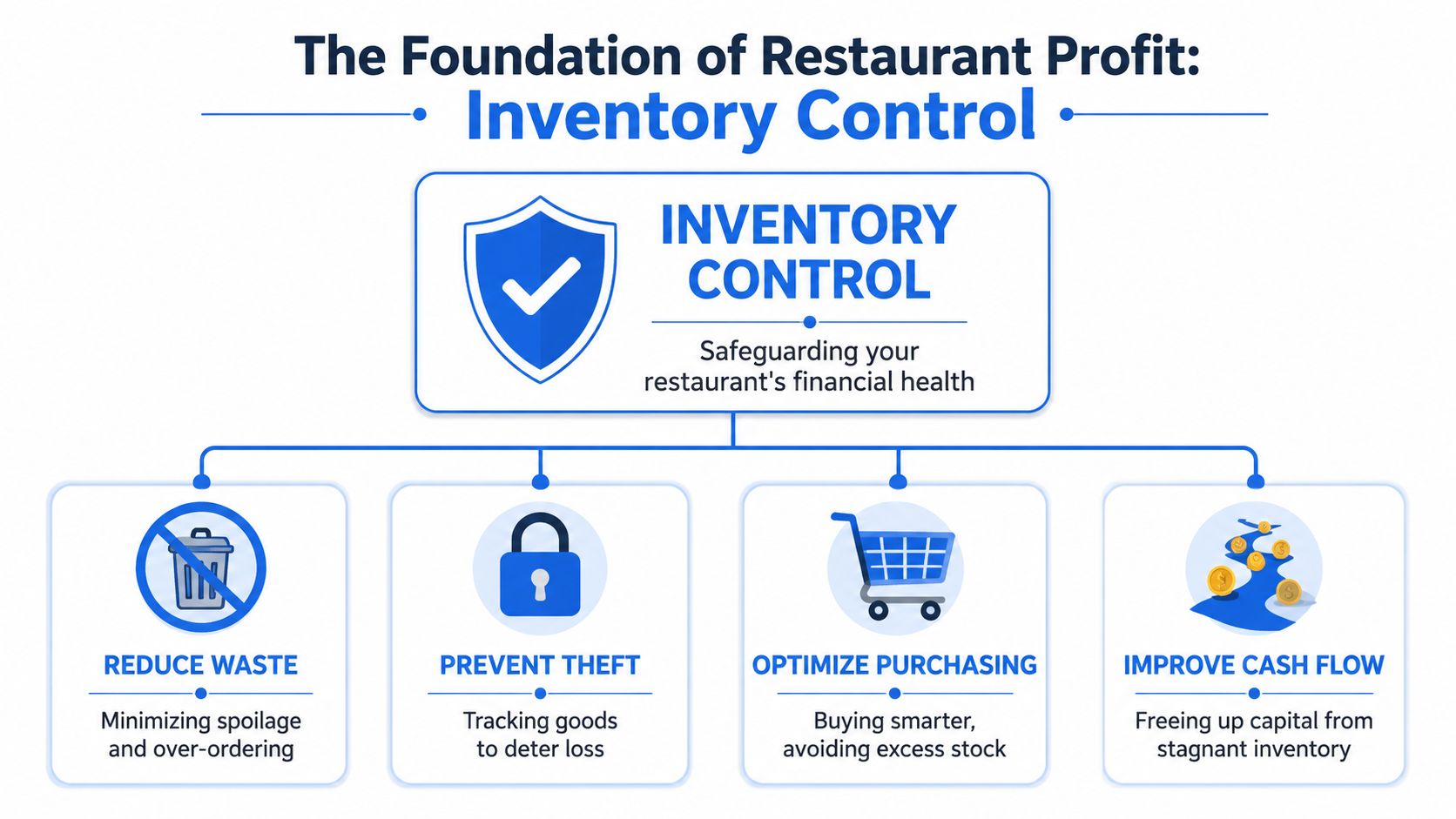
Waste, cash, and missed sales are all the same problem
A lot of operators separate inventory issues into buckets. Spoilage is one issue. Purchasing is another. Menu pricing is another. In practice, they're connected.
When you order too much fish, you don't just create spoilage risk. You also reduce flexibility to buy faster-moving ingredients. When prep teams overproduce sauces or sides, your theoretical food cost stops matching reality. When receiving is sloppy, bad counts ripple into bad ordering.
Here's the commercial view you should take:
- Waste hurts margin immediately because you already paid for product that won't generate revenue.
- Poor ordering hurts cash flow because excess stock ties up money you could use elsewhere.
- Stockouts hurt sales because guests can't buy what isn't available.
- Bad data hurts menu decisions because you can't price, promote, or trim dishes properly if your true ingredient usage is fuzzy.
What healthy inventory looks like
There are useful benchmarks, and they matter. According to Square's guide to managing restaurant inventory across ordering channels, a healthy food cost percentage is typically 25% to 35%. The same guide says operators often aim for an inventory turnover ratio of 4 to 8 times per month, which means stock is replenished roughly every 4 to 8 days.
That same source also notes many restaurants function best with 7 to 14 days of inventory and often keep inventory equal to about 25% to 35% of monthly food sales. Those aren't abstract finance targets. They're practical guardrails for keeping enough product on hand without drowning in perishables.
Practical rule: If your team can't explain why an item is sitting in storage, you probably shouldn't have bought that much of it.
The point isn't perfect precision. It's control. You want enough inventory to serve confidently, not so much that your walk-in becomes a graveyard for margin.
The Core Processes for Accurate Inventory Tracking
Most inventory systems don't fail because the math is hard. They fail because the process is loose.
If you want accurate restaurant inventory management, tighten three basics first. FIFO, par levels, and counting discipline. Get these right and everything else becomes easier.
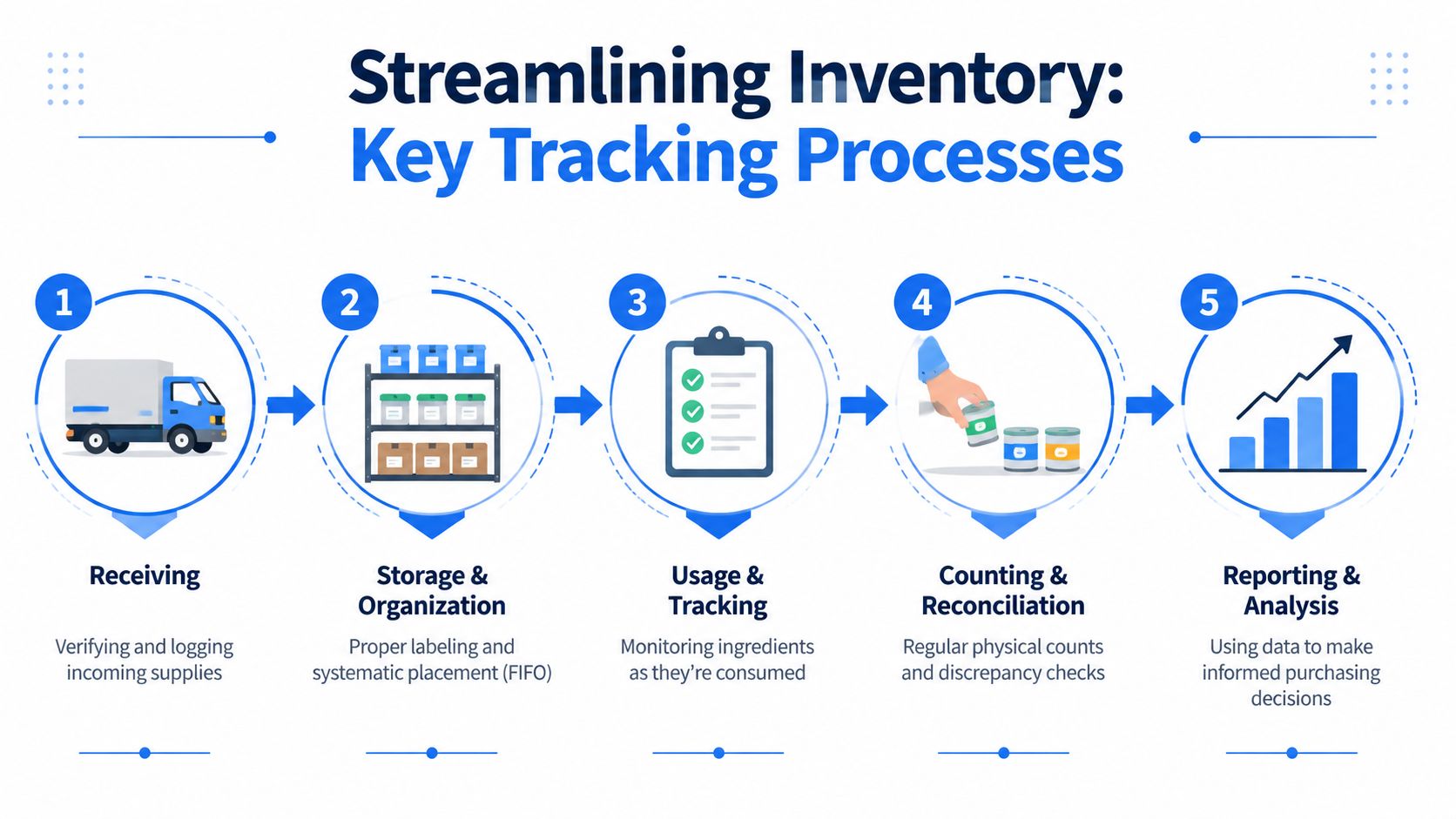
Make FIFO real, not theoretical
Everybody says they use FIFO. Far fewer kitchens actually do.
FIFO only works when the physical setup forces the right behavior. If new stock lands in front of old stock during a busy delivery, your team will grab the easiest item first, not the oldest one.
Do this instead:
- Date everything clearly on receipt, on prep, and when packs are opened
- Set shelf flow deliberately so older stock sits in front and gets used first
- Assign receiving ownership to one person per shift, even if that person rotates by day
- Check date order during counts so counting doubles as a freshness audit
A simple example. If your salad greens from Tuesday are behind a new Friday delivery, your staff won't “remember” FIFO during lunch rush. They'll grab what they can reach. Good operators design storage so the right move is also the easy move.
Set par levels that match service reality
Par levels are not a guess. They're your operating decision on how much stock you need between orders.
Most restaurants get this wrong in one of two ways. They set pars too high because someone's afraid of running out, or too low because someone wants to look lean on paper. Both create pain. The first ties up cash and boosts spoilage. The second creates stockouts and panic buying.
Strong par levels account for:
- Sales pattern by daypart because Friday dinner and Tuesday lunch don't consume the same mix
- Lead time from suppliers because reliable next-day delivery allows a tighter par than unpredictable schedules
- Menu changes and promotions because demand shifts when you push certain items
- Cross-utilization because shared ingredients can justify smarter stocking
If burgers sell steadily but brioche buns swing wildly with weather and event traffic, don't treat both items the same. The right par level reflects actual volatility, not kitchen optimism.
Count on a rhythm you can actually sustain
A brilliant count schedule that nobody follows is useless.
Industry guidance from Emerging Concepts on strategic inventory management recommends taking inventory on the same day and time each week or month for consistency. The same source says more advanced or high-volume operations may count daily or twice weekly, and notes that one industry study found operators who perform weekly inventory counts and calculate cost of sales can add 2% to 10% to their bottom line.
That's why I push operators to choose a cadence that fits reality, then protect it hard.
A practical structure looks like this:
- Weekly core count for your full inventory at the same day and time.
- Midweek spot checks for high-value or fast-moving items.
- Receiving checks every time product arrives, before it disappears into storage.
- Variance review right after the count, while the week is still fresh in everyone's head.
Counting late at night after a brutal service sounds disciplined. In reality, it often creates bad numbers because tired people estimate.
For higher-control operations, perpetual tracking tied to POS sales plus physical cycle counts is the strongest setup. Restaurant365's inventory best-practices guidance recommends combining perpetual tracking with physical counts, using weekly or bi-weekly audits for fast-moving or high-value items and monthly full counts for broader reconciliation.
If your actual on-hand inventory keeps drifting from theoretical usage, don't blame the spreadsheet first. Check receiving, portioning, waste logging, and whether your team is counting what's really there instead of what they think should be there.
KPIs That Show if Your Inventory System Is Working
You can tell within minutes whether an operator is in control. Ask what they track. If they answer with vague phrases like “food cost is a bit high,” they're flying blind.
You need a short KPI set that exposes waste, overbuying, bad pricing, and sloppy execution.
The numbers that matter
Here's a simple scorecard.
| KPI | How to Calculate It | What It Tells You |
|---|---|---|
| Food Cost Percentage | Food cost / food sales | Whether menu sales are producing healthy gross margin |
| COGS | Starting inventory + direct costs – ending inventory | What the food and beverage you sold actually cost |
| Inventory Turnover | COGS / average inventory | How quickly inventory is moving through the business |
| Sitting Inventory Value | Total value of stock currently on hand | How much cash is trapped in storage |
| Variance | Difference between theoretical inventory and physical count | Where shrink, receiving errors, waste, or portion drift may be hiding |
If you want a broader operating dashboard, this guide to restaurant KPIs is worth keeping nearby.
How to read the story behind the number
A KPI only matters if it changes your behavior.
Use the scorecard like this:
- Food cost percentage rising usually means you need to check recipe adherence, supplier pricing, portion control, and menu mix.
- Turnover slowing often means you're carrying too much stock or backing the wrong items.
- Sitting inventory staying high is a cash flow warning. Product on shelves can't pay wages or rent.
- Variance showing up repeatedly in the same categories points to process failure, not random noise.
A single bad week happens. The same unexplained variance in proteins, spirits, or prep-heavy items means your system is leaking.
Don't obsess over having dozens of metrics. Keep a handful, review them on schedule, and act fast when one goes sideways. Inventory performance should shape purchasing, prep, pricing, and menu emphasis, not live in an end-of-month report nobody uses.
How to Implement an Inventory Management System
Most operators overcomplicate implementation. They start shopping for software before they've fixed recipes, count sheets, storage order, or team accountability.
That's backwards.
Start with standards, not software
If your recipes aren't standardized, your inventory won't be either. The same goes for portion sizes, prep yields, and naming conventions.
Lock down these basics first:
- Recipe specs that define exact ingredients and portions
- Unit consistency so you're not counting one item by case, another by pack, and another by rough memory
- Storage maps so products are always counted in the same location order
- Waste categories so spoilage, over-prep, and comps don't vanish into a black hole
This is also where many operators discover that menu complexity is working against them. If five low-volume dishes each need their own fragile ingredient, inventory gets harder, waste risk rises, and purchasing gets noisier.
Build the system in the order your team works
A workable rollout follows kitchen reality.
- Create your master item list. Include food, beverage, and the items that affect margin.
- Run a full opening count. That gives you a clean baseline.
- Standardize receiving. Every delivery gets checked before product is stored.
- Set count cadence. Weekly full counts, plus targeted spot checks where needed.
- Review variance with the manager who owns the area. Don't let discrepancies float without accountability.
The most effective programs also combine recipe costing, waste tracking, and forecasting with reorder logic like par levels. Buyer's Edge Platform's guidance on restaurant inventory management highlights this approach because it supports just-in-time purchasing and aligns buying with actual demand.
That's the difference between “ordering what we usually get” and ordering with intent.
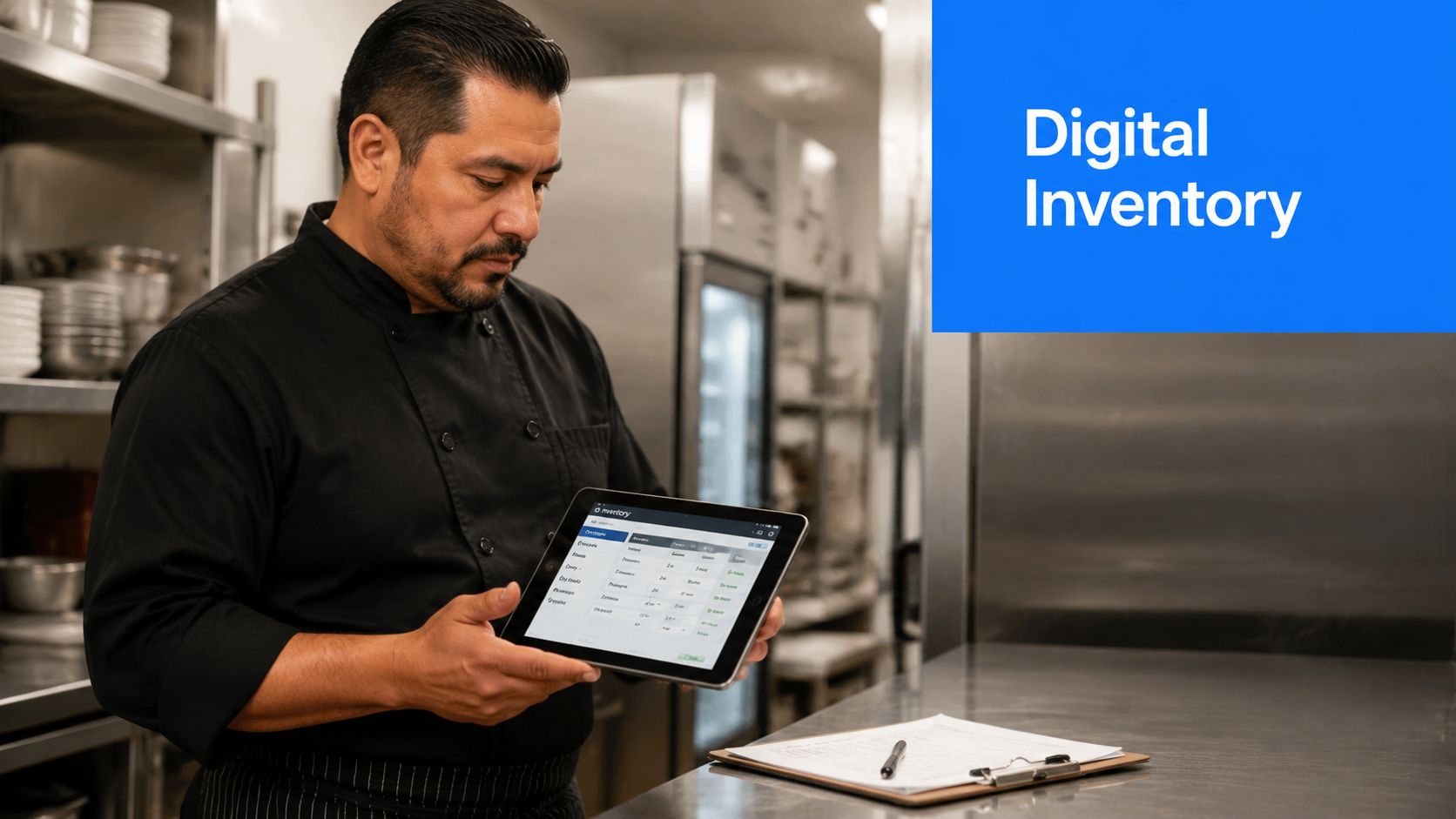
A tool can help streamline this. If you're evaluating digital options, take a look at an inventory manager app for restaurant teams. The value isn't the app itself. The value is reducing missed counts, inconsistent records, and manual follow-up.
Use software where it removes friction
Software should do three things well. Pull sales data, simplify counts, and surface variance fast enough for action.
A POS-linked setup proves helpful. It gives you theoretical inventory from sales, then lets you compare it against physical counts. That comparison reveals the true status.
A short video can help your team visualize the workflow before rollout.
Don't automate chaos. Clean process first, then software. Otherwise you just get faster bad data.
Common Inventory Management Pitfalls and How to Avoid Them
The biggest inventory mistakes aren't mysterious. They're repetitive, boring, and expensive.
Most come from operators assuming a good process on paper will survive a bad week in the kitchen. It won't.
Where operators lose control
These are the failure points I see most often:
Inconsistent count timing
One week you count after close. Next week it's before prep. Then a delivery lands halfway through. Your data stops being comparable, so trends become noise.Pencil-whipped counts
Staff get tired, rushed, or annoyed and start estimating. That gives you fake confidence and bad purchasing decisions.Weak receiving discipline
Deliveries go straight onto shelves without proper verification. Once that happens, any later discrepancy becomes impossible to diagnose cleanly.Waste that never gets logged
Spills, over-prep, spoilage, staff meals, and comps all distort true usage when nobody records them.Too many SKUs for the sales volume
Operators keep adding niche products for menu creativity, then wonder why the walk-in is messy and counts take forever.
The more exceptions your kitchen carries, the harder it is to keep inventory honest.
How small teams keep accuracy without burnout
Labor pressure is where good intentions usually collapse. GoFoodservice's inventory advice for restaurants points to a real gap in most guidance. Teams know best practices like two-person counts and daily spot checks. The hard part is sustaining accuracy when staff are rushed, undertrained, or juggling multiple roles.
So simplify the system until your team can execute it.
Use practical rules:
- Reserve two-person counts for high-risk categories such as expensive proteins, liquor, and fast-moving prep items
- Run short daily spot checks instead of relying only on one giant weekly count
- Cut count sheets aggressively so low-impact items don't slow down critical controls
- Train receiving and counting as separate skills because they require different habits
- Own variances quickly while the people and events involved are still fresh
If vendor inconsistency is part of the problem, tighten that side too. Better ordering, cleaner receiving records, and clearer supplier accountability are easier when you use vendor management software built for restaurant operations.
Perfection isn't the target. Reliable execution is. A smaller system your team follows every week beats a complex system that collapses during service pressure.
Connecting Inventory Data to a Smarter Menu
The smartest operators don't stop at controlling stock. They use inventory data to shape what guests see and buy.
That's where back-of-house discipline turns into front-of-house profit.
Use back-of-house truth to drive front-of-house profit
If you know true ingredient movement, you can make better menu decisions fast:
- Push dishes that use ingredients you need to move
- Trim dishes that create awkward, low-usage stock
- Bundle items that improve yield across shared ingredients
- Suppress items that are likely to create stockouts or service friction
- Adjust digital menu emphasis toward cleaner-margin choices
That's especially powerful with QR menus and digital ordering. A static printed menu can't react when a prep item is running low, when a garnish is overbought, or when a high-margin add-on fits perfectly with what you already need to sell through.
Good inventory management should influence menu engineering, upselling, specials, and availability. When those systems talk to each other, you reduce waste, protect guest experience, and stop forcing staff to apologize for avoidable 86s.
That's the shift that matters. Inventory stops being a defensive chore and starts becoming a revenue tool.
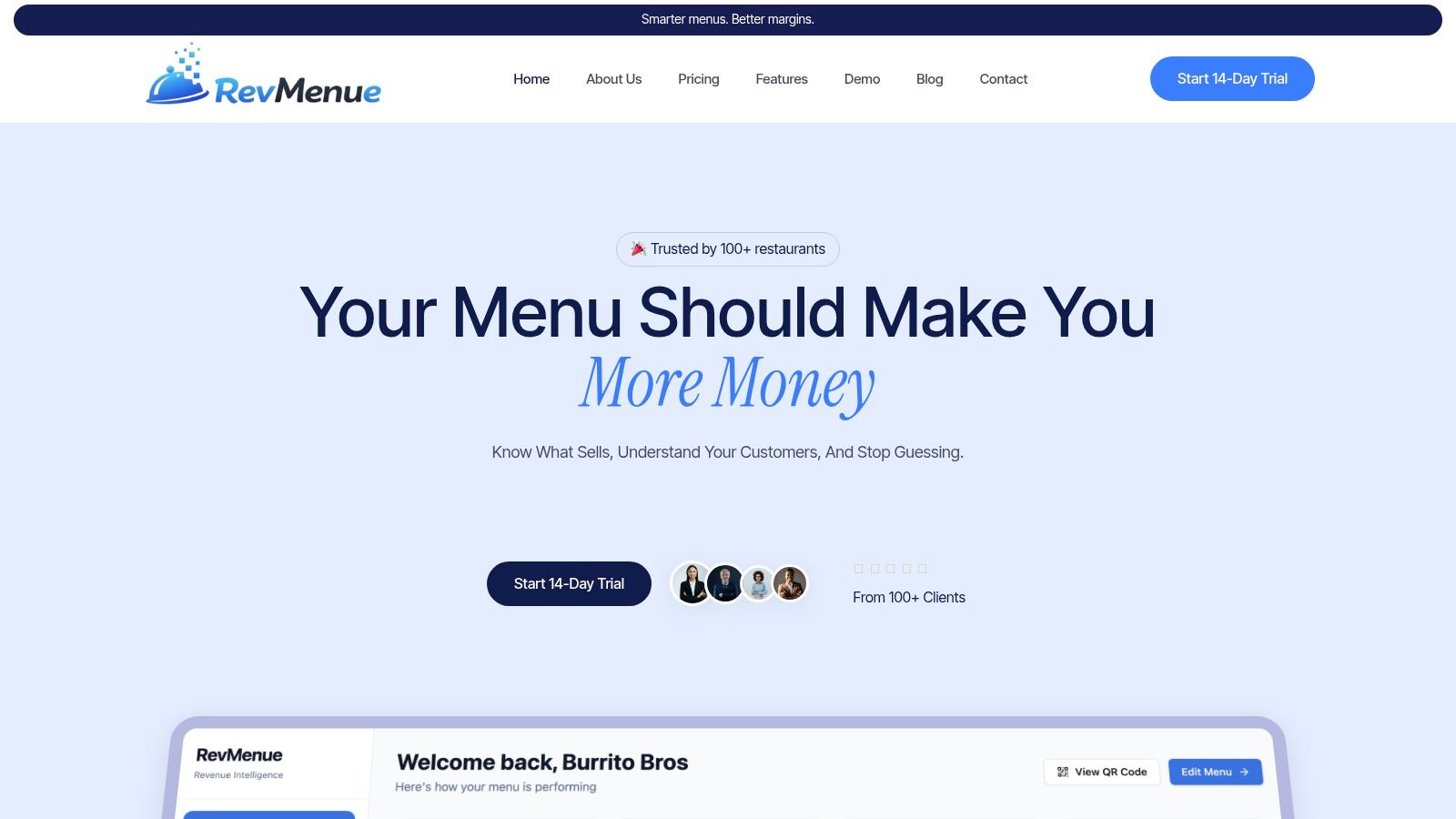
If you want that connection between inventory reality and menu performance, RevMenue is worth a look. It helps restaurants turn digital menus into a profit lever with fast updates, smarter upsells, and clearer menu analytics, so the items you promote align better with what your operation can sell well.