
Most restaurant owners don't have a sales problem. They have a visibility problem.
The dining room is full. The POS says the week looked strong. Staff worked hard. Vendors got paid. Then you check the bank balance and wonder why all that activity produced so little cash. That's the moment a restaurant profit and loss statement stops being an accounting chore and becomes a management tool.
A good P and L for restaurant use tells you where the money went. It shows whether the extra sales came from profitable items or low-margin ones. It shows whether labor crept up faster than revenue. It shows whether your menu is helping or hurting. If you run a café, bistro, bar, or multi-unit group, you need that clarity every week, not just when your accountant closes the month.
Table of Contents
- Why Record Sales Do Not Always Mean High Profit
- Deconstructing the Restaurant P&L Line by Line
- The Numbers That Matter Most Restaurant KPIs
- How to Build and Review Your P&L Statement
- Turning Your P&L into a Profit Growth Playbook
- Your P&L Is a Tool Not a Test
Why Record Sales Do Not Always Mean High Profit
Friday night is slammed. The dining room is full, the kitchen is pushing hard, and the POS shows a big number at close. Then the month ends, and the owner still has little left over.
That result is normal in restaurants that treat sales as the scoreboard instead of the starting point for decisions.
A restaurant can post record revenue and still bleed profit. High sales do not protect you from bad menu mix, loose portion control, overtime, waste, discounting, comps, or delivery fees. They can hide those problems for a while, which is worse.
Margins are thin. Sage notes that full-service restaurants often land in the 3% to 6% net profit range in its restaurant profit and loss guidance. That means a busy week only helps if the extra sales drop through to profit after food, labor, and operating costs.
Here is what that looks like on the floor.
A neighborhood restaurant has its best Saturday of the quarter. Sales jump because the team pushes specials and turns tables fast. Sounds great. But the specials use expensive ingredients, two servers stay on the clock too long after the rush, the kitchen overpreps for Sunday, and three tables get comped after ticket delays. The owner remembers the volume. The P&L records the damage.
That is why a restaurant P&L matters. It is not just a report card for last month. It is a control tool for this week. If sales rise but gross profit falls, your menu mix or food cost is off. If sales rise and labor climbs at the same pace, your scheduling is off. If sales are steady but net profit drops, small operating costs are eating the month alive.
Owners ask the wrong question all the time. They ask, “Were we busy?”
Ask better questions:
- Which sales produced margin
- Which menu items added profit, not just volume
- How much labor those extra sales required
- Whether discounts, comps, and promos paid back what they cost
- Where waste showed up before the month was over
That shift matters. A backward-looking owner sees a strong top line and relaxes. A forward-looking owner uses the P&L to change pricing, trim low-margin items, reset prep pars, and fix the schedule before another “great sales week” turns into a weak profit month.
Deconstructing the Restaurant P&L Line by Line
Most owners make the same mistake. They look at the P&L as a summary. It's better used as a chain of cause and effect.
If you understand each line, you can spot where profit leaked before the month is gone.
Revenue is not one number
Start with sales, but don't lump everything together.
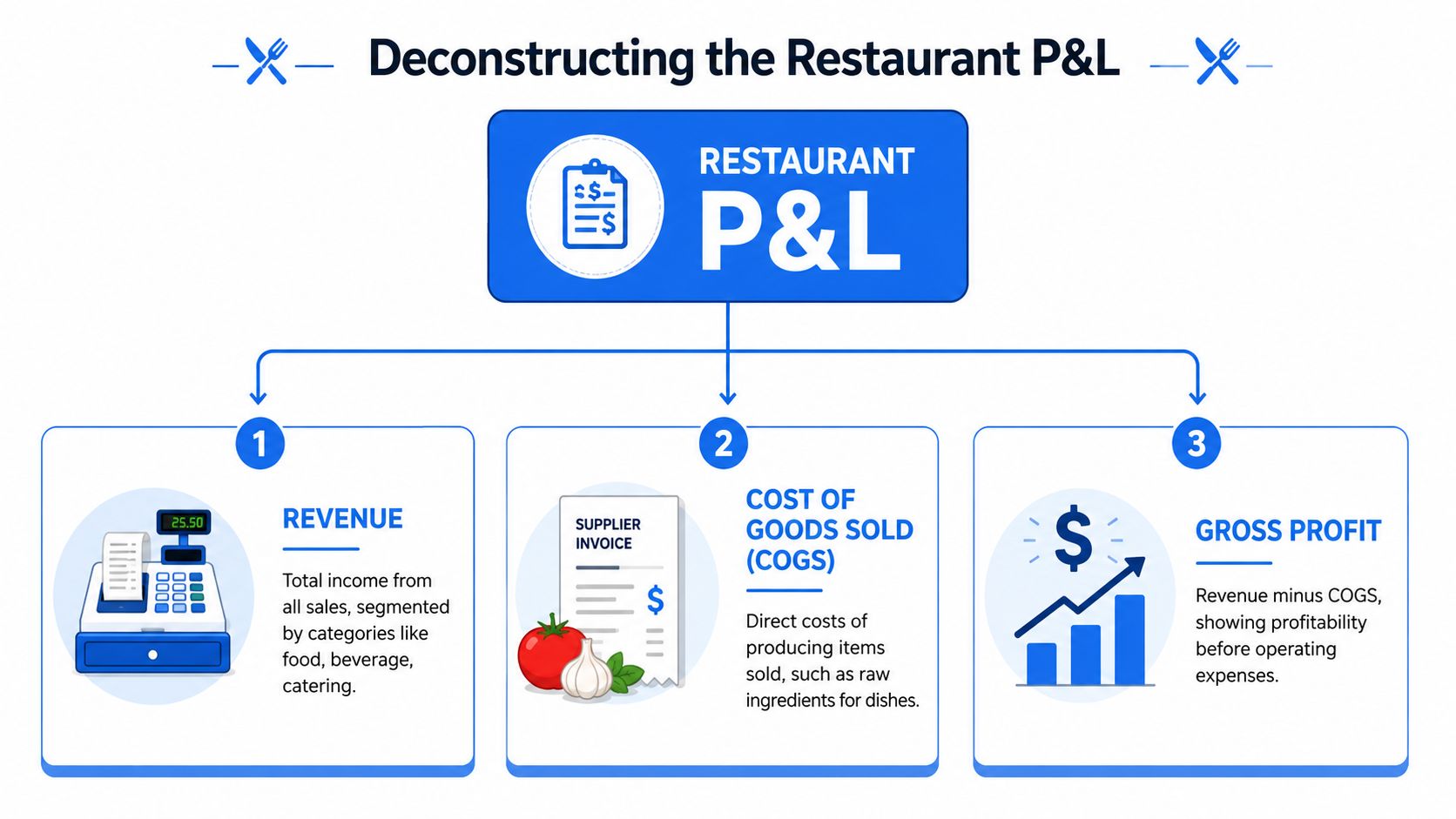
A restaurant P&L is more useful when sales are segmented by revenue source and costs are split into COGS, labor, operating, and occupancy lines, because that lets you calculate gross profit, net profit, and percent-of-sales by bucket instead of treating the business like one blended number, as explained in WebstaurantStore's restaurant P&L guide.
For a burger concept, don't just record “sales.” Break them out:
- Dine-in food
- Alcohol or beverage
- Takeout
- Delivery
- Catering or events
- Merchandise or retail if relevant
That matters because not every revenue stream behaves the same way. Delivery can drive volume but bring different cost pressure than dine-in. Beverage usually behaves differently from food. Catering may look strong on paper but strain labor and prep.
COGS and gross profit tell the menu story
Cost of Goods Sold (COGS) is the direct cost of what you sold. Ingredients, packaged goods, and direct product costs live here.
Use a simple burger example:
- You sell a burger.
- The bun, beef, cheese, lettuce, sauce, fries, and packaging all affect COGS.
- If ingredient cost rises or portion control slips, COGS rises.
- If price stays the same, gross profit shrinks.
Gross profit is revenue minus COGS.
This is where menu economics start getting real. If a menu item sells well but eats up too much product cost, it can make the restaurant look busy while doing little for profit. Owners miss this all the time because they focus on popularity instead of contribution.
Practical rule: A popular item that doesn't leave enough money after product cost is not helping as much as you think.
Labor, operating costs, occupancy, and net profit
After gross profit, labor enters the picture.
Labor includes wages and the full cost of staffing. In practice, owners should look at labor as a decision line, not just a payroll line. Overstaffing, poor scheduling, slow table turns, clumsy handoffs, and menu complexity all show up here sooner or later.
Then come operating expenses. These are the controllable and semi-controllable costs that keep the place running. Think utilities, marketing, software, smallwares, repairs, cleaning supplies, and admin costs. They don't get as much attention as food and labor, but they nonetheless stack up.
Then there's occupancy. Rent and related location costs belong in their own view because they behave differently from daily operating decisions.
Read the P&L in this order:
- Revenue asks, what did we sell?
- COGS asks, what did that product cost us?
- Gross profit asks, what was left before people and overhead?
- Labor asks, how much did service and production cost?
- Operating and occupancy ask, what did it take to keep the doors open?
- Net profit asks, what's left?
If you want a useful P and L for restaurant management, stop reading only the bottom line. Read the story from top to bottom and ask where the margin got weaker.
The Numbers That Matter Most Restaurant KPIs
Saturday night was packed. Sales looked great. Then you open the P&L and realize the extra volume barely turned into profit because food cost ran high, labor stayed bloated, and the rush was full of low-margin items. That is why KPI tracking matters. The point is not to admire last week's sales. The point is to see, fast, whether your decisions are creating margin or destroying it.
Prime cost is the control center
Start with prime cost because it ties daily operating decisions directly to profit.
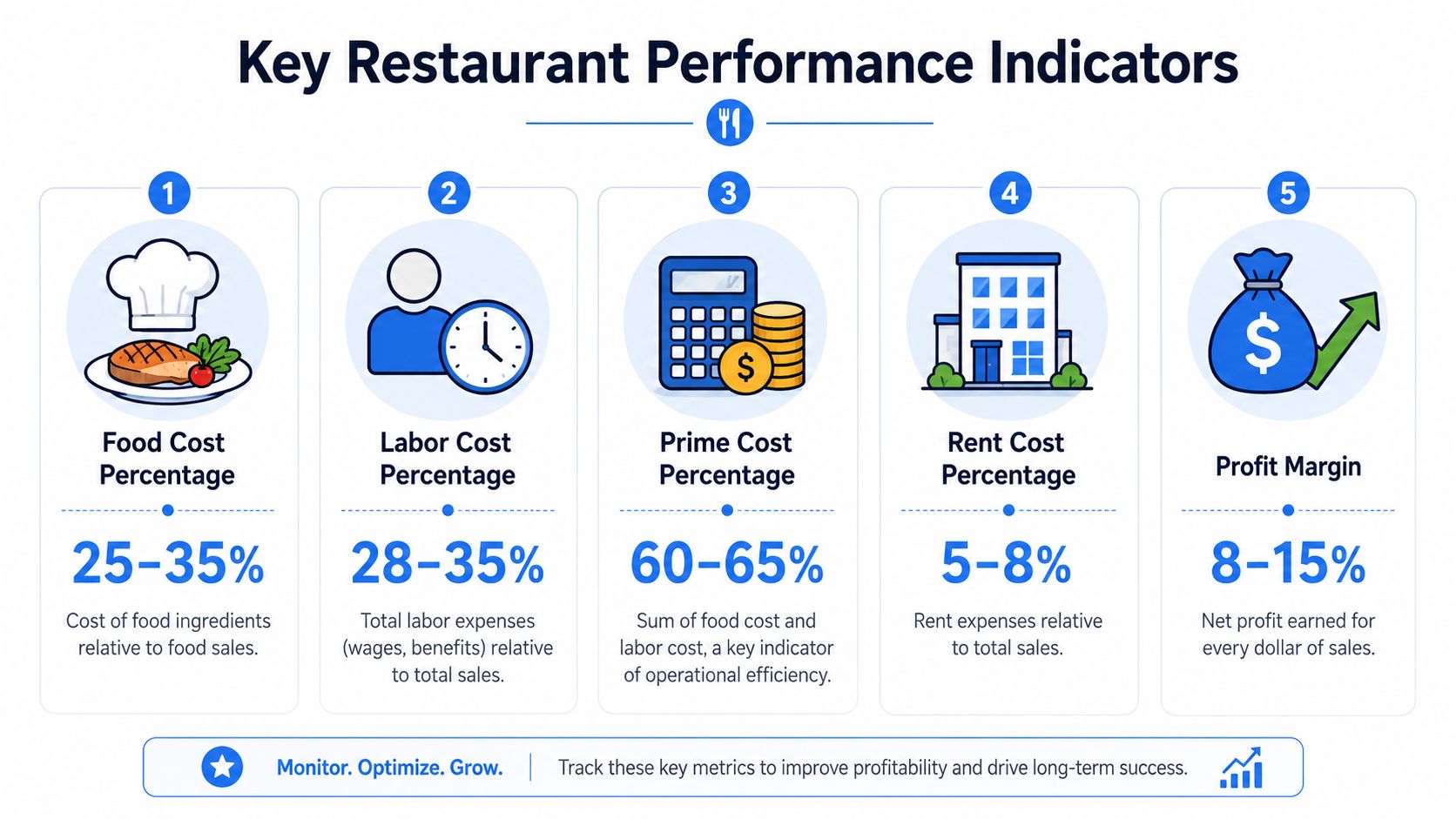
Prime cost is COGS plus total labor expense. Paychex notes that many operators use rough targets of 30% to 35% for COGS and 25% to 30% for labor, which puts prime cost in the 55% to 65% range for many restaurant models, as outlined in Paychex's guide to reading a restaurant profit and loss statement.
Here's the practical takeaway. If prime cost rises, you usually do not have an accounting problem. You have an operating problem. Portions drifted. Prep created waste. Prices stayed stale. The schedule did not match demand. The menu mix shifted toward items that bring in sales but not enough gross profit.
That is why prime cost deserves attention every week, not just at month end.
What healthy looks like
Use these KPIs as a decision screen, not a scoreboard.
| KPI | What to watch |
|---|---|
| COGS | Waste, portion control, yield loss, vendor increases, menu pricing |
| Labor | Scheduling, overtime, training gaps, prep complexity, sales per labor hour |
| Prime cost | Whether food and labor together are leaving enough room for overhead and profit |
| Net profit margin | Whether the business actually keeps cash after all expenses |
Healthy numbers depend on your format, check average, service style, and rent structure. A fast-casual shop and a full-service dinner house should not chase the same percentages. What matters is whether your targets leave enough room for operating expenses and a real bottom line.
For a broader operating scorecard, this guide to restaurant KPIs that owners should track helps connect the P&L to service, menu, and floor performance.
How to read these KPIs without fooling yourself
Single numbers can mislead you. Trends are what matter.
- Food cost rises while sales stay flat: Check portioning, waste, invoice price changes, theft, and whether menu prices are behind your actual plate cost.
- Labor rises faster than sales: Fix scheduling first. Then look at throughput, prep systems, station design, and menu items that take too many labor minutes to produce.
- Prime cost looks acceptable but net profit stays weak: Overhead is eating the margin. Review discounts, utilities, software, repairs, supplies, and other operating expenses that creep up gradually.
- Strong weekends and weak monthly profit: Your weekday sales mix, promo strategy, and staffing pattern are probably dragging down the full period.
Read these KPIs like an operator. If labor jumped, ask which shifts, which roles, and which service periods caused it. If food cost moved, ask which items, which vendors, and which recipes drove the change. A useful restaurant P&L is not a report card. It is an early warning system that tells you what to fix while the month is still in progress.
If prime cost is out of line, act on the floor, on the schedule, and on the menu. That is where the margin is won or lost.
How to Build and Review Your P&L Statement
A restaurant P&L doesn't need to be fancy. It needs to be fast, consistent, and readable.
Most owners wait for an end-of-month statement that arrives too late to be useful. By then, the waste already happened, the overtime already hit, and the margin is already gone.
Build a management P&L not just an accounting report
You need two versions of the truth:
- A weekly flash P&L for decisions
- A monthly finalized P&L for accounting accuracy
The weekly version doesn't need perfect accrual treatment to be useful. It needs enough structure to show whether food, labor, and operating trends are moving in the wrong direction.
Build it around a simple rhythm:
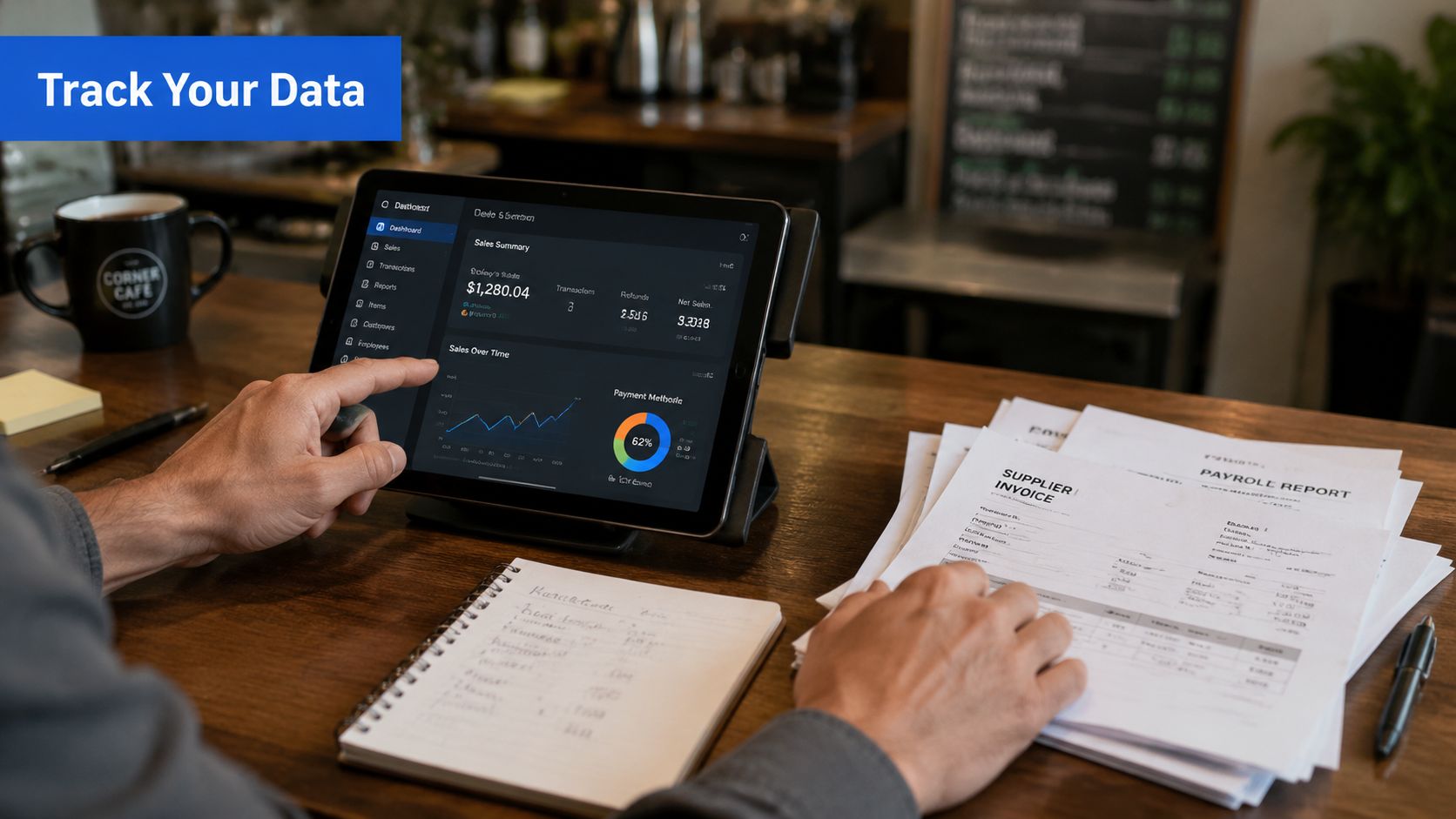
- Pull sales from the POS
- Pull payroll and labor cost from your payroll or scheduling system
- Pull invoices and purchases from suppliers
- Group expenses into clean categories
- Review as percentages of sales, not just totals
If your current books are messy, start by cleaning category names and mapping every recurring cost to the same bucket every week. Consistency matters more than elegance.
A practical reference for organizing the finance side is this guide to bookkeeping for restaurants.
What to pull each week
Here's the weekly stack I'd expect an operator to review:
- Sales by channel: Dine-in, bar, takeout, delivery, catering
- Voids and comps: You need to know if margin loss is operational, not just financial
- Purchases and inventory movement: Enough to see where COGS is headed
- Labor detail: Hours, overtime, role mix, and management coverage
- Controllable operating expenses: Marketing, supplies, software, repairs, cleaning, small recurring charges
Don't let the office overcomplicate this. The point is not tax perfection. The point is catching drift.
Review weekly numbers while they're still close enough to the shift for a manager to explain them clearly.
How to review it with your team
Don't review the P&L alone and then hope people guess what to change.
Use a short operating review with managers:
- Ask what changed in sales mix
- Check whether any menu item drove cost pressure
- Look at labor against actual traffic patterns
- Flag unusual waste, comps, or overtime
- Assign one corrective action per issue
This video gives a useful visual overview of how restaurant operators think through P&L performance in practice:
Keep the meeting tight. If an issue appears three weeks in a row, it's not a one-off. It's a system problem.
Turning Your P&L into a Profit Growth Playbook
Friday night was packed. The dining room felt strong. Then the month closes and profit is thin. That happens when sales go up but the wrong items sell, labor drifts, and menu decisions add cost faster than they add margin.
That is the primary job of a restaurant P&L. Use it to decide what to change next week, not just explain what already happened.
A lot of restaurant P&L advice stops at line items. Owners need the next step. They need to connect each line to a controllable action on the floor, in the kitchen, and on the menu. That missing link is discussed in this analysis of restaurant P&Ls and menu-level action.
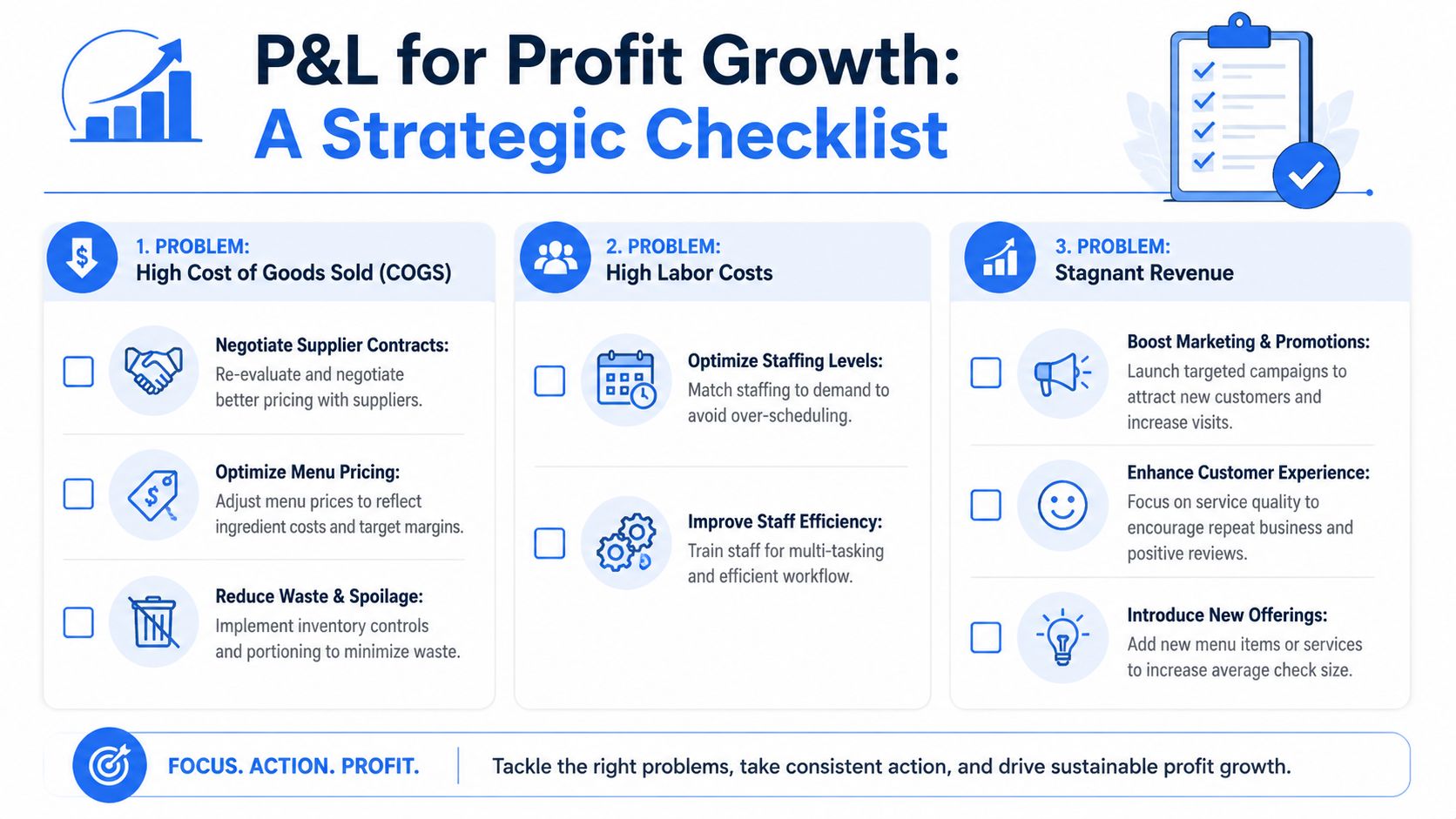
When COGS is the problem
High COGS usually comes from a chain of bad choices, not one dramatic mistake.
Start with product mix. If an item sells inconsistently, uses expensive ingredients, and creates waste, cut it. If a dish is popular but margins are weak, reprice it with intent. If portions change by cook or shift, fix the spec and enforce it. If supplier costs keep creeping up, review pack sizes, substitutes, and specs instead of accepting the invoice.
Here is the common failure pattern. A café adds seasonal dishes with ingredients that do not appear anywhere else on the menu. Guests like the idea. A few plates sell. The rest of the product dies on the shelf. Sales tick up. Food cost gets worse. The P&L shows the truth before cash flow does.
When labor is the problem
Labor problems often start in the operation, not in payroll.
If service steps are clumsy, staff hours rise. If the menu is bloated, prep grows, ticket times slow down, and managers solve the problem by adding people instead of fixing the system. If the schedule follows habit instead of demand, you pay for empty minutes all week.
Fix the design first.
- Simplify service steps: Remove handoffs, duplicate touches, and unnecessary approval points.
- Schedule to actual demand: Build labor around traffic patterns, not old templates.
- Trim menu drag: Fewer low-value items usually means less prep, better execution, and lower labor pressure.
- Train for throughput: Speed matters, but only if quality holds.
I see this constantly. An owner adds two more people to a struggling service period. Guest experience improves for a few days. Labor stays high for the rest of the month because the underlying issue was station setup, menu sprawl, or bad prep flow.
Better labor margins come from better operating design.
When revenue is flat but the dining room feels busy
Busy does not guarantee profit.
Revenue stalls when guests buy low-margin items, skip add-ons, or move through a menu that does nothing to guide better choices. Owners who treat revenue as separate from the P&L miss one of the fastest ways to improve margin.
Focus on the sales decisions you can control:
- Raise average order value: Use bundles, add-ons, and stronger item placement.
- Improve ordering flow: QR and mobile ordering should make profitable choices easier to see and easier to buy.
- Feature high-contribution items: Put strong-margin dishes in prime positions and stop giving weak sellers the spotlight.
- Track menu behavior: Look beyond what sold. Review what guests viewed, ignored, modified, or abandoned.
That is why menu analytics matter. If a promotion lifts sales but increases low-margin mix, extra prep, and waste, the P&L gets worse even while revenue looks healthy. Operators who use restaurant data analytics for operators can spot that faster and adjust pricing, placement, and menu structure before the month is gone.
The operating rule that ties it together
Every weak P&L line should trigger a direct operating question.
| If this line worsens | Ask this |
|---|---|
| COGS | Which items, suppliers, portions, or waste points caused it? |
| Labor | Which shifts, stations, or service steps created drag? |
| Revenue | Did the sales mix improve margin or only create volume? |
| Net profit | Which controllable choices failed to turn sales into cash? |
Use the P&L like a weekly control panel. If food cost rises, change menu mix, portion control, or purchasing. If labor climbs, fix workflow and scheduling. If sales grow without profit, change what you promote and how guests order.
That is how operators improve margins in real time.
Your P&L Is a Tool Not a Test
Too many owners treat the P&L like a judgment. It's not. It's feedback.
A weak month doesn't mean you failed. It means the business is telling you exactly where it needs better decisions. If you review numbers weekly, track prime cost closely, and connect every line to a real action, you stop managing by mood and start managing by evidence.
Keep it simple:
- Build one clean weekly flash P&L
- Review prime cost before month-end surprises you
- Tie every bad number to one operational fix
That's the discipline that protects cash.
And that's the value of a good P and L for restaurant management. It helps you decide what to change now, while the result is still changeable.
If you want your menu to do more than display items, RevMenue is worth a look. It helps restaurants turn QR menus into revenue tools with smarter upsells, cleaner digital ordering, and menu analytics that connect ordering behavior to margin decisions. That's useful when you want your P&L to improve because of better actions at the table, not just better explanations after the fact.