

Most restaurant owners aren't short on effort. They're short on clean numbers.
You feel busy. The dining room looks solid. Staff says the weekend was strong. Then payroll hits, a supplier bill lands, delivery payouts don't match what you expected, and somehow the bank balance feels tighter than it should. That gap between a busy restaurant and a profitable restaurant is usually bookkeeping.
Good bookkeeping for restaurants isn't back-office admin. It's the operating system for pricing, staffing, menu decisions, purchasing, cash flow, and growth. If your books are late, generic, or messy, you're not managing the business. You're reacting to it.
Table of Contents
- Why Your Gut Feel Is Costing You Money
- Building a Restaurant-Specific Chart of Accounts
- Your Bookkeeping Rhythm for Consistent Clarity
- From Data to Decisions with Key KPIs
- Common Bookkeeping Mistakes Costing You Money
- Your Bookkeeping Implementation Checklist
Why Your Gut Feel Is Costing You Money
Busy does not equal profitable
A packed Friday night can fool you.
Owners often judge performance by covers, ticket noise, or how empty the walk-in looks after service. None of that tells you whether dine-in carried the night, whether delivery discounts ate your margin, or whether labor drifted too high on the slower shoulder hours. Gut feel is useful on the floor. It's terrible in the books.
Restaurant bookkeeping should act like a live dashboard. If it only exists for your accountant at month-end, you're too late. By then, the wrong schedule has already been run, the weak promo has already burned cash, and the underpriced menu item has already sold all month.
Practical rule: If your books can't separate where revenue came from and where labor went, they can't help you run the restaurant.
A lot of operators lump all sales into one line and all wages into another. That's how bad decisions start. You can't tell whether the bar is carrying profit. You can't see whether takeout is worth the packaging and labor strain. You can't tell if lunch needs a pricing fix or just a better staffing model.
What clean books let you do
Good books don't just record the past. They sharpen decisions in real time.
Restaurant accounting guidance emphasizes that bookkeeping is the backbone for key performance metrics, and that even a 2 percentage point misclassification in labor and food costs on $2 million in annual sales creates a $40,000 performance distortion, enough to affect staffing, menu pricing, and expansion decisions, according to Buyers Edge Platform's restaurant accounting guide.
That's the difference between thinking a location is healthy and realizing it's leaking money.
Here's what accurate books change:
- Pricing decisions get smarter. You spot categories that look popular but don't contribute enough margin.
- Scheduling gets tighter. You stop treating all labor as one blob and start seeing where FOH, BOH, and management hours are yielding results.
- Promotions get judged properly. You can compare what a discount brought in against what it cost in labor, packaging, or channel fees.
- Cash flow gets less chaotic. You know what's due, what cleared, and what still hasn't hit the bank.
A restaurant rarely fails because one huge number jumped overnight. It usually fails because small blind spots stayed invisible for too long.
If you want to grow, add locations, redesign a menu, or push digital ordering harder, start with the books. Operators who know their numbers don't always work less. They waste less.
Building a Restaurant-Specific Chart of Accounts
Stop using a generic setup
The default chart of accounts in accounting software is not built for a restaurant. It's built for a generic business. That's a problem.
Restaurants have multiple revenue channels, volatile input costs, heavy payroll movement, and operating realities that don't fit neatly into broad buckets like “sales” and “expenses.” If your setup is too generic, your reports will be too vague to help.
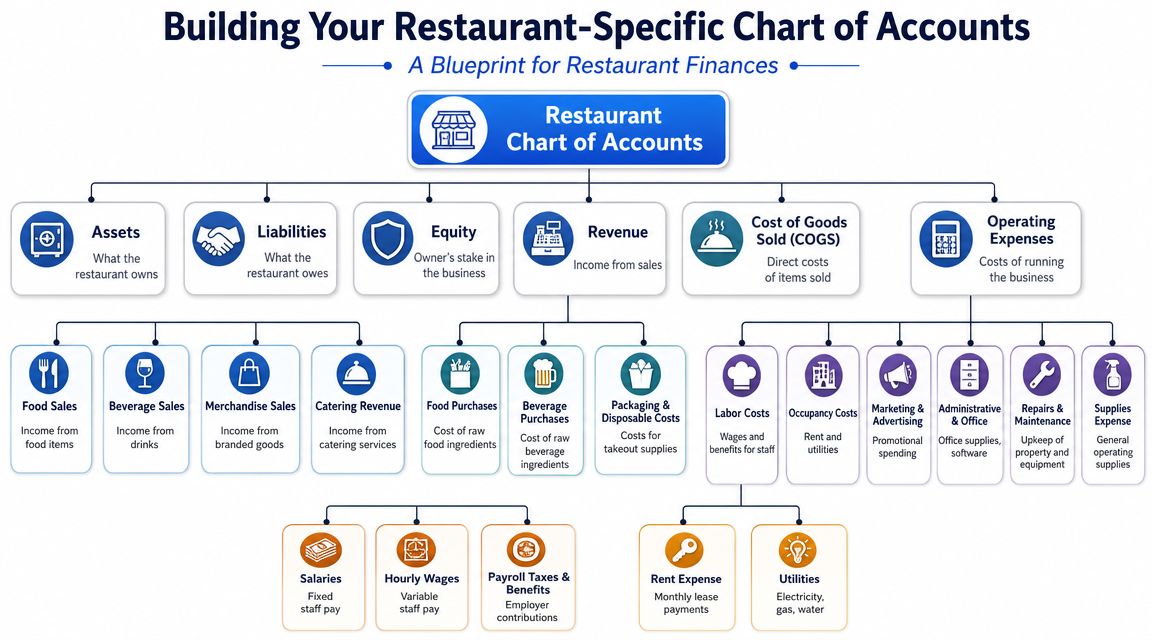
A useful chart of accounts should mirror how the restaurant runs. Not how a bookkeeper wishes it ran.
The structure that actually helps operators
Start with the standard top-level groups, then make the restaurant detail live underneath them.
| Account group | What to track |
|---|---|
| Assets | Cash, bank accounts, undeposited funds, inventory, prepaid expenses, equipment |
| Liabilities | Credit cards, loans, taxes payable, payroll liabilities, gift card liabilities |
| Equity | Owner investment, draws, retained earnings |
| Revenue | Dine-in food, takeout, delivery, catering, beverage categories, merchandise |
| COGS | Food purchases, beer, wine, liquor, non-alcoholic beverages, packaging, disposables |
| Operating expenses | Labor, occupancy, marketing, software, repairs, supplies, admin |
Under revenue, break out sales in a way that helps decisions:
- By channel: dine-in, takeout, delivery, catering
- By category: food, beer, wine, liquor, coffee, retail items
- By concept or location: if you operate more than one unit or brand
Under cost of goods sold, don't bury everything in “purchases”:
- Food purchases should be separate from beverage purchases
- Packaging and disposables should stand alone if off-premise sales matter
- Promo or comp-related usage should not disappear into normal food cost if you want honest menu analysis
Under labor, split by how you manage people:
- Kitchen labor
- Front-of-house labor
- Management salaries
- Payroll taxes and benefits
That structure lets you compare labor pressure against service style, shifts, and channel mix. It also makes operational conversations far more useful.
For operators tightening stock control, pairing clean bookkeeping with an inventory management workflow for restaurants makes the numbers easier to trust because usage and purchasing stop living in separate worlds.
Keep it useful, not bloated
Don't build a monster chart of accounts with endless tiny categories nobody uses consistently. Detail helps only when the team can maintain it.
Use this test: if a category would change a decision on pricing, staffing, purchasing, menu design, or marketing, track it separately. If it won't, keep it rolled up.
A solid restaurant chart of accounts should answer questions like:
- Which revenue stream is worth the operational effort?
- Are beverage margins covering weak food periods?
- Is delivery profitable after all related costs are recorded properly?
- Did labor rise because sales mix changed or because scheduling got loose?
Build the chart around decisions, not accounting theory.
That's how bookkeeping for restaurants becomes useful on Monday morning, not just tidy on tax day.
Your Bookkeeping Rhythm for Consistent Clarity
Friday night looked packed. Sunday felt strong. Then Monday hits, and the owner is staring at a bank balance that makes no sense.
That problem usually starts in the routine. Weak bookkeeping rhythm turns real operating issues into fog. You miss deposit gaps, let invoice coding slide, and spot margin problems weeks after they started. Good bookkeeping for restaurants fixes that by turning daily activity into usable operating signals.
Daily close tasks
Daily close is where control starts. If this step is loose, every report after it is suspect.
Restaurant bookkeeping guidance from QuickBooks' restaurant bookkeeping guide recommends recording POS sales daily and reconciling deposits regularly so errors, chargebacks, and missing deposits get caught early.
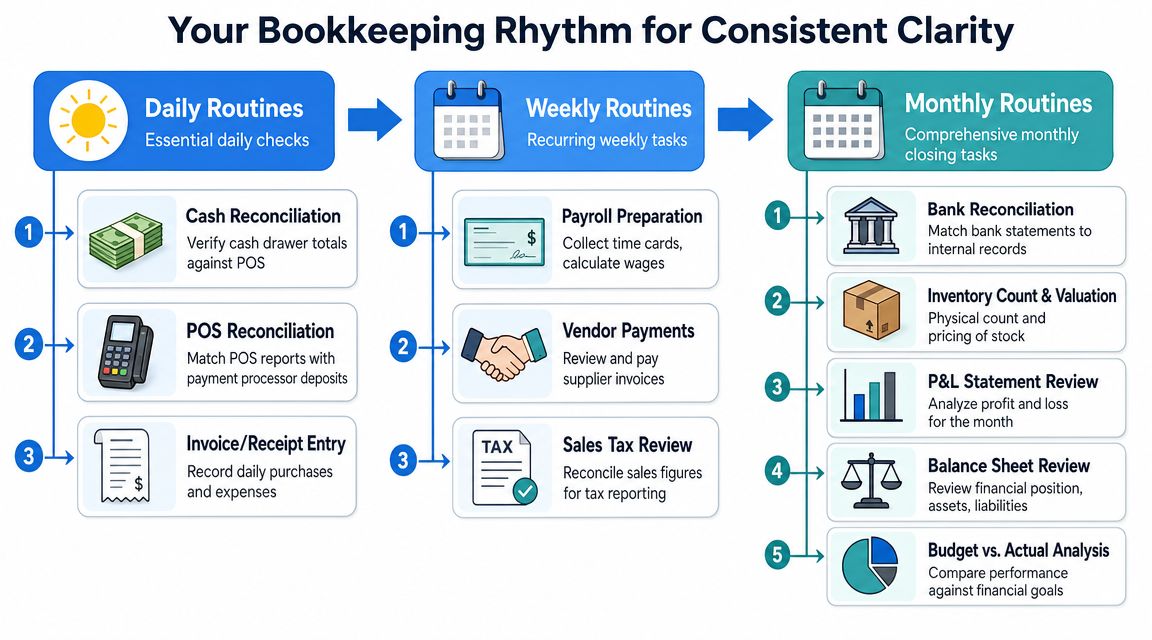
Keep the daily routine short and strict:
- Record the day's sales: Pull POS totals every day and split them by payment type and revenue stream.
- Match cash and card activity: Reconcile cash drawers, card batches, and expected deposits.
- Enter same-day purchases: Log invoices, petty cash, and emergency buys while the details are still fresh.
- Flag unusual transactions fast: Voids, refunds, chargebacks, discounts, and missing receipts need same-day follow-up.
Speed matters here because memory gets worse by the hour. By month-end, people are no longer reconciling. They are reconstructing.
Weekly review tasks
Weekly review is where you catch drift before it turns into a bad month.
This is the cadence that separates operators who manage by facts from operators who manage by mood. A weekly review gives you enough time to correct staffing, ordering, and channel issues while the month is still salvageable.
Use a checklist like this:
- Review vendor bills: Make sure invoices are entered, dated correctly, and assigned to the right accounts.
- Prepare payroll carefully: Check hours, overtime patterns, tip reporting, and role allocation before payroll is finalized.
- Find coding mistakes: Delivery commissions, comps, staff meals, and promo discounts often land in the wrong accounts.
- Review a short P&L: Look for trend changes that need action now, not after the month closes.
- Check sales mix: Revenue can rise while margin falls if the mix shifts toward lower-profit channels.
This is also a good time to compare your weekly reports against a simple restaurant KPI reference for operators. The point is not more reporting. The point is faster decisions.
Monthly close tasks
Monthly close should answer operational questions, not just satisfy your accountant.
The National Restaurant Association notes in its restaurant accounting primer that restaurants need timely financial reporting and regular account reconciliation to manage performance, cash flow, and costs. That is the standard to hold.
A strong monthly close includes four jobs.
Reconcile every cash-related account
Match bank activity, merchant processor deposits, and clearing accounts to the books. Clean up open items immediately.Post inventory-related adjustments
Record count variances, waste, spoilage, or receiving errors so cost of goods sold reflects what occurred.Produce the core financial statements
Review the:- Profit and loss statement
- Balance sheet
- Cash flow statement
Hold a leadership review
Sit down with the GM, chef, ops lead, or ownership group and make decisions.
Ask direct questions:
- Which revenue streams produced cash, and which only produced activity?
- Did labor follow the sales pattern, or did scheduling miss the demand curve?
- Which expense lines look operationally wrong?
- Which menu categories sold well but failed to produce margin?
- Is cash getting stronger or tighter?
Monthly close should end with actions assigned to specific people. Adjust pricing. Fix schedules. Challenge waste. Cut weak promotions. Change purchasing. That is where bookkeeping for restaurants becomes a playbook for profit, not a tax file with nicer formatting.
From Data to Decisions with Key KPIs
Friday night is packed. Sales look strong. Then payroll hits on Monday, your food order lands on Tuesday, and the bank balance tells a different story.
That gap is why bookkeeping matters. It gives you operating numbers you can use to make better calls on pricing, prep, scheduling, and channel mix.
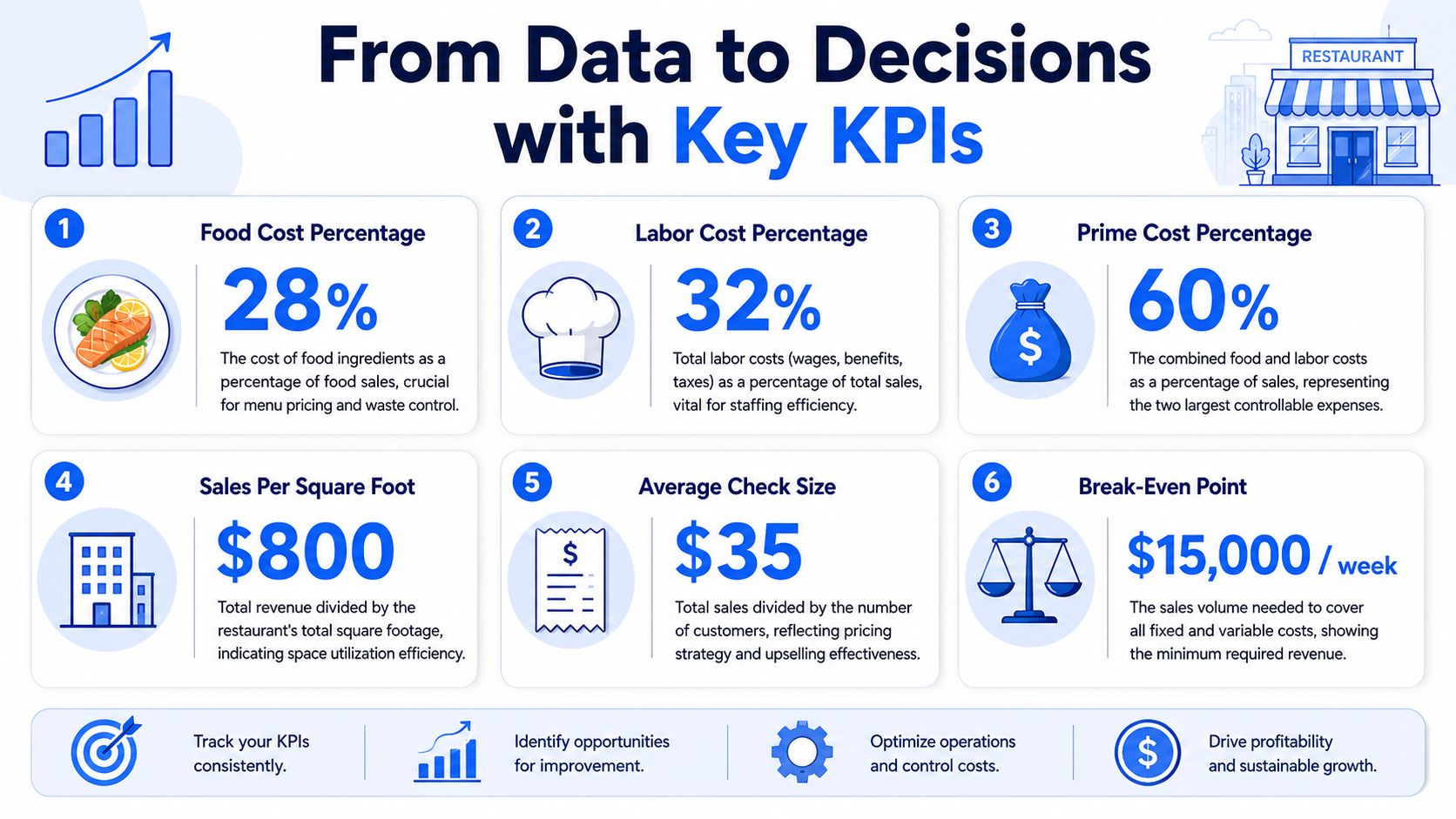
The three numbers that matter most
If I need a fast read on a restaurant, I start with food cost, labor cost, and prime cost.
Those three numbers show whether the operation can support itself. If prime cost is out of line, profit gets squeezed fast, no matter how busy the dining room feels. Food cost tells you whether purchasing, portioning, and menu pricing are under control. Labor cost tells you whether your schedule matches demand or your team is burning hours without enough sales to justify them.
Use these formulas:
- Food cost percentage = food cost ÷ relevant sales
- Labor cost percentage = labor cost ÷ total sales
- Prime cost percentage = food + beverage + labor costs ÷ total revenue
Keep a simple restaurant KPI reference guide next to your monthly reports so managers review the same numbers the same way.
Here's a short walkthrough worth watching before your next review meeting:
What each KPI should trigger
A KPI review is useless unless it leads to action.
| KPI | If it rises | What to investigate |
|---|---|---|
| Food cost | Margin gets squeezed | Portion sizes, waste, theft, receiving mistakes, supplier price changes, menu pricing, comps |
| Labor cost | Staffing efficiency drops | Scheduling by daypart, overtime, training gaps, role overlap, slow shifts, prep burden |
| Prime cost | Core profitability weakens | Whether the problem sits in food, beverage, labor, or a combination |
If food cost jumps, start in the kitchen and receiving process before you touch menu prices. Check yield, prep discipline, invoice changes, and whether a high-volume item is selling well but producing weak margin.
If labor climbs, do not hack hours across the board. Compare staffing by shift against sales, ticket times, and production load. I have seen plenty of operators blame labor when the issue was a bloated menu, poor prep flow, or too much third-party volume at the wrong times.
Prime cost is the summary number. It tells you whether the engine of the business is working. It also forces honest conversations. A restaurant can hide behind strong weekend sales for months, but prime cost exposes whether the model works on ordinary days.
Use bookkeeping to improve menu and revenue decisions
Operators either use the books well or waste them.
When bookkeeping separates sales by menu category, daypart, and channel, you can see which items and order paths produce cash and which ones only create activity. That changes the quality of your decisions fast.
Use your books to answer questions like these:
- Average order value: Which add-ons, bundles, and modifiers raise ticket size without slowing the line
- Menu mix: Which popular items carry real contribution margin, and which ones only look good on a sales report
- Channel performance: Whether dine-in, takeout, direct online ordering, and third-party delivery produce profit after fees and labor
- Pricing decisions: Which items can absorb a price change, and which need recipe or portion adjustments instead
- Operational drag: Whether a menu section creates prep complexity, waste, and labor pressure out of proportion to its sales
- Guest experience: Whether a simpler menu improves speed, consistency, and repeat business
A busy item is not always a good item.
I see that mistake constantly. Operators celebrate sales volume while a low-margin dish eats labor, creates waste, and crowds out better choices. Clean bookkeeping fixes that because it ties popularity to margin, not just to units sold.
The menu is a profit tool. Bookkeeping shows whether it earns its space.
Common Bookkeeping Mistakes Costing You Money
The leaks I see most often
Most restaurants don't lose control because they ignored bookkeeping entirely. They lose control because they do it halfway.
A few mistakes show up constantly.
- Mixing staff meals, comps, and promos into normal food cost: That inflates your cost picture and hides what the menu is doing.
- Recording delivery deposits without the full gross sale picture: Then you can't see what that channel really costs.
- Dumping all labor into one account: That makes it harder to spot whether the issue is management structure, kitchen prep, or front-of-house scheduling.
- Treating sales tax like revenue: It isn't. If that liability gets sloppy, your reports get sloppy.
- Leaving tip records messy: Then payroll gets painful, and so do disputes.
- Relying on manual re-entry from POS reports: That's where avoidable errors creep in fast.
Operators also miss a big one: they don't separate revenue streams well enough to judge margin. If dine-in, takeout, QR ordering, and third-party delivery all sit in one sales bucket, you're blind.
Simple fixes that clean up the picture fast
The fix is usually less dramatic than people think. It comes down to rules.
Set these rules and enforce them:
- Gross sales first, fees second: Record the full sale, then the commission or platform fee separately.
- Dedicated accounts for comps and employee meals: Don't let them distort normal COGS analysis.
- Role-based labor tracking: Split kitchen, front-of-house, and management so labor conversations become operational, not emotional.
- Clear ownership for daily close: One person prepares it, another reviews it.
- Consistent channel mapping: Every order source should land in the same revenue bucket every time.
If labor keeps slipping and the reports don't show why, clean role coding matters as much as schedule discipline. A practical guide on controlling restaurant labor costs without hurting service helps once the bookkeeping is clear enough to show what's happening.
Use this quick problem-and-plug table:
| Hidden leak | Better treatment |
|---|---|
| Discounts buried in sales totals | Track discounts separately |
| Delivery fees netted against revenue | Record gross revenue and fees distinctly |
| Tips handled outside payroll flow | Reconcile tip records with payroll every cycle |
| Irregular invoice coding | Standardize vendor coding rules |
| One giant wages account | Split labor by function |
Good bookkeeping for restaurants isn't fancy. It's disciplined. The restaurants that hold margin usually aren't doing magical finance work. They're just not letting the same mistakes repeat every week.
Your Bookkeeping Implementation Checklist
Set the system up once, then run it every week
If your bookkeeping feels messy, don't overhaul everything at once. Fix the structure, assign the routine, and tighten the handoffs.
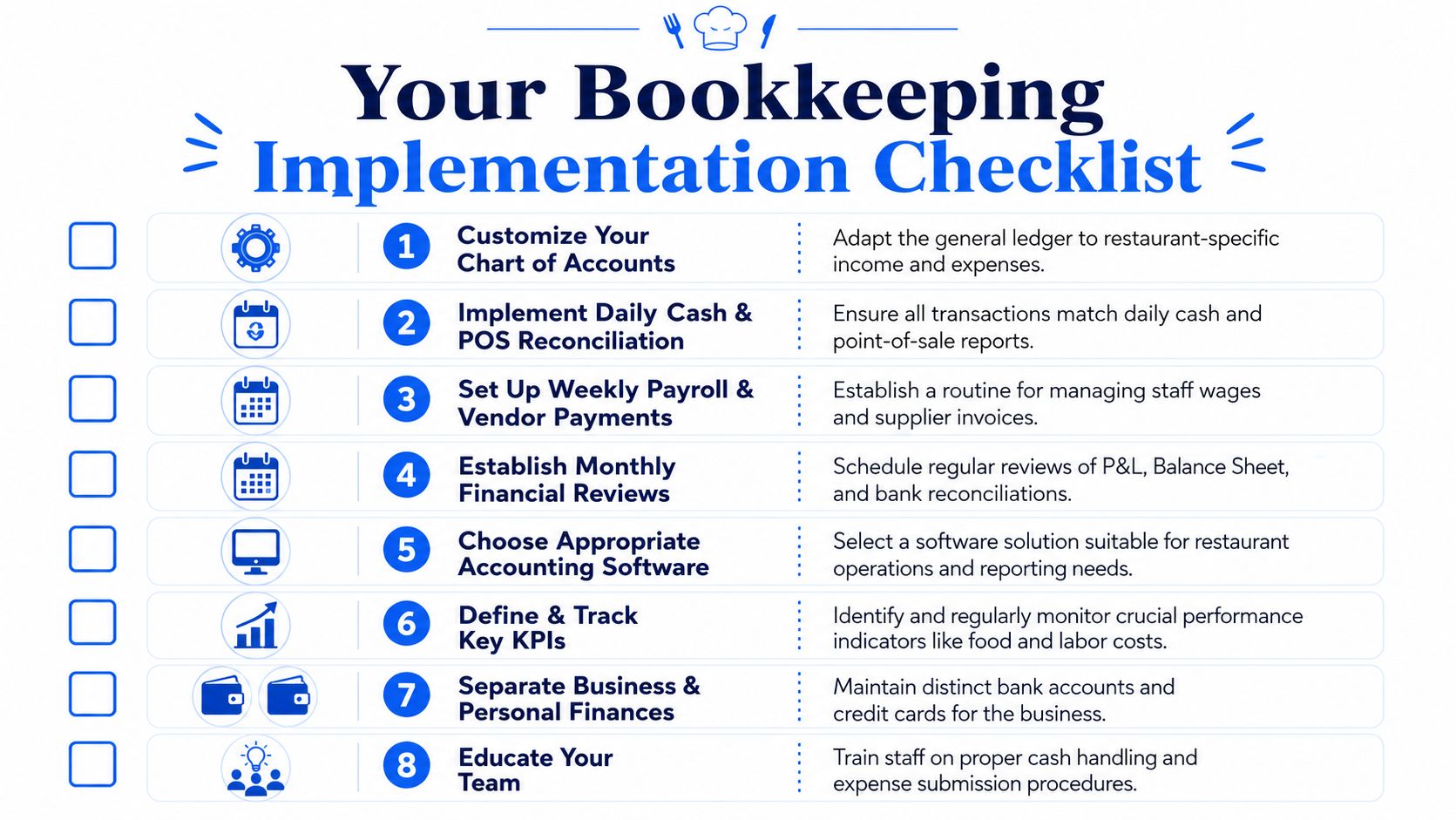
Start with this checklist:
- Customize the chart of accounts: Separate revenue streams, COGS categories, labor buckets, and operating expenses in a way your managers can understand.
- Set a daily close process: Match POS sales, cash, card batches, and deposits every day.
- Assign weekly ownership: Vendor bills, payroll prep, coding checks, and a mini review should have names next to them.
- Run a real monthly close: Reconcile accounts and review the P&L, balance sheet, and cash flow statement with the leadership team.
- Use connected tools where possible: The less manual re-entry you do, the fewer avoidable mistakes you create.
- Track the KPIs that drive action: Food cost, labor cost, and prime cost should lead to decisions, not just reporting.
- Keep personal and business activity separate: Mixed spending wrecks clarity fast.
- Train the team on inputs: Cash handling, discounts, comps, tips, invoice submission, and coding all affect the quality of the books.
What a solid setup changes
Once this is in place, the biggest benefit isn't cleaner accounting. It's better operating judgment.
You'll price with more confidence. You'll spot weak channels faster. You'll know whether a menu change improved margin or just created more noise. You'll reduce staff workload caused by manual correction and messy end-of-month cleanups.
If you want the books to stay clean, the data feeding them must be clean too. That includes itemized sales, channel-level revenue, and digital ordering activity from the moment the guest interacts with the menu. Tools like QuickBooks or Xero can handle the accounting side, and platforms such as RevMenue can support the front-end data flow by organizing digital menu, ordering, and revenue information before it reaches your reporting stack.
That's how bookkeeping for restaurants stops being a chore and starts becoming a profit tool.
If you want cleaner sales inputs feeding your bookkeeping, RevMenue gives restaurants a way to manage digital menus, QR ordering, and revenue tracking in one place, so the reporting behind menu decisions, upsells, and channel performance starts from better data rather than manual cleanup later.