
Most restaurants don't have a traffic problem. They have a leakage problem.
You're full on Friday, the kitchen is moving, staff are flat out, and the numbers still feel underwhelming. That usually means the restaurant customer journey is working against you in small ways. Guests struggle to find the right menu online, booking takes too many taps, tables sit on checks too long, upsell moments get missed, and nobody gives customers a reason to come back.
That's fixable. If you map the journey to revenue, not just service steps, you'll spot where money slips out before the guest arrives, while they're ordering, and right after they pay.
Table of Contents
- Why Your Busiest Nights Might Be Leaking Profit
- The Five Stages of the Modern Restaurant Journey
- Optimizing Pre-Visit Touchpoints to Win the Booking
- Turning the In-Dining Experience into a Profit Engine
- Securing the Next Visit Before They Leave
- Your Quick-Start Journey Optimization Checklist
Why Your Busiest Nights Might Be Leaking Profit
A packed room can hide bad economics.
You can be “busy” and still lose margin through avoidable friction. A guest gives up because your hours are wrong on a listing. Another can't book the table they want. A server forgets to suggest the add-on that fits the order. A party waits too long to pay, so the next cover starts late. None of that feels dramatic in the moment. It adds up shift after shift.
The pre-visit leak is bigger than most operators think. The “Digital-Pre-Visit Friction Gap” leads to 72% of potential diners dropping off because of out-of-date menus, incorrect hours, or unbookable slots before they ever arrive, according to research on restaurant customer journey friction.
Busy doesn't mean efficient
If your team is slammed, they usually focus on execution inside the building. Fair enough. But guests start judging you long before they see the host stand.
Common profit leaks look like this:
- Search leak: Your Google listing, website, and social pages don't match.
- Menu leak: The online menu is old, hard to read, or buried in a PDF.
- Booking leak: Guests hit a dead end when they try to reserve.
- Waitlist leak: Walk-ins leave because there's no clear communication or follow-up.
- Payment leak: Tables are finished eating but still occupied waiting for the bill.
Practical rule: If a guest has to guess, they usually leave.
That's why the restaurant customer journey matters. It's not a branding exercise. It's a profit diagnostic.
If walk-ins regularly bounce during peak hours, tighten that handoff with tools built to reduce confusion and abandonment. A good example is restaurant waitlist software that reduces walkouts. The point isn't software for software's sake. The point is removing delay where revenue dies.
What operators should measure
Don't start with a giant workshop. Start with the leaks that hit sales and labor fastest:
- Pre-visit conversion: Are people finding accurate information and completing the booking?
- Order value: Are guests seeing the right prompts at the right moment?
- Table time: Are payment and departure smooth enough to protect the next seating?
- Repeat intent: Does the experience end with a reason to come back?
If your margins feel weaker than your covers suggest, your journey is telling you why.
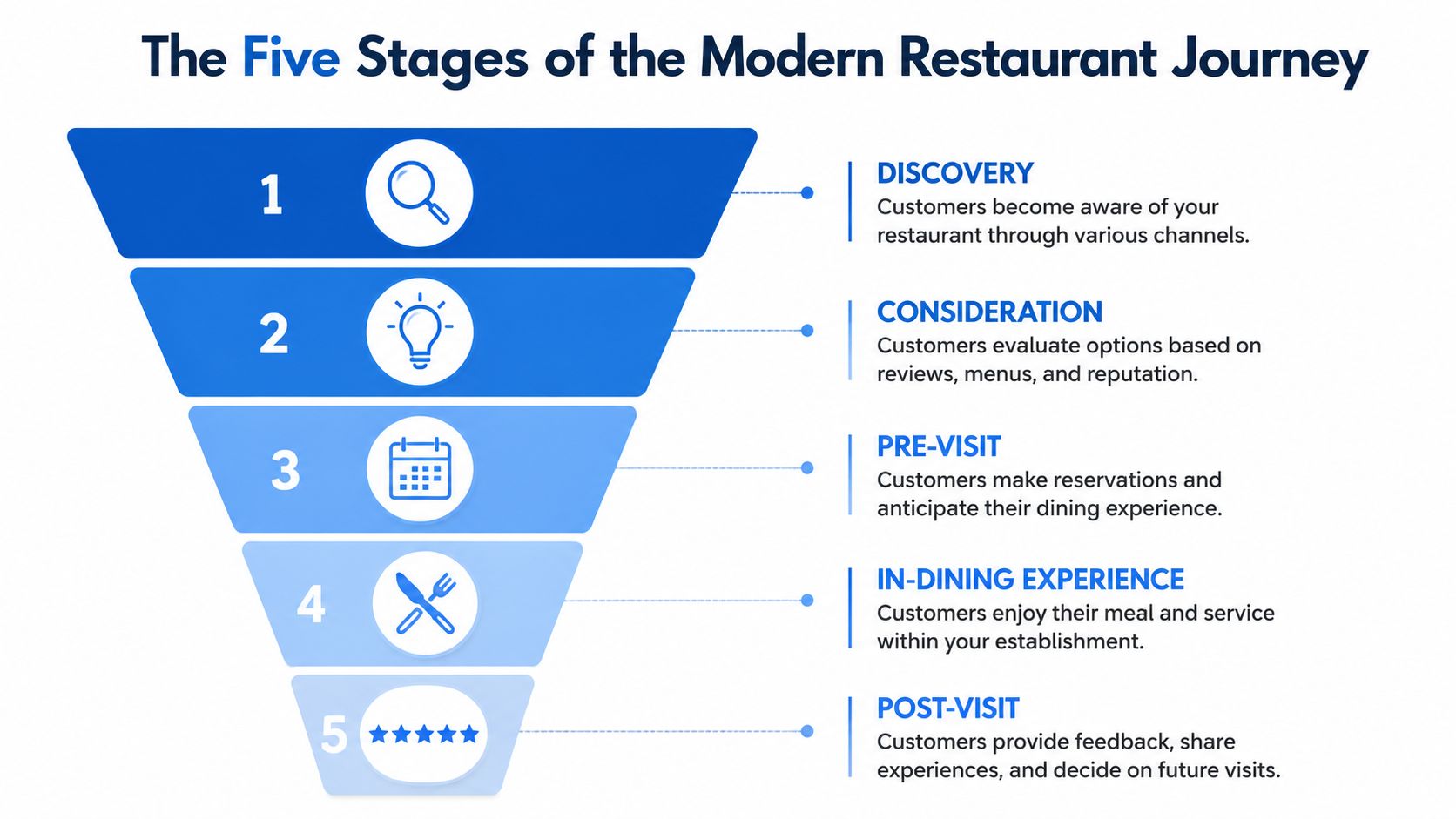
The Five Stages of the Modern Restaurant Journey
The restaurant customer journey is often treated like a list of touchpoints. That's too shallow. Each stage has a commercial job to do.
31% of U.S. operators report difficulty delivering a consistent guest experience across all touchpoints, based on SevenRooms' customer journey analysis. That's what happens when the journey isn't clearly owned stage by stage.
Stage one to two begins before the host stand
Here's the simplest useful model.
| Stage | What the guest wants | What the restaurant should want |
|---|---|---|
| Discovery | “Is this place relevant to me?” | Get found and make the first impression clean |
| Consideration and Booking | “Can I trust this choice and book quickly?” | Remove doubt and secure the visit |
| The Dining Experience | “Will this feel worth it?” | Increase spend while keeping service smooth |
| Payment and Departure | “Can I finish easily?” | Protect table turn and end on a high note |
| Loyalty and Advocacy | “Would I return or recommend it?” | Turn one visit into repeat revenue |
The first two stages happen mostly on a screen. That includes search, reviews, menu browsing, booking, confirmation, and basic trust signals.
For many operators, this is also where guest data starts. If you're thinking beyond the reservation, resources around improving restaurant guest WiFi experience are useful because they show how connectivity and first-party data can support smoother visits and better follow-up.
Stage three to five decides whether one visit becomes many
Inside the venue, the goal shifts. Now you're balancing hospitality, throughput, and spend.
A practical view of the last three stages:
- The dining experience is where menu design, pacing, and upselling shape average order value.
- Payment and departure is where friction either drags table time or keeps the night moving.
- Loyalty and advocacy is where you capture feedback, identify your best guests, and create a reason to return.
Great operators don't just ask, “Did service happen?” They ask, “Did this stage move revenue, efficiency, or loyalty?”
That's the lens to use through the rest of this article. Not touchpoints for their own sake. Touchpoints tied to sales, labor, and repeat business.
Optimizing Pre-Visit Touchpoints to Win the Booking
The sale often dies before the guest reaches your door.
That matters more than ever because food service industry sales are projected to reach $1.5 trillion in 2025, which makes every pre-visit touchpoint more valuable in the fight for demand, according to Bank of America's restaurant industry report.
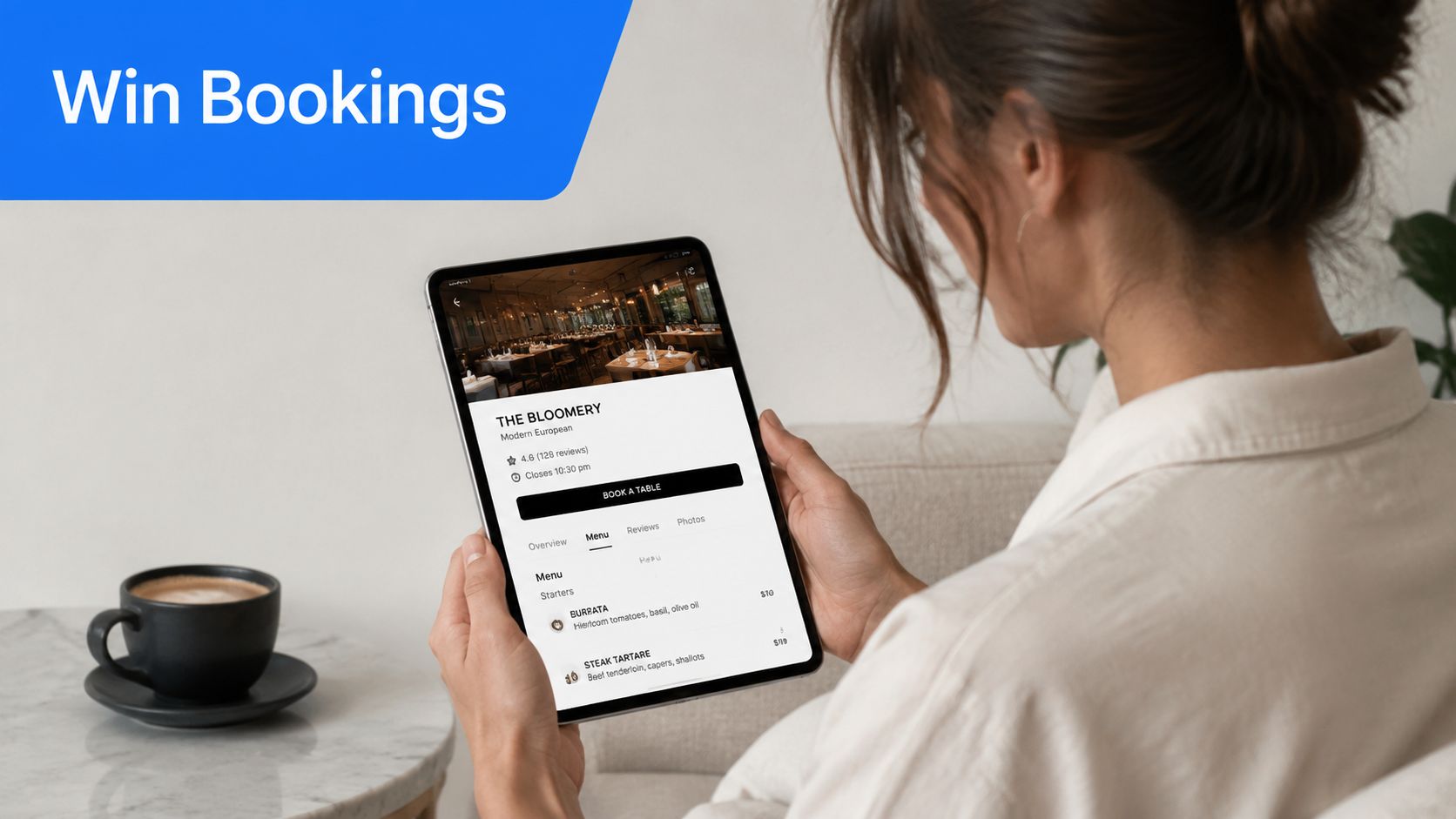
Fix the digital storefront first
Most operators overcomplicate this. Start with the obvious stuff a customer sees in under a minute.
Use this pre-visit audit:
- Check your hours everywhere: Google, Apple Maps, website, Instagram bio, booking platform.
- Replace menu PDFs if they're clunky: Phone users don't want to pinch and zoom through six pages.
- Show real menu detail: Prices, modifiers, dietary tags, and current availability reduce hesitation.
- Clean up your photos: Bad lighting and outdated dishes hurt trust.
- Make location details easy: Parking, entrance notes, and service style should be obvious.
If you run multiple locations, assign one person to own these updates. Shared responsibility usually means nobody fixes them.
Make booking feel easy
The booking flow should answer three things fast: can I get in, when, and what happens next?
That means:
- Minimal clicks: Don't force users through extra pages to reserve.
- Clear slot availability: If peak slots are full, show alternatives cleanly.
- Useful confirmation: Include time, location, policy notes, and any special instructions.
- Recovery path for no-table moments: Offer waitlist options or nearby time suggestions.
Here's a realistic example. A couple finds your restaurant from Instagram on a Saturday afternoon. They tap to book, but the website opens a slow page, the menu is out of date, and reservations redirect awkwardly. You haven't lost them because your food is bad. You've lost them because your digital front door feels unreliable.
The guest doesn't separate marketing from operations. To them, it's all one experience.
That's why your social channels should drive directly into accurate, bookable pages. If your team needs to tighten that side of the funnel, this guide on social media for restaurants is worth reviewing with whoever handles content and local promotion.
What a good pre-visit setup looks like
A solid setup is boring in the best way. It works without effort from the guest.
Use this standard:
- Menu matches reality
- Hours match service
- Reservation path works on mobile
- Special occasions can be noted easily
- Confirmation arrives fast
- Staff can see booking context before the guest walks in
If your discovery and booking flow is clean, the rest of the restaurant customer journey starts from trust instead of doubt. That gives your floor team a much easier job.
Turning the In-Dining Experience into a Profit Engine
Margin gets built or lost here.
Most restaurants still leave order value to chance. They rely on staff memory, paper menus, and rushed verbal upsells during busy service. That's expensive. The in-dining stage should be designed to increase spend, reduce ordering friction, and cut unnecessary back-and-forth.
A modern setup can do all three.
Your menu should do selling work
Your menu isn't just a list. It's your highest-traffic sales tool.
Reducing menu navigation friction by 40% through dynamic QR-based interfaces can increase average order value by 12 to 15% in full-service venues, according to Fishbowl's analysis of restaurant journey performance. That lift comes from faster browsing and better-timed add-on suggestions.
You don't need gimmicks. You need structure.
Use menu psychology that supports buying decisions:
- Lead with profitable items: Put high-margin dishes where attention naturally lands.
- Bundle naturally: Pair mains with sides, drinks, or desserts that make sense.
- Use photos selectively: High-quality food photography can increase average order value, especially in digital menus.
- Prompt at the moment of intent: Show wine after a steak choice, not before.
- Reduce dead-end browsing: Keep categories clear and modifiers simple.
A practical floor example: a guest selects a burger. Instead of waiting for a server to remember the upsell, the digital flow presents add bacon, premium cheese, a combo side, and a drink pairing while the guest is already in decision mode. That's cleaner than hoping someone remembers the script during the rush.
Reduce friction at the table
Guests spend more when ordering feels easy. Staff perform better when they're not trapped in repetitive admin.
Other useful benchmarks support the same pattern:
- Digital ordering platforms driven by QR menus can generate orders up to 20% higher than in-person orders, according to Sunday's review of QR ordering performance.
- Menus with high-quality food photography can increase average order values by 28 to 35%, with an added €4 to €5 per guest for a restaurant averaging €15 per person, based on DoxMenu's QR menu revenue findings.
- QR code ordering increases average order value by approximately 12% or $2 to $4, according to Hospitality Technology's reporting on QR ordering benefits.
Those numbers matter because they connect guest convenience to revenue, not just novelty.
On the floor: Every time a guest can browse, customize, and add without waiting for a staff touchpoint, you remove friction and create another chance to lift the check.
Good in-dining systems also reduce workload:
- Fewer repeat questions: Allergens, modifiers, and add-ons are clearer.
- Less order re-entry: Guests choose directly from structured options.
- Cleaner pacing: Teams spend less time explaining and more time hosting.
- Faster check completion: Payment can happen without the final bottleneck.
A smoother payment experience also protects table turn time, especially on peak nights when a delayed departure blocks the next seating.
Here's a useful demo of the kind of digital flow operators should study when redesigning the table experience:
Audit the floor like an operator, not a marketer
You don't need vague “guest journey mapping sessions.” You need to watch where money and time get stuck.
Run a live service audit around these questions:
| Revenue lever | What to inspect |
|---|---|
| Menu engagement | Are guests finding key items quickly? |
| Upsell timing | Are add-ons shown when the guest is ready to decide? |
| Staff load | Are servers stuck doing tasks technology could simplify? |
| Payment speed | How long do finished tables wait to close? |
If you want a structured outside view, customer service audit services can help teams spot consistency problems that managers miss during normal service.
The big takeaway is simple. Your in-dining journey should increase order value while lowering pressure on staff. If it only does one of those, it's incomplete.
Securing the Next Visit Before They Leave
Most restaurants treat the check as the finish line. It isn't. It's the handoff into the next visit.
The strongest operators use departure to lock in memory, capture signal, and open the next loop. That matters because 68% of customers prioritize emotional intelligence in staff over speed, according to Hungerrush's look at the gap between emotional experience and operational efficiency.
Departure is a loyalty moment
Guests remember how the experience felt at the end.
That doesn't require theatrical service. It requires intention:
- Close cleanly: Make payment easy and accurate.
- Acknowledge context: Birthday, business lunch, first visit, regular.
- Ask for lightweight feedback: One simple question works better than a long survey.
- Give a reason to return: Not a generic “see you again,” but a real nudge tied to their behavior.
A good example is the dessert-loving couple who paid quickly, left happy, and got no follow-up. A better approach is capturing that preference and using it later for a relevant return prompt. If you're refining that part of the loop, these examples of best loyalty programs for restaurants are useful for shaping offers that feel earned, not spammy.
If the guest leaves with no emotional high point and no next step, you're relying on luck for the second visit.
Use post-visit data without being creepy
You don't need invasive personalization. You need practical pattern recognition.
Focus on signals that help operators:
- Visit frequency
- Favorite categories
- Party type
- Redemption behavior
- Feedback at payment or right after
Then act on it directly.
For example:
- A weekday lunch regular gets a relevant midweek offer.
- A family group gets early seating prompts before busy periods.
- A guest who flagged a poor experience gets a human follow-up, not an automated promo.
The restaurant customer journey doesn't end when the card clears. It ends when the guest decides whether your place is worth repeating. Operators who understand that build steadier revenue without always chasing new traffic.
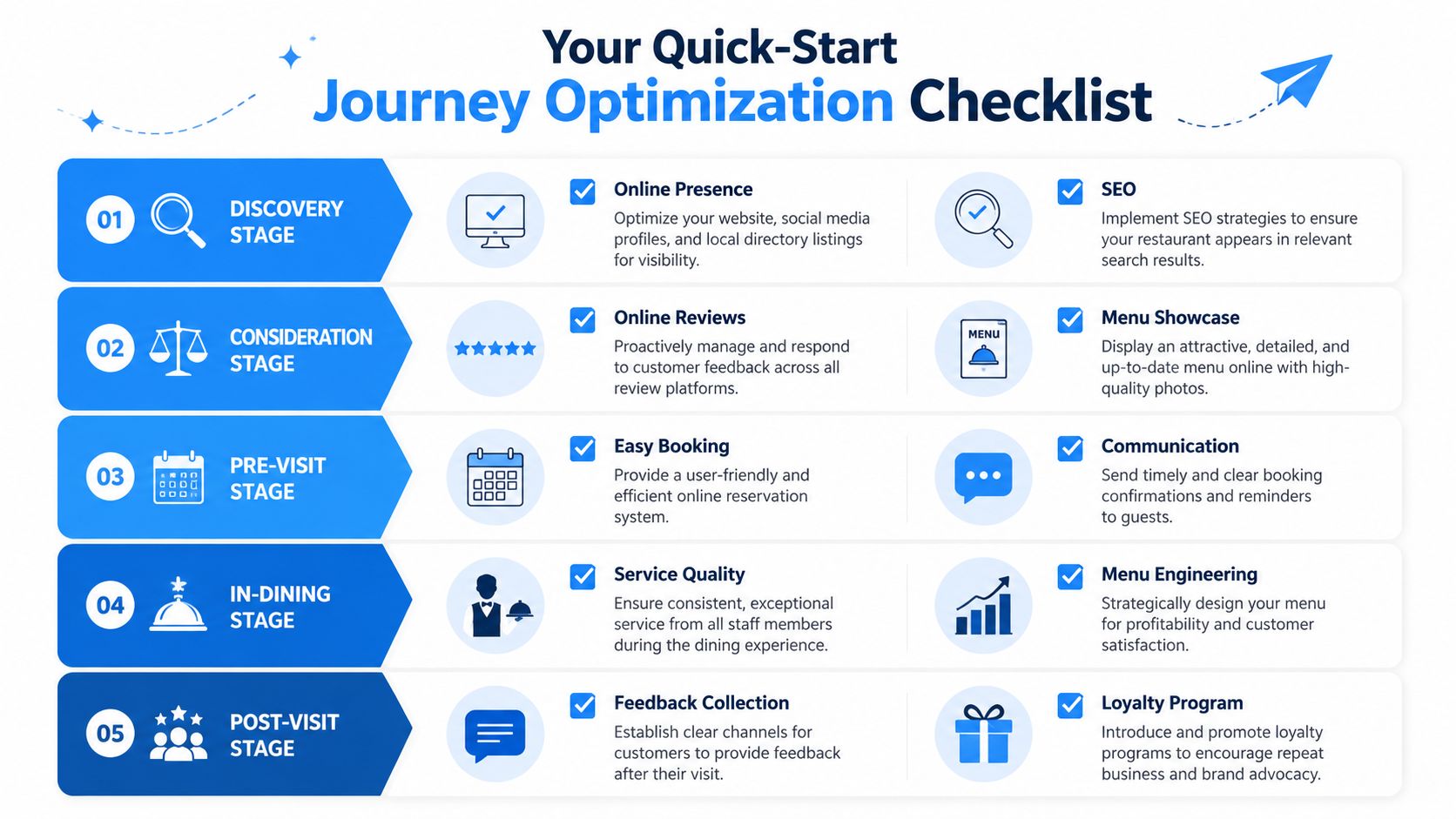
Your Quick-Start Journey Optimization Checklist
You don't need a giant transformation plan. You need a short list of fixes that remove friction and improve spend.
What to fix this week
Start with the leaks that are easiest to verify.
- Audit discovery: Check listings, hours, links, and menu accuracy on every major channel.
- Test booking on your phone: If it feels clunky to you, it's worse for guests.
- Review your top sellers: Make sure profitable add-ons and bundles are visible at ordering time.
- Watch payment delays: Identify where tables stall after the meal is finished.
- Capture one post-visit signal: Feedback, review prompt, or loyalty opt-in.
What to standardize this month
Once the urgent fixes are done, build repeatable standards.
- Create one source of truth for menu updates: No more mismatched prices or items across platforms.
- Set rules for upsell prompts: Tie suggestions to item choice, not staff memory alone.
- Train for emotional moments: Greetings, special requests, farewells, and recovery.
- Define departure workflow: Bill timing, payment options, thank-you language, return invitation.
- Track by journey stage: Pre-visit conversion, in-visit spend, post-visit return behavior.
A strong restaurant customer journey should do four jobs at once:
- Bring guests in
- Raise average order value
- Reduce staff drag
- Increase return visits
If one stage is weak, the whole system underperforms. Operators who treat the journey like a profit blueprint usually outperform those who treat it like a service checklist.
If you want a faster way to improve menu performance, reduce table friction, and turn guest data into smarter decisions, RevMenue is built for exactly that. It helps restaurants replace static menus with fast QR ordering, sharper upsell timing, and real revenue analytics, without forcing a disruptive operational overhaul.