
Most restaurants treat the menu like a design task. That's a mistake. It's a sales system.
The evidence is already clear. About 63% of diners prefer restaurants that offer digital menus and mobile payments, which means the guest expectation has already shifted beyond static printouts and one-off PDFs, according to full-service restaurant market data. If your menu still works like a laminated price list, you're forcing guests through a slower, weaker buying experience.
A strong menu doesn't just look better. It steers attention, raises average order value, reduces update friction, and makes life easier for staff. A weak one does the opposite. It hides profitable items, creates ordering hesitation, and turns every change into an operational chore.
That's why restaurant menu design services matter more now than they did a few years ago. The job isn't just visual anymore. The job is to turn the menu into an active profit tool.
Table of Contents
- Your Menu Is Probably Costing You Money
- Understanding Restaurant Menu Design Services Today
- The Core Offerings A Breakdown of Services
- Evaluating Traditional Designers vs Modern Platforms
- Questions to Ask Before Hiring Any Menu Vendor
- Beyond Design The Rise of Revenue-Focused Platforms
- Your Next Step Treat Your Menu Like an Asset
Your Menu Is Probably Costing You Money
Most menus are accidentally built to suppress sales.
They bury profitable items in the middle of cluttered sections. They overload guests with choices. They make updates so annoying that operators delay price changes, keep dead items too long, or leave staff explaining what's unavailable. That isn't a design issue alone. It's a margin issue.
A menu is your most visible sales tool. Every guest sees it. Every server relies on it. Every price, placement choice, description, and prompt affects what gets ordered. If that tool isn't built to guide behavior, you're leaving money on the table every shift.
A menu should reduce friction for the guest and reduce guesswork for the business.
This is what that looks like in practice:
- A crowded cocktail section slows decisions and lowers attach opportunities for snacks or starters.
- A static printed menu creates lag when ingredients, prices, or promos change.
- A badly structured QR menu gets scanned once, then abandoned because the experience feels clumsy on a phone.
- A vanity-first layout may look polished but still hide the dishes you want to sell.
That's why I usually tell operators to review their menu the same way they'd review labor, food cost, or table turn performance. If you haven't done that recently, start by looking at examples of a more strategic vanity restaurant menu approach and compare it to what guests see in your venue.
The real cost isn't only lost upsells
Poor menu design also creates operational drag.
Staff answer repetitive questions that a clear menu should solve. Managers approve constant one-off fixes. Multi-location teams end up with version control problems. A menu that isn't built for change becomes expensive every time the business needs to move quickly.
Good restaurant menu design services don't start with fonts. They start with profit, clarity, and speed.
Understanding Restaurant Menu Design Services Today
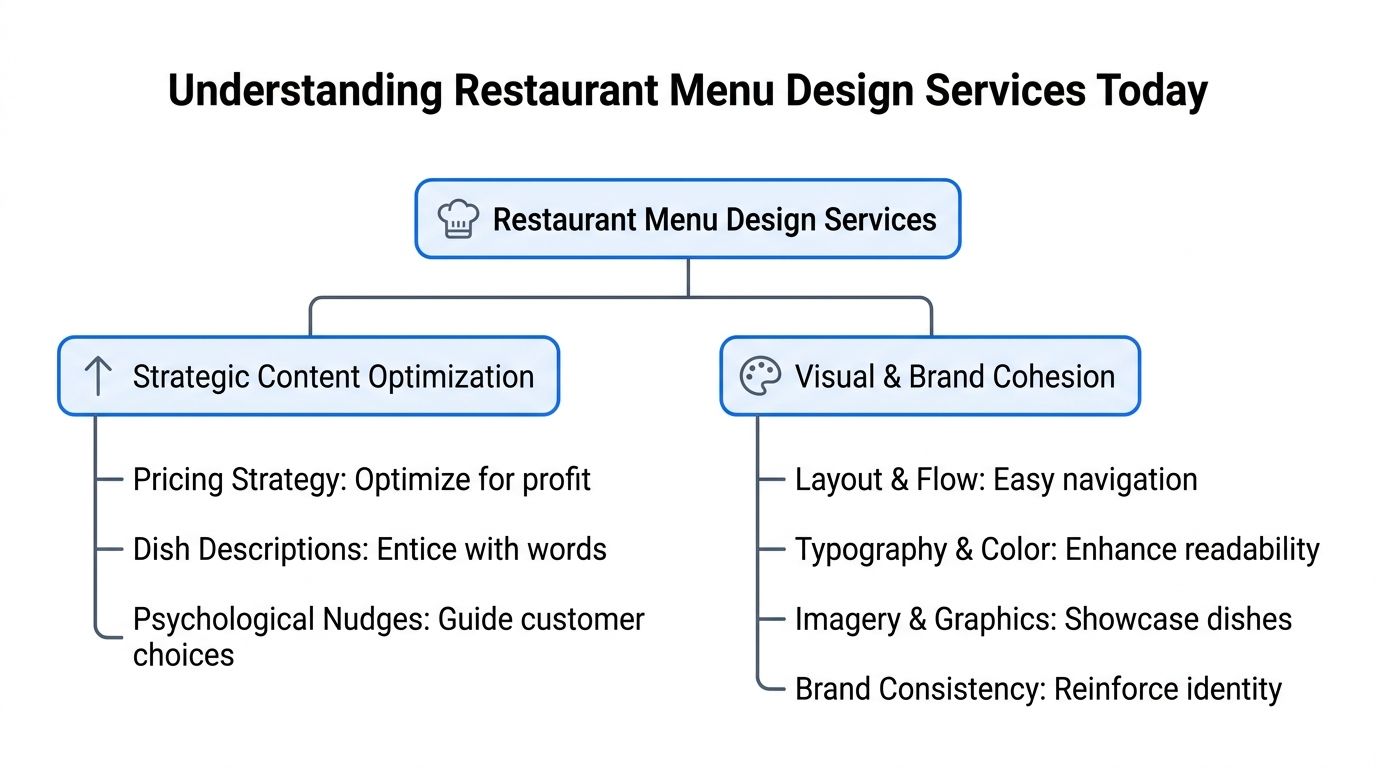
Restaurant menu design services now fall into two very different categories. If you don't separate them, you'll buy the wrong thing.
Some vendors sell design. Others sell a menu system.
Traditional design still has a place
Traditional restaurant menu design services focus on the visual asset itself.
That usually includes:
- Brand expression: colors, typography, logo use, spacing, and overall look.
- Menu layout: how sections are grouped and how the page flows.
- Print production: preparing files correctly for the printer.
- Static digital exports: PDFs or image-based versions for web or sharing.
This route works when your menu changes rarely, your concept depends heavily on visual identity, and you mainly need polished print collateral for dine-in service, events, or specialty menus.
For some operators, that's enough. A neighborhood bistro with a stable food menu and a seasonal wine insert may only need a strong designer and clean production workflow.
Modern platforms do a different job
Modern restaurant menu design services are moving toward platform-based delivery.
The menu isn't treated as a finished file. It's treated as a live operating layer that can change instantly and influence revenue every day. That includes:
- Dynamic digital menus: updates happen without reprinting.
- Mobile-first ordering flows: the menu is built for scanning and browsing on phones.
- Upsell logic: prompts for add-ons, pairings, and bundles.
- Analytics: item performance, ordering patterns, and guest behavior.
- Operational control: updates across one site or many locations from one place.
Practical rule: If your menu changes often, a one-time design project will age fast.
The difference in mindset matters more than the design style. A traditional designer asks, "How should this menu look?" A modern platform should also ask, "How should this menu perform?"
The buying decision comes down to change frequency
Use this shortcut:
| Need | Better fit |
|---|---|
| Stable menu, strong print presence | Traditional designer |
| Frequent updates, promos, multiple locations | Modern platform |
| Brand refresh or repositioning | Traditional designer first |
| Ongoing optimization and digital ordering | Modern platform |
A lot of operators need both. They need a sharp visual foundation, then a system that keeps working after launch.
The Core Offerings A Breakdown of Services
A menu service should do more than hand you a polished PDF. It should improve what guests notice, what they order, how fast your team updates changes, and how clearly you can track results.
Four service layers matter.
Visual design and brand control
Good menu design starts with control, not decoration. The layout needs to direct attention, reduce hesitation, and match the type of restaurant you run.
A capable provider should handle:
- Clear hierarchy: appetizers, mains, desserts, drinks, modifiers, and specials should be easy to scan.
- Readability: type size, spacing, and contrast should help guests choose fast.
- Brand fit: the menu should reflect your concept, price point, and service style.
- Production accuracy: print files should be prepared correctly so you are not fixing avoidable press errors later.
Print details still matter. Files should arrive ready for production with correct color settings, bleed, and export format. If a vendor gets vague on print specs, expect delays, rework, or a menu that looks worse in hand than it did on screen.
Menu engineering and buying behavior
This service layer affects revenue directly.
Designers who only focus on aesthetics miss the job. Your menu should guide guests toward items that sell well, produce healthy margin, and support kitchen execution. As outlined in this menu engineering guide for better menus, operators should review item popularity and profitability, then decide which dishes deserve prime placement, better descriptions, price adjustments, or removal.
Use that logic with discipline:
- High-profit, high-demand items: place them where guests see them first and make them easy to order.
- High-profit, low-demand items: improve naming, descriptions, positioning, or photography.
- Low-profit, high-demand items: review portion size, ingredient cost, and price.
- Low-profit, low-demand items: cut them or stop giving them valuable space.
Visual restraint matters too. If every item has a badge, box, icon, or callout, the menu loses hierarchy and your best sellers disappear into noise.
QR systems and digital ordering flow
A QR code is only the entry point. The core service is the system behind it.
Guests should land on a menu that loads fast, reads well on a phone, and makes modifiers, add-ons, and bundles easy to select. Managers should be able to update sold-out items, promos, pricing, and daypart changes without waiting on a designer to resend files.
That is why operators with frequent edits usually need restaurant menu management software instead of a design-only vendor.
If you are comparing tools, study how strong menu software for restaurants handles mobile browsing, ordering flow, and update control. A digital menu should function like an operating system for revenue, not a static flyer uploaded to the web.
Performance analytics and ongoing optimization
Most menu services stop too early. They deliver the menu and call the job done.
Serious operators need a menu platform that keeps producing answers. You should be able to see which items get viewed, which ones convert, what guests add together, where they abandon the order, and which categories need simplification. That gives you a basis for pricing decisions, promotion tests, item cuts, and upsell changes.
Without that layer, menu decisions turn into opinion battles. With it, the menu becomes a live business tool that gets sharper over time.
Evaluating Traditional Designers vs Modern Platforms
Most operators don't need a philosophical debate here. They need to know which option will make the menu easier to manage and more profitable to run.
The market direction already tells you where things are heading. The digital menu market is projected to grow from USD 6.1 billion in 2024 to USD 9.6 billion by 2030, driven by real-time pricing updates and operational agility, according to digital menu board market data.
That doesn't mean traditional design is obsolete. It means static menus are losing ground where speed and flexibility matter.
Where traditional designers still work well
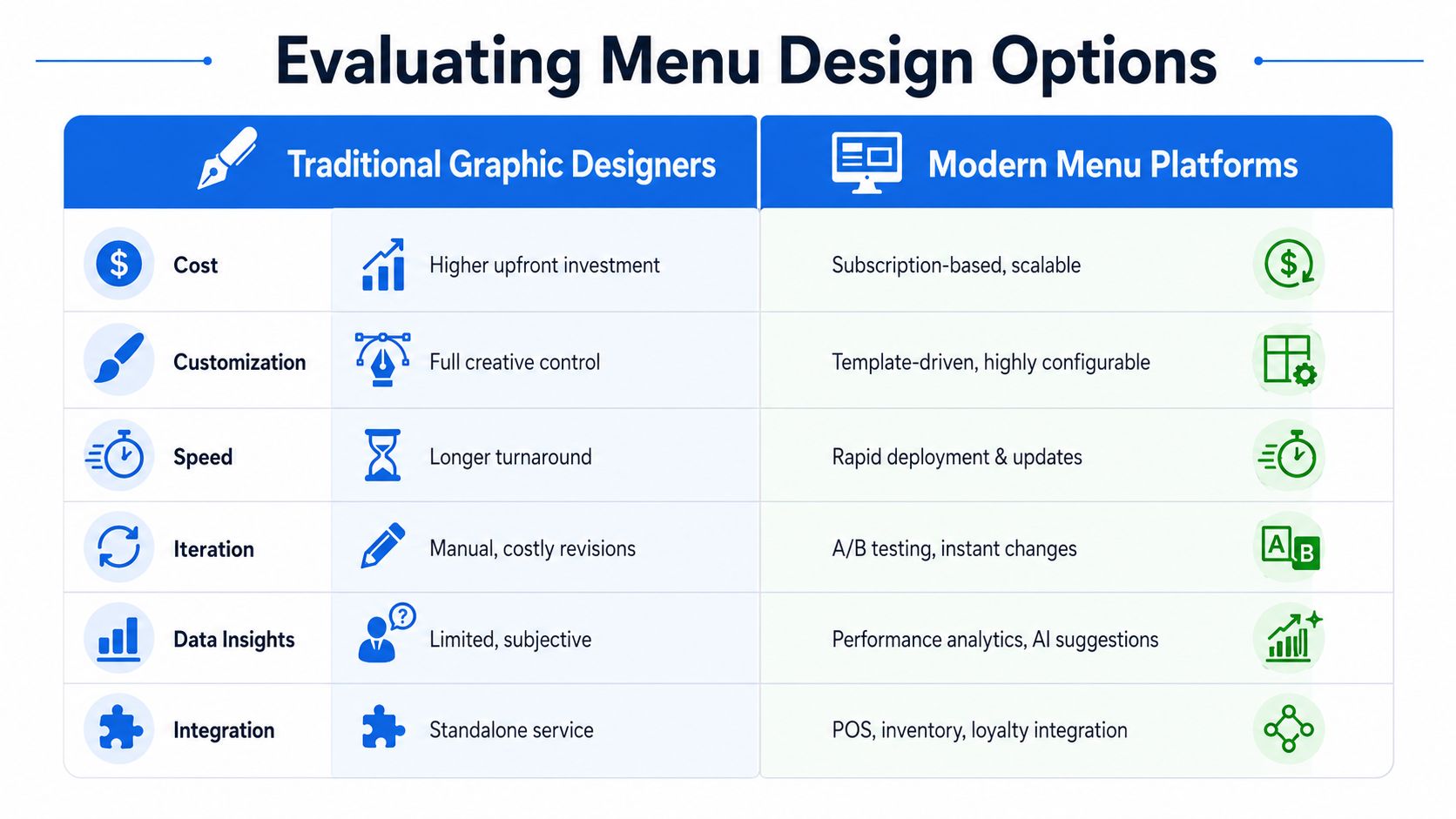
Traditional designers are useful when the core problem is visual.
They make sense if you need:
- A brand reset: new menu style, new tone, stronger visual identity.
- High-touch creative control: custom illustration, premium typography, unusual formats.
- Print-heavy service: tasting menus, wine lists, private dining packs, takeaway inserts.
They're also a good fit for one-location concepts with stable offerings and minimal weekly changes.
The downside is operational. Every revision becomes a task. Every seasonal change can turn into a mini project. Every urgent edit depends on file access, design availability, and re-exporting assets.
Later in your research, it's worth reviewing examples of menu software for restaurants so you can compare static creative work against systems built for constant iteration.
Where modern platforms win
Modern platforms solve a different problem. They reduce lag between decision and execution.
That matters in very normal scenarios:
| Situation | Traditional design response | Modern platform response |
|---|---|---|
| Item sells out mid-service | Staff explain it manually | Manager removes it instantly |
| Price change across locations | Update files one by one | Sync changes centrally |
| Limited-time bundle | New design request or workaround | Launch promotion quickly |
| Upsell opportunity | Staff-dependent | Built into ordering flow |
This is also where the economics improve over time. If your team changes menus often, speed becomes part of ROI.
A platform also gives operators more room to test. You can change names, reposition items, adjust bundles, and learn from actual ordering behavior instead of relying on internal opinion.
Later in the decision process, this short video is worth a look because it shows how operators are thinking about modern menu workflows.
A simple decision test
Pick the option that matches your operating reality.
Choose a traditional designer if:
- Your menu rarely changes
- Your priority is visual polish
- You mainly need a finished asset
Choose a modern platform if:
- You run promotions often
- You manage multiple locations
- You want digital ordering and upsells
- You need faster control without design bottlenecks
If speed, updates, and measurement matter, platform beats project.
Questions to Ask Before Hiring Any Menu Vendor
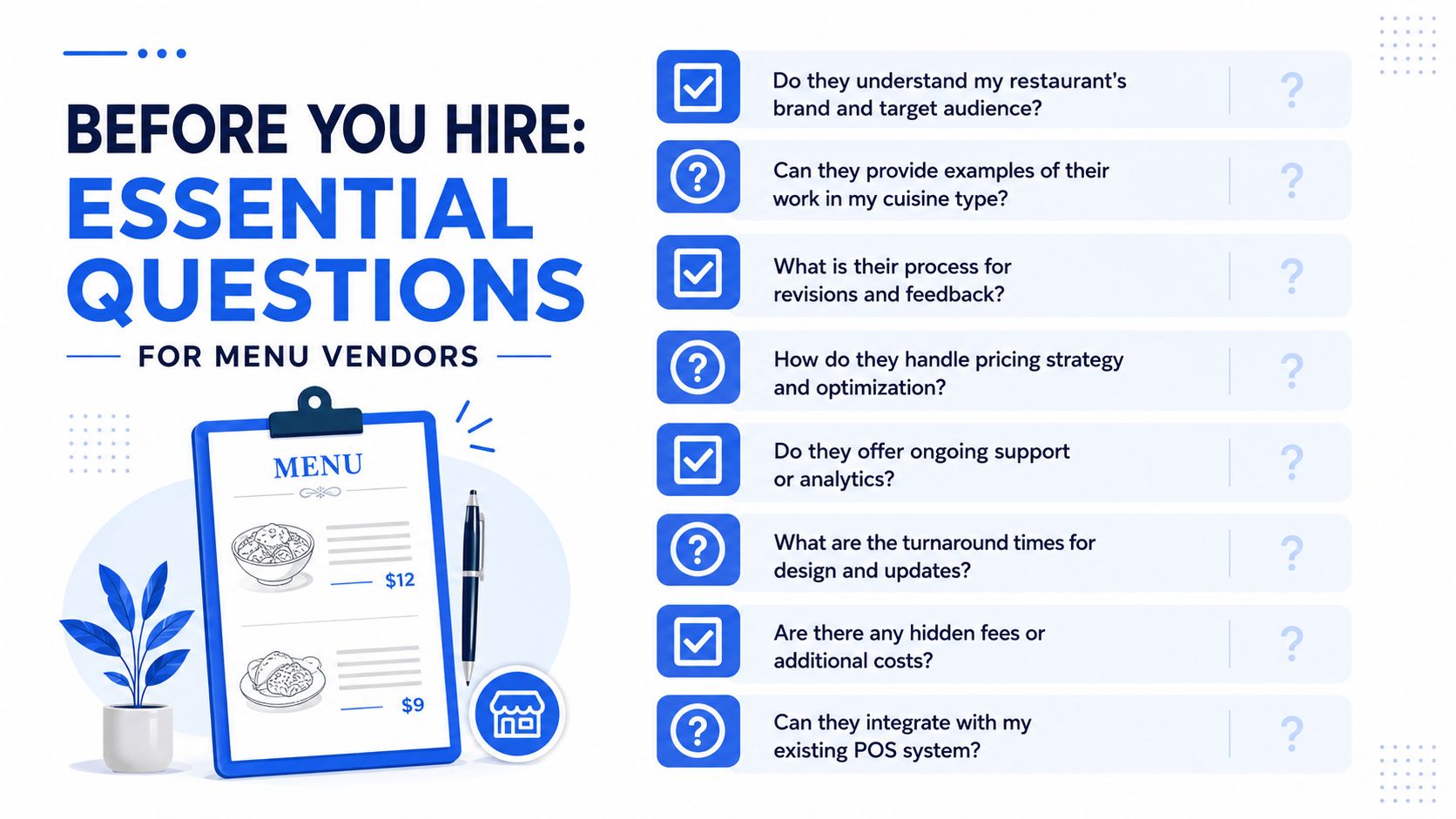
A menu vendor should be able to explain how your menu will make more money, save staff time, and stay accurate under pressure. If they can only talk about fonts, food photography, and mockups, keep looking.
Ask how they improve profit, not just presentation
Start with the business model behind their recommendations.
Ask them:
- How do you decide which items get prime placement
- How do you highlight high-margin items, add-ons, and bundles
- How do you handle menu engineering
- What do you track after launch
- How do you help us increase restaurant revenue, not just refresh the design
A serious vendor should have clear answers. They should talk about contribution margin, item mix, ordering behavior, and guest friction. They should also explain what changes after the first version goes live. That is the difference between a design project and a menu system built to produce better results over time.
If you want that standard in writing, review what a proper restaurant menu optimization process should cover before you sign anything.
Ask who controls updates and how fast they happen
Weak vendors get exposed here.
Ask direct questions:
- What files or system access do I receive at handoff
- Can my managers edit items, prices, modifiers, and availability without sending a request
- How long does a routine update take
- What costs extra after launch
- Can this connect to our POS, online ordering, or loyalty tools
- How do you handle multi-location changes
Print still matters, so ask about production standards too. A print-ready menu should be prepared correctly for commercial printing, with proper color settings, bleed, and export specs. If the vendor gets fuzzy here, your team will waste time fixing preventable errors with the printer.
Ask what happens in a real operating scenario
Portfolios are easy to polish. Operations are harder to fake.
Give the vendor a live test: an item sells out at 4:30, a supplier forces a price change, you need to push a lunch combo tomorrow, and three locations need different versions. Ask them to walk you through exactly who makes the change, how long it takes, and what your managers can do without outside help.
That answer tells you whether you're buying a static asset or a working platform.
Ask what happens after launch
The launch date matters less than the next 90 days.
You need clear answers on:
- Support, who handles urgent edits
- Ownership, who controls the menu data
- Training, who on your team can update it
- Review cycle, how performance gets reviewed
- Scalability, how the system handles new locations, dayparts, or promotions
Choose the vendor that treats the menu like an operating tool. The right partner helps you run faster, test faster, and correct mistakes before they hit service.
Beyond Design The Rise of Revenue-Focused Platforms
The biggest shift in restaurant menu design services isn't visual. It's operational.
The menu is becoming a live platform that shapes ordering behavior, captures data, and supports faster decisions. That's a better fit for how restaurants run.
What changes when the menu becomes a platform
A digital menu can do more than display items. Used properly, it can raise spend without adding pressure to staff. Digital menus can increase average order value by 15-30% through strategic upselling tactics, highlighting high-margin items, and presenting combo deals at the right moment, according to this analysis of how digital menus boost average order value.
That changes how owners should think about the menu.
Instead of asking, "Does it look good?" ask:
- Does it push the right add-ons
- Does it surface profitable bundles
- Does it show what guests buy together
- Does it help us react quickly to sales patterns
- Does it reduce the number of manual fixes staff deal with
This is also why owners looking for broader tactics to increase restaurant revenue should stop separating menu decisions from growth strategy. The menu is one of the fastest places to improve buying behavior.
What operators should expect now
The newer standard is simple. Operators should expect menus that are editable, measurable, and built for phones first.
One example is restaurant menu optimization, where a platform like RevMenue combines QR menus, real-time updates, upsell prompts, bundles, and revenue analytics in one operating layer. That's a different category from a one-time design project. It turns the menu into something teams can manage continuously instead of replacing periodically.
The menu shouldn't freeze the moment it's approved. It should keep learning from service.
That approach is especially useful for cafés, quick-service brands, hospitality groups, and full-service venues running frequent promos or multiple locations. The more often your menu changes, the more a revenue-focused platform makes sense.
Your Next Step Treat Your Menu Like an Asset
Stop treating the menu like a file you finalize and forget.
Treat it like an asset that should earn its place every day. If an item is badly placed, rewrite it. If a section is overloaded, trim it. If updates are slow, fix the system. If your QR menu feels clunky on a phone, rebuild the experience.
Run a quick menu health check this week:
- Review placement: are your profitable items getting prime visibility?
- Review friction: where do guests hesitate or ask staff for help?
- Review updates: how fast can your team change pricing, availability, or promos?
- Review upsells: are add-ons and bundles built into the ordering path?
- Review insight: do you know what the menu is doing to revenue?
You don't need a huge redesign to improve results. You need a menu that works harder.
If your current menu looks fine but isn't helping you sell smarter, it's time to evaluate a platform built for revenue, not just presentation. RevMenue is one option for restaurants that want fast QR menus, built-in upsells, real-time updates, and clearer menu performance data without replacing their whole operating stack.