
Most restaurants don't have a marketing problem. They have a conversion problem.
You're already paying for rent, labor, ingredients, delivery fees, and attention. Guests are walking in, scanning, browsing, ordering, and leaving. The leak usually happens in the gap between interest and spend. A weak menu, a neglected Google profile, slow follow-up, and no system for repeat visits drain revenue every day.
That's why digital marketing for restaurants needs a reset. It's not just about getting more eyeballs. It's about turning visibility into higher tickets, smoother service, and more return visits without piling more work on your team.
Table of Contents
- Marketing Is More Than Getting People In The Door
- The Foundational Channels You Cannot Ignore
- Driving Direct Revenue with Email SMS and Paid Ads
- Your Menu Is Your Most Powerful Marketing Engine
- Measuring What Matters for Restaurant Growth
- Your Quick Implementation Checklist
Marketing Is More Than Getting People In The Door
You're running service, fixing staffing gaps, chasing deliveries, and trying to keep margins alive. Then someone says you need to “do more marketing,” as if that solves anything by itself.
It doesn't. Not if your definition of marketing stops at filling seats.
Real digital marketing for restaurants starts when the guest engages with your business. That includes what they see on Google, what they scan at the table, how easy it is to order, what gets suggested, and whether you give them a reason to come back. If those touchpoints are clunky, more traffic just means more wasted opportunity.
According to Toast's 2022 restaurant technology survey, 79% of diners agree that technology significantly improves their guest experience at restaurants. That should settle the debate. Digital tools aren't a side project anymore. They're part of hospitality.
Practical rule: If a tool improves speed, clarity, or spend without making service feel colder, it belongs in your operation.
Here's the shift smart operators make:
- They stop treating marketing as promotion only. Marketing also includes menu design, digital ordering flow, and post-visit follow-up.
- They focus on revenue per guest, not just guest count. A packed room with weak average tickets still hurts.
- They use tech to reduce staff pressure. QR menus, cleaner modifiers, and smarter prompts help teams sell without sounding scripted.
- They tighten the guest journey. Less friction means faster decisions, fewer ordering errors, and better table flow.
A neighborhood bistro doesn't need a giant “brand strategy.” It needs a clear Google listing, good review management, a menu that sells profitable items first, and a way to bring people back on slower days.
That's the difference between busy and profitable.
The Foundational Channels You Cannot Ignore
Most operators overcomplicate this part. You don't need ten channels. You need three that influence where people choose to eat: local search, social media, and reviews.
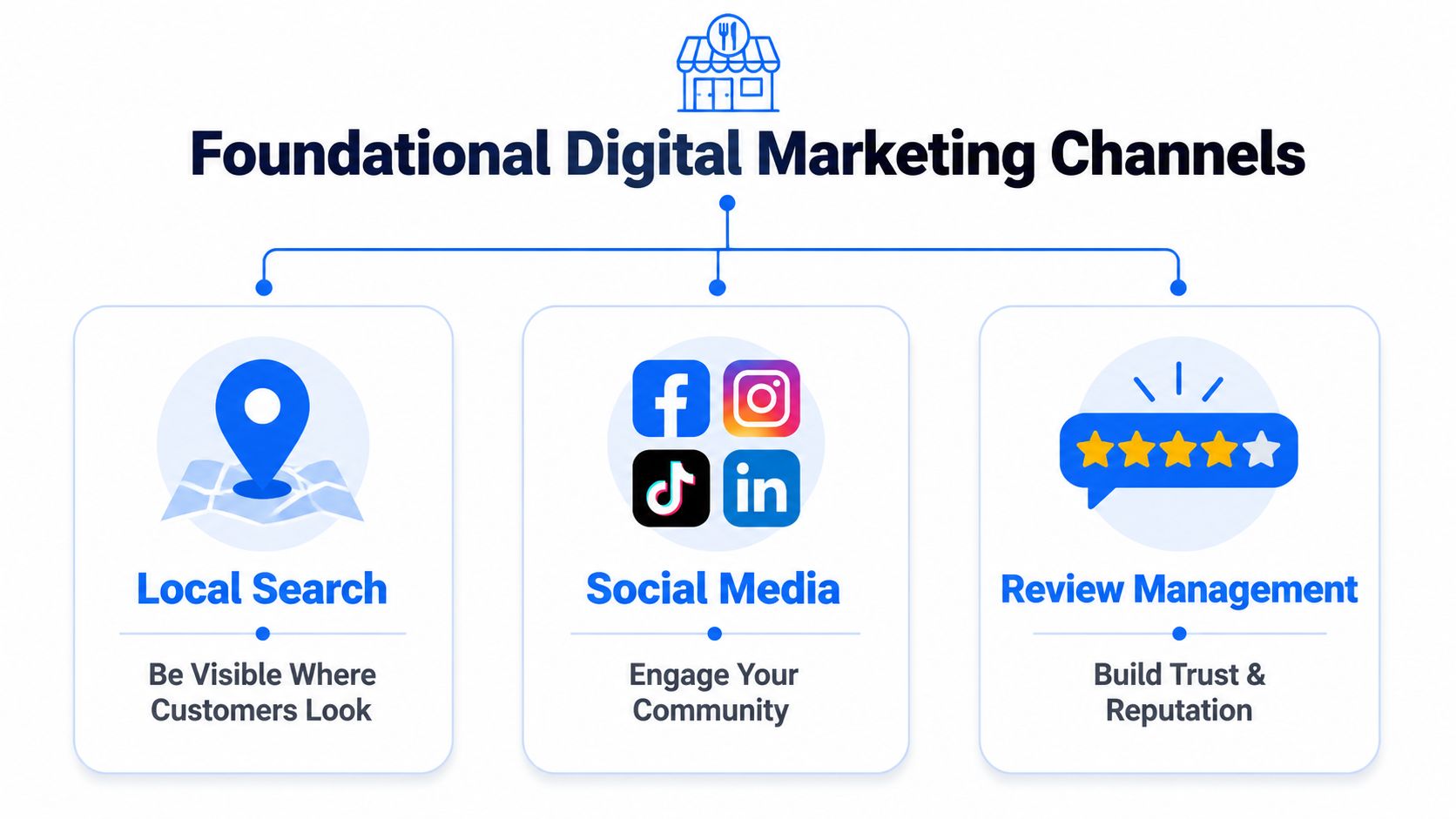
Local Search Wins The First Click
If your Google Business Profile is incomplete, outdated, or sloppy, you're losing customers before they ever see your dining room.
A complete and accurate Google Business Profile can lead to a 300% increase in click-through rates compared to incomplete listings, according to Grubhub's published guidance cited in the verified data. That's not a branding detail. That's discoverability.
Do these first:
- Fix core business info. Name, address, phone, hours, and website must match everywhere.
- Upload useful photos. Lead with food, storefront, interior, patio, and drinks. Skip random poster shots.
- Use a real menu page. Don't bury your menu in a hard-to-read file if a clean web page is possible.
- Update holiday and special hours. Nothing kills trust faster than a guest showing up to a closed door.
- Answer common questions. Parking, reservations, vegan options, corkage, private dining. Put it where people search.
A brunch cafe can win a lot of business just by making sure “open now,” “outdoor seating,” and its signature dishes are obvious the moment someone finds the listing.
Social Media Should Sell The Experience
Restaurants don't need more content. They need better sales triggers.
Your social media should answer three questions fast:
- What kind of place is this?
- What should I order?
- Why should I come this week?
That means simple, repeatable content.
| Content type | What to show | Why it works |
|---|---|---|
| Signature dish posts | Best-selling or highest-margin plates | Gives guests an easy decision |
| Short kitchen clips | Finishing touches, pours, grill moments | Makes food feel immediate |
| Staff moments | Bartender recommendations, chef specials | Adds personality without forcing it |
| Timely promos | Lunch bundle, happy hour, weekend special | Gives a reason to act now |
Don't chase trends that don't fit the room. A fine dining restaurant should look composed and intentional. A burger concept can be louder and faster. The point is consistency.
Post what a first-time guest needs to see before saying yes.
Reviews Are Revenue Signals
Reviews do two jobs at once. They build trust, and they show you where the operation is breaking.
If guests keep praising one dessert, feature it harder. If they keep mentioning slow lunch service, fix the shift pattern before you spend another pound or dollar on ads.
Use this response standard:
- Thank positive reviewers specifically. Mention the dish, bartender, or experience they referenced.
- Acknowledge negative reviews cleanly. Don't argue. Don't get theatrical.
- Move resolution offline when needed. Give a manager contact path.
- Share patterns with the floor and kitchen. Reviews aren't just for marketing. They're operational feedback.
A realistic example: a casual Italian spot notices repeated praise for burrata and complaints that guests “didn't know” about weekday wine specials. The answer isn't another generic Instagram post. It's better in-store prompts, clearer digital menus, and a stronger Google update.
Driving Direct Revenue with Email SMS and Paid Ads
Social platforms are rented land. Your guest list isn't.
The operators who build repeat business well collect contact details through reservations, digital receipts, Wi-Fi access, waitlists, and loyalty sign-ups. Then they use that data to drive another visit with a specific offer, not another vague “come dine with us” message.
Own The Guest Relationship
Email and SMS work best together because they do different jobs.
Email gives you room to explain a seasonal menu, promote an event, or tell a fuller story. SMS is better for urgency. A same-day reminder. A weather-driven offer. A quiet Tuesday push. Used well, they support each other instead of competing.
A simple framework:
- Email for planning. Weekly specials, chef events, birthday offers, private dining reminders.
- SMS for action. Tonight's patio opening, lunch deal, last-call reservation nudge.
- Paid ads for amplification. Push the strongest offer to nearby people who haven't joined your list yet.
If you're building retention, it helps to study restaurant loyalty program approaches that reward repeat visits without adding operational clutter.
What To Send And Why It Works
Most restaurant campaigns fail because the message is too broad.
Better examples:
- We miss you offer: For guests who haven't returned in a while. Keep the reward tied to a real reason to revisit, like a new menu item or quieter midweek service.
- Birthday club: Low effort, high relevance. Guests expect it, and it gives them a natural booking reason.
- Weekly special alert: Best for regular rhythms such as taco night, roast Sunday, wine flights, or office lunch bundles.
- Event-driven note: New brunch launch, live music night, holiday set menu, sports screening.
Keep the creative tight. One offer. One image. One action.
The best campaign usually isn't the prettiest one. It's the one a tired guest understands in five seconds.
Paid Ads Work Best When The Offer Is Tight
Paid social works when the destination is clear and the offer makes sense. It fails when restaurants boost random posts and hope for the best.
Restaurants that invest in paid digital marketing campaigns, such as targeted Facebook Ads, experience an average revenue increase 2.5 times faster than those who do not, according to the AppFront summary citing Deloitte.
That doesn't mean you should throw money at “brand awareness.” It means you should run ads like an operator.
Good ad angles:
- A lunch offer for nearby workers
- A weekday family bundle
- A limited menu item with strong visuals
- A happy hour promotion with a clear time window
- A reservation push for a slow night
A practical example: a neighborhood taco bar runs a local Instagram and Facebook campaign around Taco Tuesday, using a short video, a tight radius, and a direct booking or ordering path. The ad works because the guest knows exactly what they'll get and when.
Your Menu Is Your Most Powerful Marketing Engine
Most restaurants still treat the menu like a document. It's not. It's a sales tool.
Every other channel points here. Search gets the click. Social creates desire. Reviews create trust. But the menu closes the decision. If it's static, cluttered, or passive, your marketing stops right where money should start.
A Static Menu Leaves Money On The Table
A print PDF uploaded three years ago isn't digital strategy. It's dead weight.
A smart QR menu can do work your staff doesn't always have time to do during service:
- Highlight profitable items first
- Recommend relevant add-ons at the right moment
- Bundle items into cleaner, higher-value choices
- Adapt instantly when stock or pricing changes
- Reduce repetitive guest questions
This matters because timing matters. A guest deciding between two mains is far more valuable than a guest seeing a generic promotion later in their inbox.
A Harvard Business Review analysis found that table-side micro-personalization through QR menus generates a 22% higher average ticket size compared to traditional email campaigns. That fits what strong operators already know. Suggestions inside the ordering moment outperform broad marketing sent hours or days later.
Use Menu Psychology Inside The Ordering Moment
Good menu psychology isn't manipulation. It's clarity with commercial intent.
A few moves work across almost every format:
- Lead with anchors. Put signature, profitable, or visually appealing items where attention lands first.
- Name dishes clearly. Guests shouldn't decode the menu.
- Use modifiers to protect margin. Add sauce options, side upgrades, premium toppings, and pairing suggestions.
- Bundle intelligently. Meal deals work because they simplify choice and raise spend.
- Show strong photography selectively. One or two hero visuals often do more than a gallery overload.
For a burger concept, that might mean a clean prompt for loaded fries or a premium drink pairing. For a wine bar, it could mean a dessert-and-digestif suggestion after a guest opens the sweets section.
Operators looking deeper into restaurant menu optimization methods that connect design decisions to profitability usually find the same pattern. Simpler paths sell better.
Here's a quick operational comparison:
| Weak menu behavior | Strong menu behavior |
|---|---|
| Lists everything equally | Guides attention to priority items |
| Uses vague category names | Uses plain language guests understand |
| Leaves add-ons hidden | Prompts them inside the flow |
| Needs staff to explain too much | Answers common questions upfront |
Later in the process, this kind of menu design becomes even more useful:
Analytics Turn Guesswork Into Decisions
The menu also tells you what your guests are trying to do.
You can see what gets viewed, what gets ignored, what categories pull attention, and where guests hesitate. That's valuable because many restaurants change pricing or promotions based on instinct alone.
A menu should help you sell tonight and teach you what to change next week.
A realistic example: a brunch venue sees strong interest in a premium breakfast plate but weak attachment sales. Instead of cutting the price, it adjusts the flow. Coffee upgrades appear earlier, juice bundles become easier to add, and the hero dish gets stronger placement. That's marketing tied directly to average order value.
This is the true center of digital marketing for restaurants. Not vanity exposure. In-venue conversion.
Measuring What Matters for Restaurant Growth
A lot of restaurant teams track whatever the platform makes easiest. Likes. Reach. Followers. Those numbers can be useful, but they don't tell you enough about profit.
The better approach is to watch a small set of operating metrics and tie them to actions.
Ignore Vanity Metrics
You don't need another meeting about impressions if tables are slow to turn and tickets are flat.
Start with business outcomes:
- Average order value tells you whether your menu, upsells, and bundles are working.
- Customer acquisition cost shows whether paid campaigns are efficient.
- Customer lifetime value helps you judge whether retention efforts are worth the effort.
- Table turn time affects how much revenue you can realistically process during peak periods.
Digital reputation also belongs here because trust affects traffic quality. Nielsen reports that 72% of customers trust an online review as much as a personal recommendation. If your review profile weakens, conversion usually weakens with it.
The Numbers Worth Watching Weekly
This doesn't need a complex dashboard at first. It needs discipline.
Track these weekly:
- AOV by daypart: Lunch and dinner usually behave differently.
- Offer performance: Which promotion drove bookings or orders.
- Repeat visit signals: Reservation returns, loyalty redemptions, or recurring customer IDs.
- Menu interaction patterns: Which items attract attention but don't convert.
- Review themes: Not star score only, but recurring praise and complaints.
For operators trying to tighten reporting, restaurant data analytics practices built around menu, guest, and sales behavior are usually more useful than social dashboards alone.
If a metric doesn't help you change staffing, menu design, pricing, or promotions, it's probably not important enough to lead with.
A practical example: if AOV rises after adding a drink pairing prompt, keep it. If paid ads increase clicks but don't improve bookings or orders, the issue is probably the offer or the landing experience, not the ad platform itself.
Your Quick Implementation Checklist
Most restaurants don't need a twelve-month transformation plan. They need a short list of changes they can execute while service is still happening.
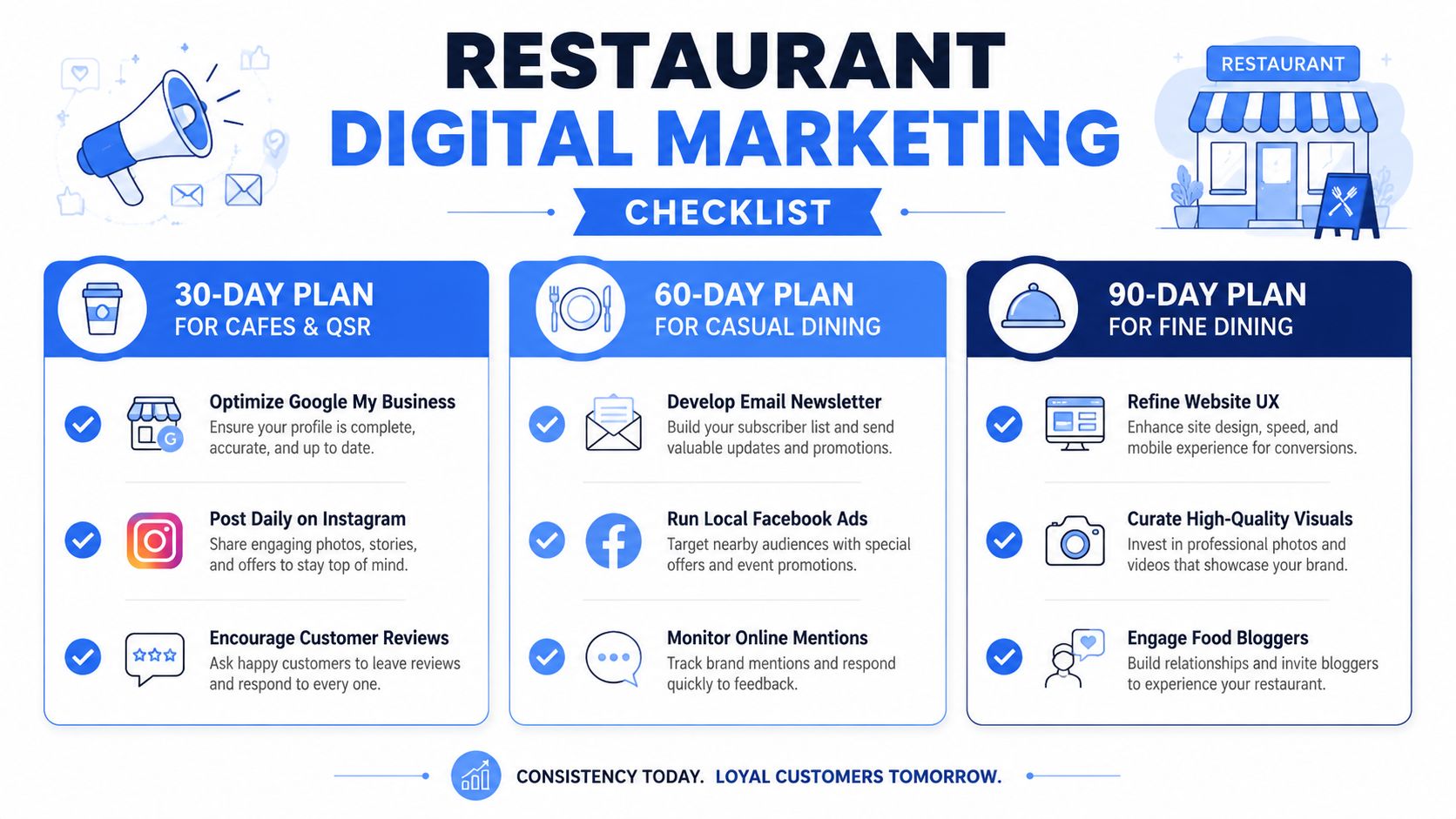
The 30 Day Plan For Cafes And QSR
Speed matters more than complexity here.
- Clean up local visibility. Fix your Google profile, opening hours, menu link, and storefront photos.
- Simplify the menu path. Put best-sellers, combos, and add-ons where guests can choose fast.
- Capture guest data lightly. Use digital receipts, Wi-Fi, or loyalty prompts without creating friction.
- Promote one repeatable offer. Think breakfast bundle, weekday coffee upsell, or afternoon pickup push.
A cafe owner can get a lot done by focusing on one hero product line and one return-visit trigger.
The 90 Day Plan For Full Service Restaurants
Full-service teams need a stronger blend of hospitality and systems.
First, tighten the front end. Update search listings, improve photography, and make reservations or ordering obvious.
Then fix the in-house conversion layer:
- Rework the menu for margin. Prioritize profitable dishes and premium pairings.
- Train staff around prompts that feel natural. “Would you like fries?” is weaker than “Most guests add the rosemary fries with that.”
- Use email and SMS for slow periods. Midweek covers, private dining, tastings, and birthdays are all fair game.
- Review feedback by category. Food, pacing, service, ambiance. Don't lump everything together.
The Multi Location Growth Plan
Multi-site operators need consistency first. Creativity comes second.
Use this order:
- Standardize data inputs. Hours, menu naming, category structure, and location information should match.
- Set one reporting cadence. Weekly is enough if it's clean.
- Localize offers by unit. Don't force the same promotion everywhere if trade patterns differ.
- Roll out menu changes centrally, then test location by location.
- Use review trends as operating signals. One store's recurring complaint often points to a training gap.
For groups, the biggest gain usually comes from reducing inconsistency. One location shouldn't look abandoned online while another looks polished.
Keep the implementation simple. Fix discoverability. Improve the ordering moment. Build a repeat-visit system. Measure what changes revenue.
If you want a faster way to put this into practice, RevMenue is built for exactly this job. It helps restaurants turn the menu into a revenue tool with fast QR menus, built-in upsells, menu analytics, and low-friction setup that works alongside existing systems. It's a practical fit for operators who want better margins, less manual menu work, and a clearer link between digital marketing and in-venue profit.