
Most restaurants lose revenue through their menus without realizing it.
You can feel it in service. The dining room is busy enough, but the check average won't move. Guests keep ordering the same safe items. A few dishes sell well but don't leave much margin. Other dishes should be profitable, yet they barely move. Staff are too busy to upsell consistently, and every menu reprint turns a simple change into a chore.
That's a menu problem, not just a traffic problem.
A menu isn't a list of dishes. It's your most important sales tool. If it's static, cluttered, badly priced, or disconnected from real ordering behavior, it drags down revenue and adds unnecessary operational friction. Good restaurant menu optimization fixes that. It gives you better margins, cleaner ordering, smarter upsells, and fewer decisions left to chance.
Table of Contents
- Your Menu Is Leaking Profit Here's How to Fix It
- First Diagnose Your Menu's Performance
- Engineer Prices and Items for Higher Margins
- Design Your Menu Layout to Guide Customer Choice
- Increase Average Order Value with Smart Upsells
- Make Optimization a Habit with Testing and Analytics
Your Menu Is Leaking Profit Here's How to Fix It
If your menu hasn't been reviewed seriously in months, it's almost certainly underperforming.
Owners often blame slow margin growth on labor, delivery fees, or supplier inflation. Those are real issues. But I've seen plenty of operators ignore the one tool sitting in front of every customer. The menu shapes what people order, what they add, what they skip, and how easy the kitchen can execute service.
An unoptimized menu creates three expensive problems:
- It hides profitable items. Guests order what they notice first, not always what you want to sell most.
- It protects weak sellers. Low-margin items stay on the menu because nobody has forced a hard decision.
- It increases staff workload. Servers and cashiers end up doing the selling work that the menu should already be doing.
Practical rule: If your team has to constantly explain the best choices, the menu isn't doing its job.
Restaurant menu optimization works best when you stop treating menu design, pricing, and digital ordering as separate projects. They're the same system.
The fix is straightforward:
- Diagnose item performance using popularity and profitability.
- Re-engineer prices and recipes where margin is weak.
- Redesign layout and wording so guests notice the right items first.
- Use QR and digital menus to test, update, and upsell faster than print ever could.
- Track results continuously instead of waiting for the next full menu overhaul.
That's the shift most operators need. Traditional menu engineering gives you the framework. Modern digital menus give you speed, visibility, and control. Put the two together and the menu stops being a static document. It becomes a working revenue system.
First Diagnose Your Menu's Performance
Most menu changes fail because the owner starts with opinions. Start with item performance instead.
An expertly designed restaurant menu can increase profits by up to 15% through menu engineering that combines psychology, data, and creativity, according to Tableo's guide to restaurant menu engineering. That matters because guesswork usually protects familiar dishes instead of profitable ones.
Start with the two numbers that matter
You need two numbers for every item on the menu.
| Measure | What it tells you | How to calculate it |
|---|---|---|
| Contribution margin | Profitability per dish | Selling Price minus Portion Cost |
| Sales mix | Popularity | Share of total sales for that item |
That first number is imperative. If you don't know contribution margin item by item, you don't know your menu.
Sales mix matters just as much. A dish can look great on paper and still be dead weight if guests don't order it. On the other hand, a lower-margin item can still matter if it drives strong volume and creates attachment opportunities with sides, drinks, or desserts.
Here's the practical way to run the diagnosis:
- Pull recent sales data. Use a normal trading period, not a holiday spike or one-off event week.
- Match each item to its portion cost. Don't use rough estimates. Use recipe-costing cards.
- Calculate contribution margin. Keep it simple and consistent.
- Rank popularity by sales mix. This tells you what guests choose.
- Classify every item. Don't leave “special cases” outside the analysis.
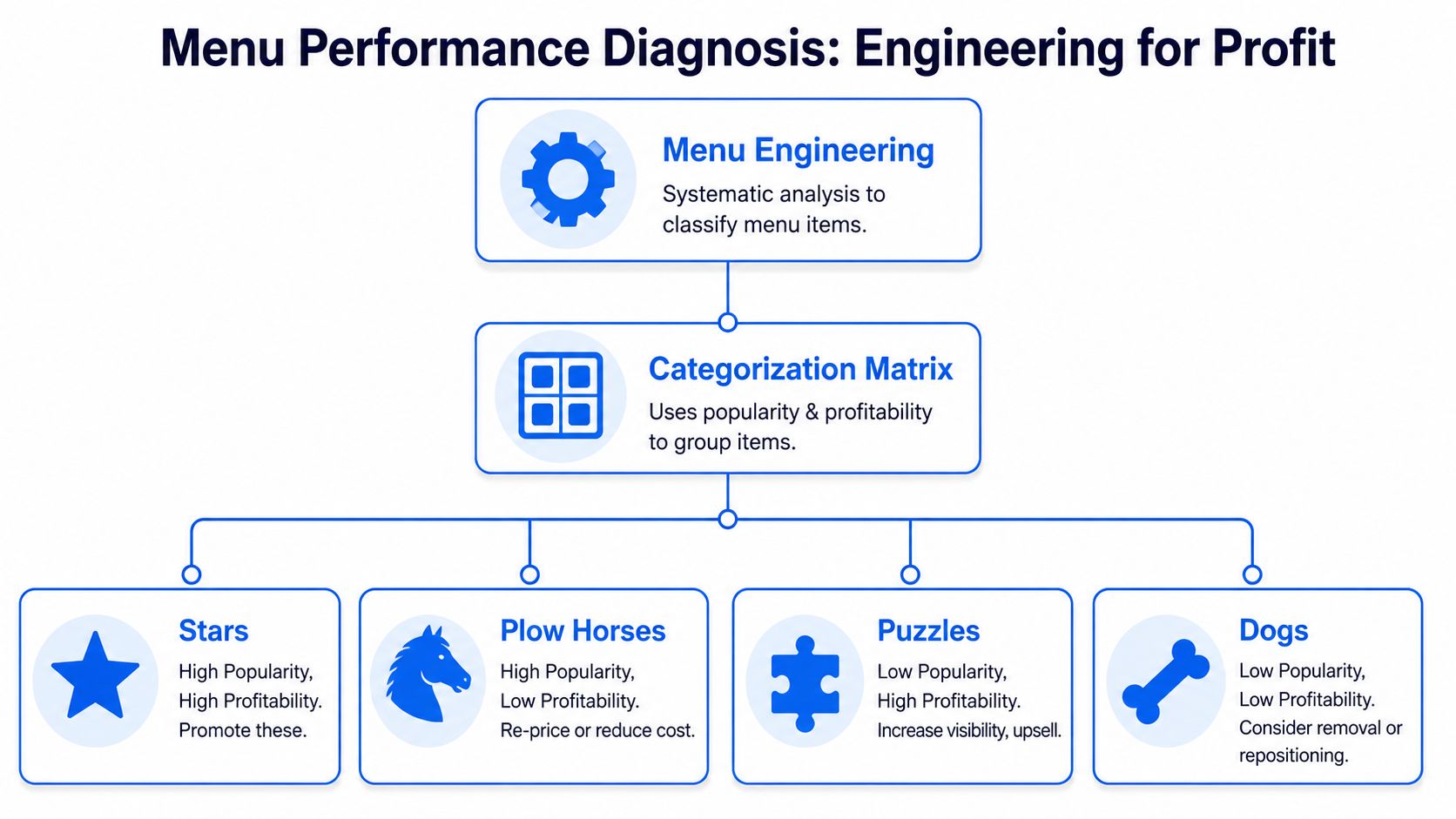
Use the four-box menu matrix properly
Once you have profitability and popularity, sort items into four categories:
Stars
These are high popularity and high profitability. Protect them. Keep quality tight, place them prominently, and make sure they never disappear in a crowded section.Plowhorses
These sell well but don't make enough money. Many restaurants experience margin erosion from these offerings. Re-price carefully, tighten portioning, or swap a costly component for a better-controlled alternative.Puzzles
These make good money but don't sell enough. Usually the problem isn't the dish. It's placement, naming, visibility, or lack of staff confidence when recommending it.Dogs
Low popularity and low profitability. Be ruthless here. If an item adds complexity, prep burden, or inventory drag without earning its spot, remove it or reposition it.
Don't ask whether a dish is “liked.” Ask whether it earns its place on the menu.
There's another operational point owners miss. Menu analysis should be recurring, not occasional. Research on menu cost management found strong positive relationships between cost management and operational performance, including a Spearman's Rank-Order correlation coefficient of 0.773 and Kendall's Tau-b of 0.573, and it recommends analyzing the menu at least four times a year while using customer feedback and A/B testing to keep improving, as outlined in this menu cost management study.
That quarterly habit changes decisions fast. A brunch item that was acceptable three months ago may now be a margin problem. A dinner entrée nobody noticed in print may become a strong seller once it gets better placement in digital ordering.
Engineer Prices and Items for Higher Margins
Once you know which dishes are helping and which are hurting, fix the economics. Don't redesign your menu before you repair the offers on it.
Price for buying behavior, not just food cost
A lot of restaurants still price from the kitchen backward. They take cost, add target markup, and stop there. That's incomplete. Pricing is also presentation.
According to Bento's menu psychology guidance for restaurants, placing high-margin items in the first 2-3 items of the prime viewing zone can increase average order size by directing attention early. The same source notes that removing dollar signs can reduce price friction. Guests read 14.99 differently than $14.99.
That gives you a few immediate rules:
- Lead with margin. Put the profitable dishes high in the section, not buried in the middle.
- Drop dollar signs. Keep the focus on the dish, not the spend.
- Use charm pricing where it fits your concept. Casual and fast-casual brands often benefit from it.
- Avoid neat price columns. They turn the menu into a price-comparison chart.
If you need a sharper framework for that process, review a practical restaurant pricing strategy before you touch the full menu.
Treat each menu category differently
Not every dish needs the same intervention. That's where many operators waste time.
| Category | What to do tomorrow | Why it matters |
|---|---|---|
| Stars | Feature them early in the section and keep execution consistent | They already win. Don't tamper carelessly. |
| Plowhorses | Test a price increase, portion adjustment, or ingredient swap | Volume without margin is a trap. |
| Puzzles | Rename, reposition, and give staff a reason to mention them | The issue is often visibility, not value. |
| Dogs | Remove, simplify, or move to a limited role | They clutter the menu and the kitchen. |
A realistic example: say your chicken sandwich is one of your best sellers, but margin is weak because of an expensive side and oversized protein portion. Don't kill the item. Tighten the plate build, review garnish waste, or make the premium side an upgrade. Guests still get the sandwich they came for, and you stop leaking margin on every order.
Another example: a profitable pasta isn't selling. That's usually a Puzzle. Put it near the top, rewrite the name so it sounds like a finished dish instead of a kitchen shorthand, and have servers recommend it when guests want something shareable or comforting.
The best menu edits are rarely dramatic. Small changes repeated across multiple items do the heavy lifting.
Design Your Menu Layout to Guide Customer Choice
Menu design isn't decoration. It's traffic control.
Most operators know layout matters, but they still treat print layout and digital ordering as different conversations. That's a mistake. The same menu psychology applies to both. The difference is that digital menus let you apply it faster, more precisely, and with much better visibility into what's working.
Paper menus can guide attention, digital menus can direct it
A printed menu can highlight an item. A QR menu can actively shape the decision path.
Digital menus can increase average order value by 15-30% compared with static paper menus because they make it easier to spotlight high-margin dishes through larger images, recommendation badges, and visual emphasis, according to Calisto's analysis of digital menus and AOV.
That difference matters in real operations:
- Print menus are slow to change. If a dish underperforms, you live with it until the next reprint.
- QR menus update instantly. You can change order, wording, availability, and highlights without waste.
- Paper has limited selling space. Too much detail makes it cluttered.
- Digital supports layered information. You can keep browsing clean while still adding photos, badges, and modifiers.
If you want to see what strong presentation looks like in practice, study examples of the best designed menu layouts and notice how they guide the eye without overwhelming the guest.
Use visual cues to sell without adding pressure
A good layout should make profitable choices feel obvious, not forced.
Use these design moves:
- Feature badges selectively. “Chef's Recommendation” works best when it's reserved for dishes you want to push.
- Give Puzzles more visual support. A strong photo or better thumbnail can do what a printed description can't.
- Keep sections tight. Fewer weak options means stronger decision flow.
- Write like a restaurant, not a spreadsheet. “Charred lemon chicken with rosemary potatoes” sells better than a flat product label.
Digital menus also offer operational advantages. They reduce the need for staff to repeat basic item explanations, especially in busy lunch or peak weekend service. Guests can browse at their own pace, see details clearly, and move toward a decision faster.
Here's a useful example of how modern menu presentation works on screen:
The big advantage isn't just aesthetics. It's control. When a profitable item needs help, you can change its presentation today instead of next quarter.
Increase Average Order Value with Smart Upsells
If your menu only helps guests pick a main, you're leaving money behind.
The best restaurants build ordering paths, not just item lists. They make it easy for the guest to complete the meal. Done well, this feels helpful. Done badly, it feels like pressure. Digital ordering makes the helpful version much easier to deliver consistently.
Build offers that make ordering easier
Bundles and combos work because they reduce decision fatigue while nudging spend upward.
A guest choosing lunch doesn't always want to build the meal piece by piece. A bundle solves that. It also gives you control over what gets attached to the core item.
Use this playbook:
- Create logical combinations. Sandwich plus fries plus soft drink. Coffee plus pastry. Pasta plus starter plus glass of wine.
- Pair low-friction add-ons. Dips, sides, desserts, and drinks should appear when they make sense in the order flow.
- Match upsells to the item. Offer garlic bread with pasta, not random extras that slow the decision.
- Keep the language soft. “Complete your meal with a drink?” works because it sounds useful, not aggressive.
Curated bundles and combo deals are a top strategy for increasing average order value, and digital platforms make them easier to test and refine in real time, while automated prompts such as “Complete your meal with a drink?” help drive add-ons during ordering, according to ChowNow's guidance on increasing restaurant average order volume.
A good upsell removes effort for the guest. That's why it converts.
Use urgency without making the menu feel gimmicky
Limited-time offers and seasonal menus are strong commercial tools when they're tied to real demand and clean execution.
Seasonal menus that use local ingredients and limited-time offers can drive repeat business and raise average order value by creating urgency and exclusivity, as explained in Lightspeed's article on seasonal restaurant menus.
The operational upside is just as important:
- They focus the menu. Fewer competing choices make ordering simpler.
- They support marketing. A timely offer gives email, social, and in-store promotion a clear hook.
- They reduce stale menu sections. Guests notice when nothing changes.
- They can lighten service friction. A tighter seasonal offer often means quicker recommendations and cleaner prep planning.
A café can run a limited seasonal latte and pastry pairing. A pub can push a match-day burger bundle. A bistro can feature a short seasonal special section with clear availability dates. None of that is difficult in digital ordering. In print, every tweak is slower and more expensive.
Make Optimization a Habit with Testing and Analytics
Menu optimization isn't a redesign project you finish once. It's an operating discipline.
That's the biggest gap between old-school menu engineering theory and what restaurants need now. Historical sales data is useful, but it's not enough on its own. Guests don't order the same way at lunch and dinner. Rain changes behavior. Local events change behavior. A hot Saturday afternoon doesn't produce the same mix as a cold Tuesday night.
Review the menu on a schedule
Operators who wait until they “feel” the menu is stale usually wait too long.
Build a review rhythm around real checks:
- Item profitability by menu item
- Sales mix by category and daypart
- Average order value by channel
- Attachment behavior on sides, drinks, and desserts
- Customer feedback that points to confusion, friction, or demand shifts
Use A/B testing where possible. Change one thing at a time. Test item names, placement, featured badges, bundle structure, or upsell timing. Then keep what improves commercial performance and drop what doesn't.
If you're building a more disciplined reporting habit, a solid restaurant data analytics setup should make these reviews easy to run without creating another spreadsheet project for the team.
Use real-time data, not yesterday's assumptions
In this regard, modern QR and digital menus become much more powerful than static engineering models.
Recent 2025-2026 data shows AI-driven menu optimization can produce 4-9% gross margin improvements by replacing intuition-led menu decisions with real-time forecasting that adjusts for dayparts and peak periods. The same source notes that QSRs can see 3-5% margin lifts and 12-15% waste reductions when they optimize offerings for different dayparts, according to ChowNow's coverage of menu optimization trends.
That's the practical leap many restaurants still haven't made.
Traditional menu engineering asks, “What sold well last month?”
Modern digital optimization asks better questions:
- What should we push at lunch versus dinner?
- Which items deserve visibility during slower periods?
- Which offers reduce waste when demand shifts?
- What's the best bundle for this daypart, not just this season?
The menu that works at 12:30 p.m. may be the wrong menu at 8:30 p.m.
A full-service restaurant might feature lighter, faster decisions during lunch and steer guests toward higher-value shareables and drinks in the evening. A café can change the upsell path once morning coffee traffic slows. A multi-location group can compare patterns across neighborhoods instead of forcing one identical menu logic everywhere.
That's why restaurant menu optimization should sit inside daily operations, not just quarterly planning. The old framework still matters. Popularity, margin, pricing, and placement remain core. But QR menus, digital ordering, and live analytics let you act on those principles while the business is moving.
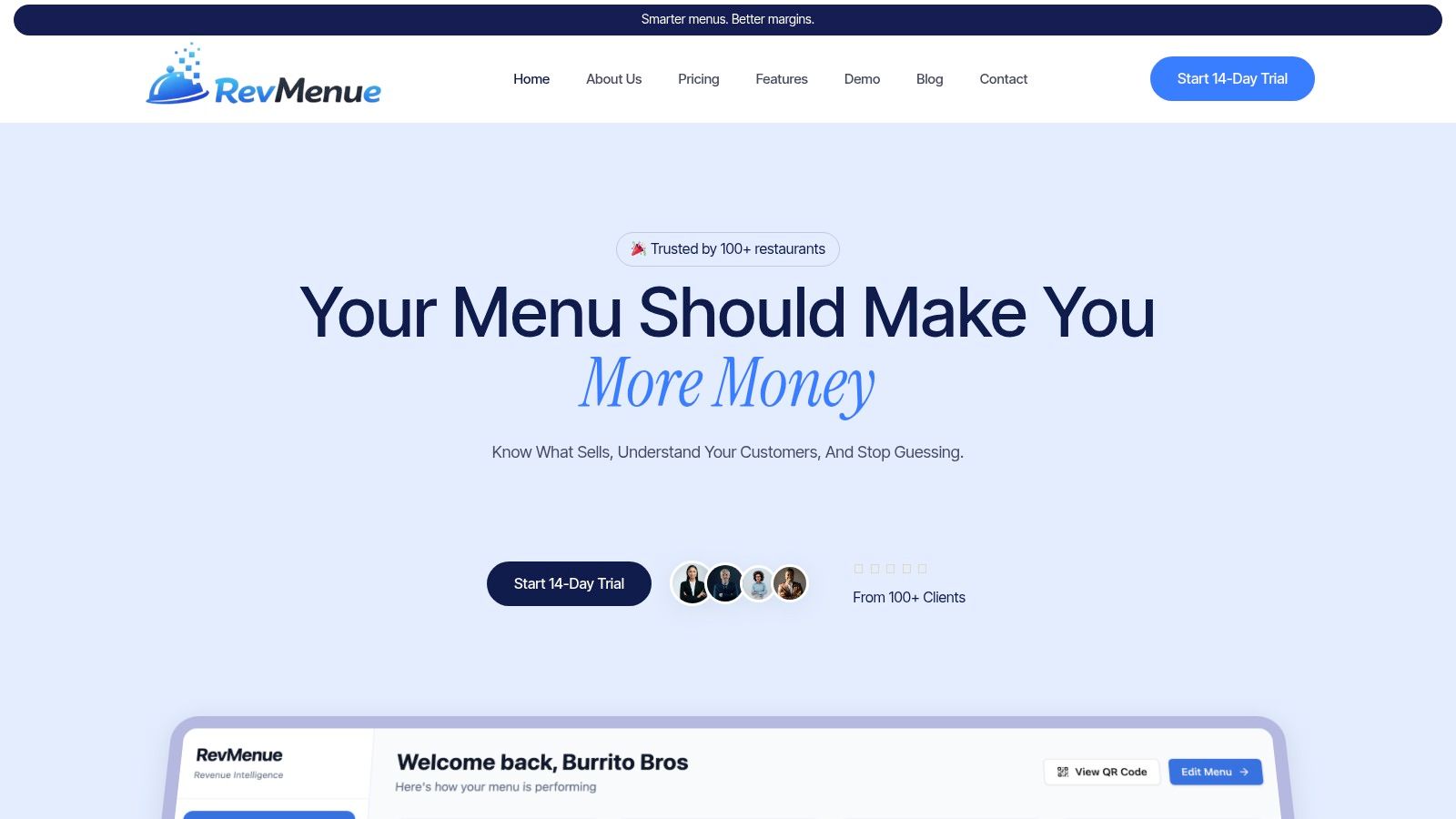
RevMenue helps restaurants turn menu theory into day-to-day revenue action. If you want faster QR menu updates, cleaner upsells, better bundles, and live performance data without ripping out your existing systems, take a look at RevMenue.