
Most restaurants don't have a staffing problem. They have a training problem that shows up as staffing pain, guest complaints, slower service, and smaller checks.
You see it every week. A new hire gets tossed into a live shift too early. They don't know the menu well enough to recommend anything. They ring items in wrong. A manager jumps in to fix mistakes. The guest feels the wobble. The server feels overwhelmed. Nobody wins.
If you want better retention and higher sales, treat training in a restaurant like a revenue system. Every module should connect to a business outcome. Better onboarding should reduce early churn. Better menu training should increase check averages. Better FOH and BOH role clarity should cut errors and speed up service.
Table of Contents
- Why Most Restaurant Training Fails (and Costs You Money)
- Building Your 7-Day Onboarding Playbook
- Front of House vs Back of House Training Tracks
- Training Your Team to Increase Average Order Value
- Measuring Success and Keeping Skills Sharp
- Scaling Training Across Multiple Locations
Why Most Restaurant Training Fails (and Costs You Money)
The biggest training mistake is simple. Operators confuse exposure with training.
A new team member shadows one shift, watches a few steps, gets a quick POS walkthrough, then gets pushed onto the floor. That isn't training. That's controlled chaos. When that person misses an allergy note, forgets an add-on, or freezes during a rush, the labor cost isn't the underlying issue. The lost guest confidence is.
The usual failure pattern
Most weak programs break down in the same places:
- No standard start: One manager trains one way, another manager trains a different way, and the employee gets mixed signals.
- Too much talk, not enough reps: Staff hear standards once but don't practice them under pressure.
- No link to sales: Nobody explains which menu items matter most, what pairings lift checks, or how to recommend them naturally.
- No measurement: If you don't track retention, order errors, ticket time, and sales behavior, you're guessing.
The cost of that guesswork is huge. Undertraining incurs nearly $200,000 in excess annual expenses, or 40% of average revenue, driven by turnover, low productivity, and errors, according to Escoffier's breakdown of undertrained restaurant staff costs.
That's why I don't treat training as admin. I treat it like margin protection.
Practical rule: If a training topic can't be tied to guest experience, speed, accuracy, retention, or check average, it doesn't belong in your core program.
What good operators do differently
Strong operators build one repeatable system and make every location use it. They document standards, train in short blocks, and coach in live service. They also keep materials easy to access. A printed binder buried in an office won't help a server before lineup.
A useful model is a central playbook with clear role expectations, menu knowledge, service standards, and refreshers. If you want a reference point for structuring that system, this guide on restaurant staff training is worth reviewing.
Here's the blunt truth. If your team keeps making the same mistakes, your process trained them to.
Building Your 7-Day Onboarding Playbook
The first week decides whether a new hire becomes productive or becomes a problem. If day one is sloppy, the rest of the month turns into repair work.
I'd rather slow the first week down and speed the next six months up.
What the first week should accomplish
Your onboarding goal isn't to flood people with information. It's to build competence in the basics fast.
That lines up with what operators are doing right now. A “back to basics” movement has emerged, with 61% of operators prioritizing fundamental job skills training, up 25% from 2024, according to the QSR Magazine report on restaurant training trends for 2025.
That's the right move. Fundamentals create consistency. Consistency creates trust. Trust creates repeat business.
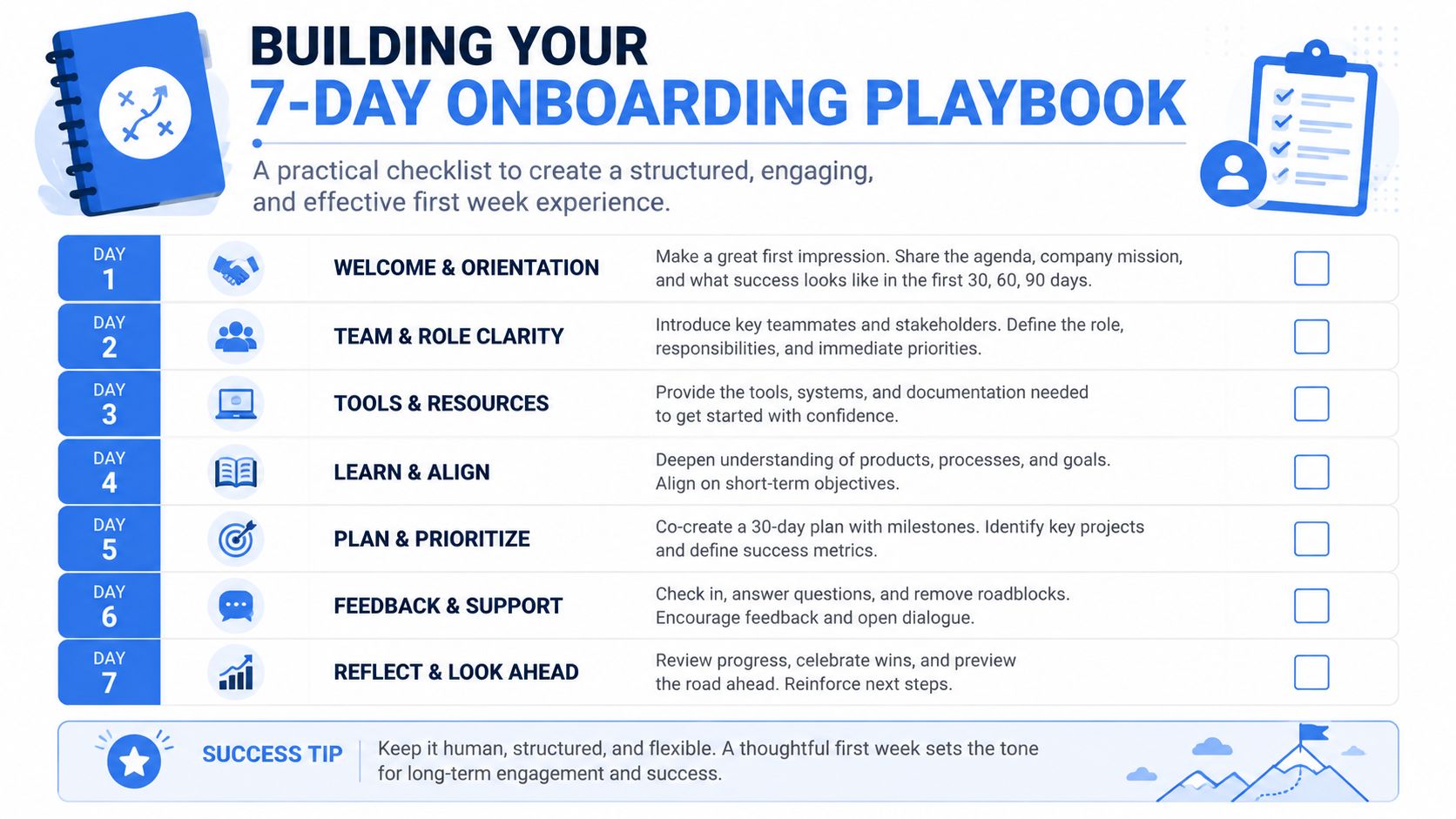
A practical 7-day schedule
Here's the first-week structure I recommend.
Day 1
Start with standards, not paperwork.
- Brand basics: Explain what your restaurant promises guests every shift.
- Team map: Show who owns what on the floor and in the kitchen.
- Non-negotiables: Uniform, punctuality, communication, allergy handling, station setup.
- Tour the operation: Walk the line, expo, storage, POS, service stations, and restrooms.
End the day with one simple check. Ask the hire to explain the guest experience in their own words. If they can't do that, they're not ready for day two.
Days 2 and 3
This is menu and safety territory.
Use short sessions. Taste where possible. Keep it practical.
- Menu knowledge: Top sellers, highest-margin items, common modifications, allergen concerns.
- POS basics: Open checks, modifiers, void process, split checks, payment flow.
- Service mechanics: Greeting timing, table touches, order review, handoff standards.
- Food safety basics: Temperature awareness, handwashing, contamination prevention, holding standards.
Don't let staff memorize menu descriptions like actors reading lines. Train them to explain items like hosts.
If a server can't answer “What do you recommend?” with confidence, you haven't finished onboarding.
Days 4 and 5
Now the new hire shadows a top performer. Not just any available employee. Your best trainer.
The trainer should narrate decisions in real time:
- Why they suggest one appetizer over another
- How they pace a table
- When they fire a course
- How they recover a small mistake before it becomes a guest complaint
New hires learn rhythm in this environment. Restaurants run on rhythm more than policy.
Days 6 and 7
Put them into live reps with supervision.
Use a controlled section, lighter volume if possible, and immediate feedback after each table or ticket cycle.
A good end-of-week checklist looks like this:
- Can they greet confidently?
- Can they use the POS without freezing?
- Can they explain core menu items clearly?
- Can they handle a basic guest question without calling a manager?
- Can they follow sidework and station reset standards?
If the answer is “not yet,” extend the practical work. Don't promote someone to independence because the schedule needs it. That decision usually costs more than it saves.
Front of House vs Back of House Training Tracks
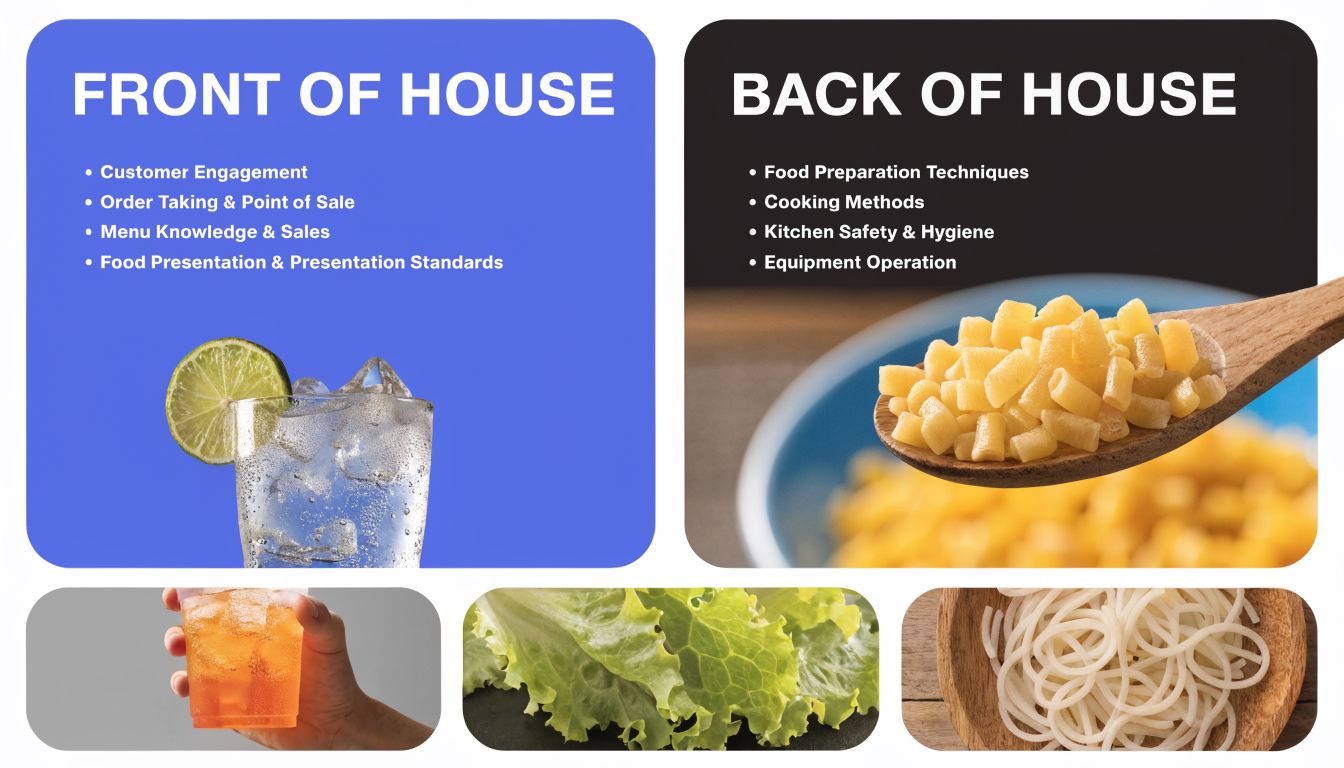
A one-size-fits-all program wastes time. FOH and BOH create the same guest experience from different angles, but they need different training tracks.
That distinction matters because the mistakes are different. FOH mistakes usually hit perception and sales. BOH mistakes usually hit speed, consistency, and product quality.
What FOH needs to master first
FOH training should create confident, calm sellers. Not scripted robots.
Priorities for servers, hosts, runners, and cashiers:
- Guest flow: Greeting, waitlist communication, pacing, check presentation, problem recovery.
- POS speed and accuracy: Modifiers, special requests, seat positions, payment handling.
- Menu storytelling: What a dish is, who it's for, what pairs well with it, and what to recommend instead if a guest hesitates.
- Upsell judgment: Offering add-ons that fit the guest, not random pitches.
- Communication with BOH: Clear firing, allergy calls, timing notes, and ticket follow-up.
A host needs a version of this too. Hosts shape first impression and floor flow. They should know enough about menu highlights and wait-time communication to protect the mood before a guest ever orders.
If you manage FOH teams regularly, this category archive on FOH training gives useful examples of what to standardize.
What BOH needs to master first
BOH training should build repeatable execution under pressure.
Focus on these areas first:
- Station setup: Every tool, pan, product, and backup in the same place every shift.
- Recipe accuracy: Consistent portioning, plating, garnish, and build sequence.
- Ticket discipline: Read correctly, fire correctly, communicate delays early.
- Prep and par levels: Know what must be ready before service and what gets replenished during service.
- Sanitation habits: Clean-as-you-go, label discipline, storage control, and handoff cleanliness.
Good BOH training also includes cross-understanding of the floor. Cooks don't need full FOH training, but they should understand service pressure points. That reduces friction at expo and shortens the gap between kitchen output and guest expectation.
Where bartenders need a separate track
Bartenders sit between FOH sales and BOH precision. Train them separately.
Their track should include:
- Build consistency: Every drink made the same way, every time.
- Speed under load: Sequence drinks by efficiency, not panic.
- Pour cost awareness: Know which drinks are profitable and which ones need tighter control.
- Guest reading: Some guests want guidance, others want speed. Bartenders need to know the difference.
- Responsible service: This is operational discipline, not optional etiquette.
The best bartenders don't just make drinks quickly. They protect margin while keeping the bar feeling smooth.
Training Your Team to Increase Average Order Value
If your training doesn't improve sales behavior, you're leaving money on the table.
Many restaurant groups struggle with upselling because they rely on awkward scripts. Asking, “Do you want to add anything?” is lazy. It creates friction and usually gets a no. Good recommendation training sounds specific and useful.
Stop teaching scripts and start teaching recommendations
Train staff to recommend with context.
Here's the difference:
- Weak approach: “Would you like an appetizer?”
- Better approach: “If you want something quick to share while the mains are working, the loaded fries come out fast and pair well with the burgers.”
That sounds like service, not pressure.
Your team should learn three recommendation moves:
Pairing recommendations
Teach one drink, one side, and one dessert pairing for each priority menu item.Upgrade recommendations
Show when to suggest premium add-ons, doubles, combo upgrades, or bundle choices.Substitution recovery
If a guest rejects one option, staff should have a second recommendation ready.
This needs live practice. Role-play common table moments before service. Keep it short and realistic.
- At greeting: Recommend a fast opener.
- At order time: Suggest the best-fit side or beverage.
- Before check drop: Offer dessert or a takeout add-on if it suits the concept.
Use QR menus as a live training tool
Digital menus are more than a guest interface. They're a coaching tool.
When staff can see what guests click, what pairings convert, and which items get ignored, they stop guessing. They start selling what works. That's where menu analytics become useful in training, not just marketing.
According to Yelp's restaurant training guidance, integrating QR menu analytics into training for real-time upsell drills can boost Average Order Value by 10-15% post-training.
That matters because now you can train from facts:
- What dishes get scanned most often
- Which modifiers guests add most
- What bundles or pairings deserve more verbal support
- Which high-margin items need better explanation from staff
If you're building this into your playbook, this page on restaurant menu optimization gives a practical view of how menu performance can inform training decisions.
Sales coaching rule: Don't ask staff to “sell more.” Show them which items deserve attention and exactly how to present them.
A café can use this to train baristas to pair pastries with top drinks. A casual dining operator can train servers to guide guests toward profitable add-ons that match entrée choices. A bar can coach bartenders on which signature cocktails deserve a second sentence, not just a mention.
That's how training increases average order value without making service feel transactional.
Measuring Success and Keeping Skills Sharp
Training isn't finished when onboarding ends. Skills fade fast when teams don't revisit them.
That's why I prefer short, recurring training over occasional marathon sessions. Big training days feel productive. Daily or weekly refreshers change performance.
What to measure every week
You don't need a complicated system. You need a short list of useful metrics tied to behavior.
Use this table as your base.
| Training Goal | Primary Metric | How to Measure |
|---|---|---|
| Faster ramp-up | Time to independent shift readiness | Manager signoff after observed live-service reps |
| Better order accuracy | Order error trend | Review comps, voids, remakes, and guest recovery notes |
| Stronger menu knowledge | Quiz and verbal recommendation quality | Use short pre-shift quizzes and role-play checks |
| Higher check averages | Upsell behavior and check mix | Compare add-on attachment patterns and item mix before and after coaching |
| Better guest experience | Service consistency | Review guest feedback themes and manager floor observations |
| Lower turnover risk | Early retention trend | Track who leaves during the first weeks and what training gaps show up repeatedly |
This is coaching data. Don't bury it in reports nobody reads.
Use it in lineup. Use it in one-on-ones. Use it to spot which location, shift, or manager needs help.
Why microlearning works better than big retraining days
The best refresher training is short enough to survive a real restaurant schedule.
That's why microlearning works. A quick pre-shift drill on allergy communication, one menu feature, one beverage pairing, or one POS habit is easier to repeat and easier to retain.
The payoff is clear. According to Echo360's article on restaurant training and employee development, overlooking ongoing training causes 40% skill decay in 90 days, while continuous microlearning can cut employee turnover by 25-35% by enabling incremental skill-building.
Use that insight practically:
- Monday: one menu quiz
- Wednesday: one role-play on guest objections
- Friday: one POS speed drill
- Weekend preshift: one reminder on the priority upsell for that shift
Small training, repeated often, beats occasional information dumps.
You can also assign location managers one simple rule. Every pre-shift should include one operational reminder and one revenue reminder. That keeps standards and sales moving together.
Scaling Training Across Multiple Locations
Chain operators often make one bad assumption. If every store gets the same training, every store will perform the same.
That isn't how restaurants work.
A downtown lunch-heavy café, a suburban family restaurant, and a neighborhood bar do not need identical daily coaching. They need the same brand standards and different local emphasis.
Centralized core, localized execution
The smarter model is centralized core, localized execution.
Keep these items standardized across every location:
- Brand standards
- Core service sequence
- Food safety and compliance
- POS rules
- Menu knowledge framework
- Opening and closing expectations
Next, allow local operators to adjust the daily training focus based on what guests order, which complaints repeat, and where staff struggle.
That matters even more because there's still minimal guidance on adapting training for local markets, while real-time menu insights can reveal regional preferences to tailor training in ways that support both equity and profitability, as noted by the National Restaurant Association press release on unconscious bias training.
What should stay standard and what should flex
Use a simple split.
Keep standard
- New-hire orientation
- Allergy and safety procedures
- Core guest recovery language
- Service timing expectations
- Recipe and plating specs
Let flex
- Which items get featured in upsell practice
- Which guest scenarios show up in role-play
- Which cultural and communication examples managers use
- Which local modifiers, combos, or pairings deserve emphasis
A multi-location operator should also expect local managers to send feedback upward. If one region sees repeated guest confusion around spice level, dietary language, or ordering habits, update the training examples. Don't force every store to pretend the same guest profile exists everywhere.
That's how you scale without becoming rigid.
Most operators don't need more training content. They need a cleaner system that ties training to sales, speed, consistency, and retention. If you want a practical way to support that with smarter menu data, digital upsell opportunities, and location-level insight, take a look at RevMenue. It helps restaurants turn menu behavior into clearer decisions, better coaching, and stronger revenue.