
Most restaurants don't have a hiring problem. They have a training problem.
You see it in the same places every week. New servers hesitate at the table. Cashiers miss easy add-ons. Kitchen handoffs get messy during the rush. Managers answer the same questions again and again instead of running service. The result isn't just slower operations. It's lower check averages, tired staff, avoidable mistakes, and a team that starts looking for the exit.
Good restaurant staff training fixes more than service standards. It reduces friction, gives people confidence, and makes the business easier to run. In restaurants using digital ordering, QR menus, and menu analytics, training also becomes a direct revenue lever. Staff don't just need to know how to serve. They need to know how to guide orders, use tools properly, and protect margin without making guests feel sold to.
Table of Contents
- The Real Cost of Inconsistent Restaurant Training
- Building Your Restaurant Training Blueprint
- Mastering the First 30 Days A New Hire Onboarding Plan
- Designing Effective FOH and BOH Training Modules
- Training for Profit Upselling Soft Skills and Tech Fluency
- How to Measure Training ROI and Reduce Staff Turnover
The Real Cost of Inconsistent Restaurant Training
If your training is inconsistent, your costs are already showing up in payroll, waste, reviews, and turnover.
The hardest part is that most operators don't book those losses under “training.” They show up as comps, remakes, voids, weak upselling, slower turns, and managers spending half a shift cleaning up preventable errors. That makes training feel optional when it's one of the cleanest profit levers in the building.
The turnover piece alone is brutal. The National Restaurant Association estimates that the average restaurant loses $150,000 yearly in staff turnover alone, and 41% of employees report they'll leave a job if it doesn't provide adequate training opportunities, according to Escoffier's breakdown of undertrained restaurant staff costs.
Why poor training hits the P&L fast
When a server doesn't know the menu well, they default to taking orders instead of guiding them.
When a cashier isn't comfortable with modifiers or digital ordering flows, errors rise.
When line cooks learn by guesswork, ticket consistency drops and the floor absorbs the frustration.
That's why labor efficiency and service quality need to be managed together. Tightening hours without fixing capability usually backfires. A better approach is to improve output per labor hour first, then look at scheduling. This is the same principle behind controlling labor costs without hurting service.
Practical rule: If managers spend the rush answering basic process questions, the restaurant is undertrained.
What undertrained teams look like in real service
You don't need a spreadsheet to spot it. You can see it on the floor:
- Guest interactions feel reactive: Staff answer questions but rarely recommend, clarify, or guide.
- Shift handoffs break down: FOH blames BOH, BOH blames the ticket, and the guest waits.
- Managers become human help desks: They solve repeat issues that training should have prevented.
- New hires stay anxious too long: People who don't feel competent don't stay confident.
Restaurants with stable teams usually aren't lucky. They're structured. They teach the job clearly, check for understanding, and keep training alive after onboarding.
Building Your Restaurant Training Blueprint
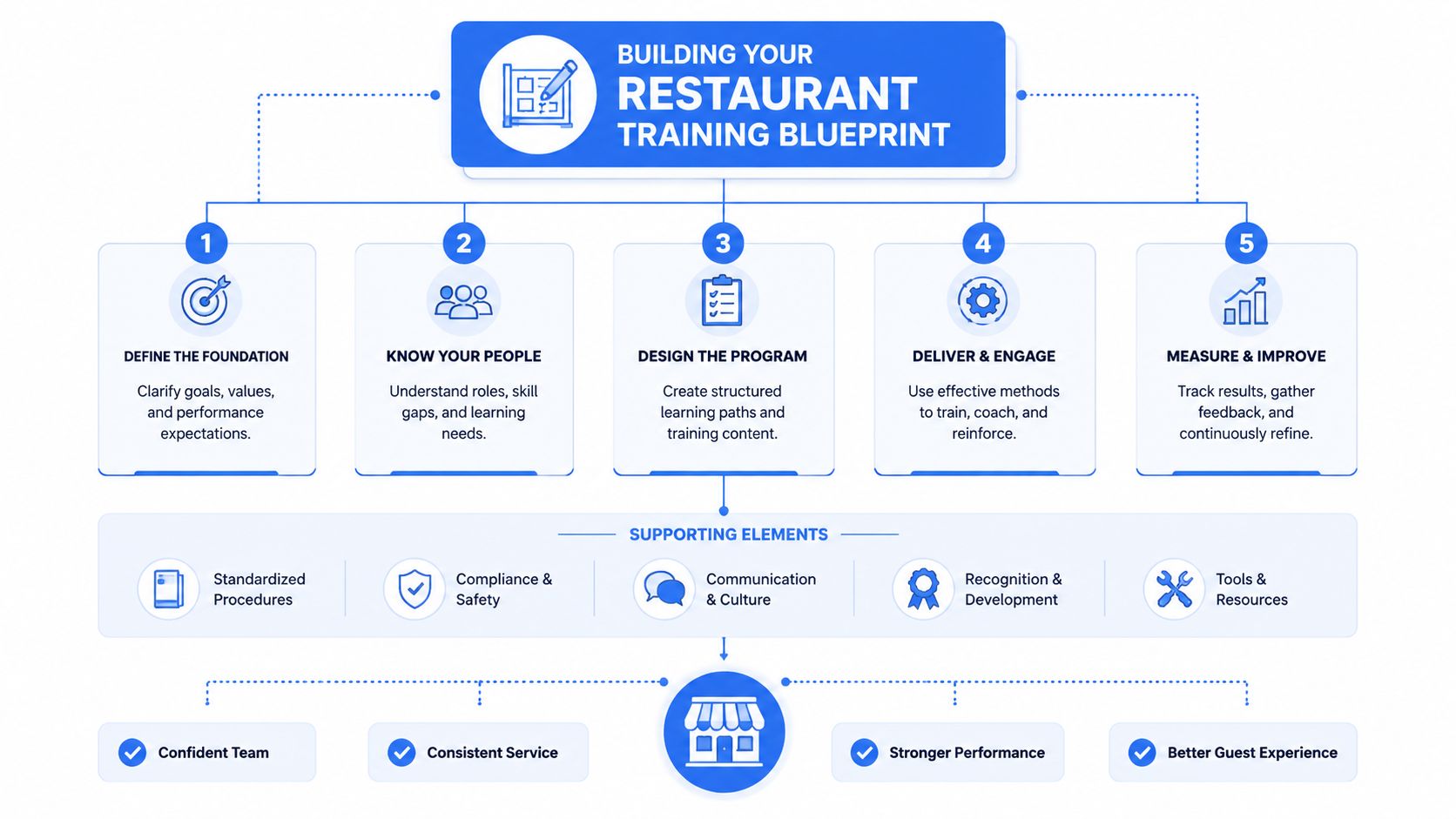
A strong training system isn't a binder in the office. It's an operating system.
The best restaurant staff training programs are built around a few repeatable pillars, then adapted by role, shift pattern, and service style. That matters more now because training time is tighter, menus change faster, and more restaurants rely on digital tools in daily service.
In 2025, 61% of restaurant operators prioritized basic job skills training, a 25% increase from 2024. In the same report, 72% of learning and development professionals said AI improves their work quality, according to QSR Magazine's coverage of 2025 restaurant training trends. That's the right pairing. Get the basics right, then use technology to deliver and reinforce them faster.
What a complete training system includes
Most operators need four working parts.
Foundational onboarding
This covers the core operating standards every employee needs before they're turned loose on a live shift. Think service basics, opening and closing routines, menu structure, ordering flow, and team expectations.
Role-specific modules A host doesn't need the same training as a bartender. A prep cook doesn't need the same coaching as an expo. Build separate modules by role so people train on what they will do.
Compliance and safety
This can't live only in orientation. Food safety, allergy handling, alcohol procedures, and workplace conduct need refreshers and checks, not one-off signoffs.
Continuous development
Menu changes, promotions, new systems, and seasonal service patterns all require updates. Restaurants that stop training after week one usually end up retraining through mistakes.
Why basics and tech now belong together
A lot of owners still treat service training and tool training as separate tracks. That's outdated.
If your team uses a POS, handhelds, QR menus, kitchen display systems, reservation software, or feedback tools, those systems are part of service. A server who can read guest cues but cannot move through the order flow cleanly is still undertrained. The same is true in reverse. A technically fast cashier with weak hospitality habits still leaves money on the table.
A practical blueprint usually looks like this:
- Define standards clearly: Write what “good” looks like for greeting, order taking, handoff, issue recovery, and closeout.
- Break training into modules: Keep topics narrow so staff can absorb and apply them quickly.
- Assign ownership: Managers, shift leads, and senior team members each need clear training responsibilities.
- Build checks into the calendar: Quizzes, shadow shifts, observations, and short refreshers keep standards from drifting.
- Update content when the operation changes: If the menu, layout, workflow, or tech stack changes, training content has to change too.
Strong restaurants don't leave training quality to whoever happens to be on shift with the new hire.
Mastering the First 30 Days A New Hire Onboarding Plan
Most turnover starts early.
Not because people can't do the job, but because the job feels chaotic, unclear, or harder than promised. The first month decides whether a hire becomes productive or becomes another opening on the rota. Good onboarding gives people a win on day one, a clear path in week one, and proof of progress by the end of the month.
Day 1 needs structure not paperwork overload
Day 1 should reduce anxiety. Too many restaurants waste it on forms, policy talk, and a rushed tour, then wonder why the new hire looks lost on day three.
A better first day does three things:
- Show how the restaurant runs: Walk the floor, kitchen, service stations, storage, break area, and handoff points.
- Introduce the people who matter: Shift leader, trainer, key FOH contacts, key BOH contacts.
- Explain what success looks like this week: Keep it concrete and role-specific.
For FOH, that might mean greeting standards, table numbers, menu basics, and how to ask for help. For BOH, it might mean station setup, labeling, prep expectations, and communication during service.
New hires don't need every answer on day one. They need clarity, pace, and one person they can trust.
Week 1 is where confidence gets built
Week 1 should combine observation, repetition, and low-risk practice.
Many operators either overprotect or overexpose during this phase. If you keep a new hire watching for too long, they disengage. If you put them into full-speed service too soon, they panic and start making defensive mistakes.
Use a simple progression:
- watch
- do it with support
- do it alone with a check
- repeat until consistent
This is also the right time to introduce your task flow in a structured way. If your managers rely on memory and verbal reminders, onboarding gets messy fast. A shared workflow tool helps standardize side work, opening checks, training tasks, and follow-ups across shifts. That's why many operators move this into restaurant task management software.
Weeks 2 to 4 are for guided repetition
The goal in weeks 2 to 4 isn't perfection. It's dependable execution.
This is when you tighten the fundamentals:
- FOH learns to handle modifiers, objections, guest questions, and pacing
- BOH learns ticket discipline, station readiness, consistency, and recovery under pressure
- everyone learns communication standards across the pass, expo line, and floor
Use short competency checks instead of one big test. A manager can verify whether someone can close a table, enter a complex ticket, run a station checklist, or explain menu items clearly. If they can't, retrain that one task. Don't restart the whole program.
Sample 30-Day Onboarding Schedule
| Timeframe | FOH Key Activities | BOH Key Activities | Goal |
|---|---|---|---|
| Day 1 | Team introductions, floor tour, service standards, menu overview, shadow host or server | Team introductions, kitchen tour, safety basics, station orientation, shadow prep or line lead | Reduce anxiety and establish basic expectations |
| Days 2 to 3 | POS basics, greeting practice, table numbers, side work routine, observe live service | Prep routines, labeling, storage standards, ticket flow overview, observe live service | Build familiarity with workflow |
| Days 4 to 7 | Guided order taking, menu question handling, runner support, cashout exposure | Guided prep tasks, station support, recipe review, cleaning and close support | Start active participation with support |
| Week 2 | Live tables with trainer check-ins, issue recovery practice, upsell phrasing, modifier accuracy | Independent prep blocks, ticket pacing, quality checks, handoff communication | Move from observation to controlled execution |
| Week 3 | More independent sections, guest recovery drills, shift opening or closing tasks | More independent station work, rush pacing, quality consistency, reset discipline | Increase speed and reliability |
| Week 4 | Competency review, final coaching points, independent shift readiness | Competency review, final coaching points, independent station readiness | Confirm readiness and identify gaps |
A few operating rules make this work better than a generic orientation packet:
- Give one trainer ownership: New hires shouldn't get five different versions of the job.
- Use daily check-ins: Ask what feels clear, what feels shaky, and what needs another rep.
- Keep training visible: Use checklists, signoffs, and notes managers can review.
- Reward progress early: Confidence grows when people know they're improving.
The first 30 days set the tone for everything after. If onboarding feels thoughtful, the restaurant feels organized. If onboarding feels random, the business looks unstable before the new hire has even learned the menu.
Designing Effective FOH and BOH Training Modules
Front of house and back of house shouldn't sit through the same training deck and pretend it's relevant.
They work in the same restaurant, but they solve different problems under different pressure. FOH needs judgment in front of guests. BOH needs consistency under volume. The best restaurant staff training respects that difference and keeps modules short enough to fit real shift life.
Research highlighted by 7taps on restaurant training points to microlearning as the most effective format, with content broken into 5 to 15 minute modules. That format fits restaurants because staff rarely have long uninterrupted windows, and short lessons are easier to apply immediately on shift.
Front of house needs judgment and speed
FOH training should focus on what happens live, in front of paying guests.
Useful FOH modules include:
- Greeting and table approach: How to read pace, tone, and guest intent.
- Menu confidence: Ingredients, pairings, common questions, and what to recommend first.
- Modifier accuracy: Allergies, substitutions, course timing, and special requests.
- Issue recovery: Late dish, wrong item, unhappy guest, awkward wait.
- Digital order flow: How QR ordering, handhelds, or table-side prompts affect service.
A good FOH module usually combines one short explanation, one example, and one observed rep on the floor.
Back of house needs consistency under pressure
BOH modules need to train repeatable behavior, not just knowledge.
Useful BOH modules include:
- Station setup: What ready looks like before service starts.
- Recipe adherence: Build, portion, plating, and finish standards.
- Ticket management: Sequence, pace, and communication with expo.
- Cross-station handoff: What to call, when to call it, and how to avoid bottlenecks.
- Close and reset: Cleaning, storage, labeling, waste control, and prep notes.
These modules work best when the trainer demonstrates the standard, then watches the employee repeat it in real conditions.
A short module only works if it teaches one clear behavior. “Kitchen standards” is too broad. “Build the burger station for opening” is usable.
Don't make staff memorize what systems can handle
This matters more than many operators realize.
If your menu changes often, daily verbal briefings and printed cheat sheets create drift. FOH ends up guessing. BOH gets hit with avoidable questions. Managers become the only source of truth. Digital systems can reduce that burden by keeping item details, availability, modifiers, and specials current in one place.
That doesn't remove the need for training. It changes what you train. Instead of forcing staff to memorize every change, train them on where to verify, how to explain, and when to guide the guest toward the best option.
Training for Profit Upselling Soft Skills and Tech Fluency
Restaurant staff training stops being defensive and starts becoming commercial at this point.
Many hospitality groups are trained to avoid mistakes. Fewer are trained to create better orders. That's a big miss, especially in operations that already use digital ordering or QR menus. If staff understand both guest psychology and the tools in front of them, they can increase order value without sounding scripted or pushy.
Training needs to connect two skill sets that are usually taught apart: soft-selling and system fluency.
Teach upselling like hospitality not sales
Good upselling doesn't feel like upselling. It feels like help.
The best teams learn to recommend based on context:
- a lighter side with a heavier main
- a bundle that simplifies the decision
- a drink pairing that fits the dish
- an add-on that solves a guest need, such as sharing, spice level, or portion balance
Train phrases that sound natural in service:
- “Most guests pair that with…”
- “If you want the faster option, this combo works well.”
- “That dish is richer, so I'd usually suggest…”
- “If you're sharing, adding this makes the order work better.”
These recommendations improve guest confidence. They also tend to improve average order value because they're relevant, not random.
Train the team on the tools guests already use
There's a major training gap here. According to Trust20's review of restaurant staff training and digital menu adoption, 68% of independent restaurants use QR or digital menus, but only 12% of staff receive specific training on these systems. The same source states that digital-trained staff can boost average ticket size by 18% to 22% through timely, intelligent add-on recommendations.
That should change how you train.
If guests order through a QR menu, staff need to know:
- How the menu is structured: Categories, bundles, modifiers, featured items, and out-of-stock logic.
- What the prompts are trying to do: Suggested add-ons, pairings, upgrades, or timed offers.
- How to support without hovering: Answer questions, remove friction, and step in when the guest stalls.
- What data matters: Which items convert, what add-ons are accepted, and where guests drop off.
A practical drill is to run staff through the digital menu as if they were guests. Ask them to complete common order journeys:
- solo lunch
- family order
- quick coffee and pastry
- high-margin dinner with drinks
- allergy-sensitive order
Then coach what they should say when a guest asks, “What's good?” or “What should I add?” Their answer should match what the menu is already trying to surface.
If the QR menu suggests the profitable pairing but the server ignores it, the system and the team are working against each other.
Where operators usually get this wrong
Three mistakes show up again and again:
- They train etiquette but not recommendation skill: Staff stay polite but passive.
- They install digital tools but skip behavior training: Guests scan, but staff can't guide or reinforce the flow.
- They make upselling feel transactional: Scripts get forced, and guests feel pressure.
The better approach is simple. Train staff to notice cues, use the digital journey as support, and recommend like a host, not a salesperson.
How to Measure Training ROI and Reduce Staff Turnover
If training isn't measured, it usually gets cut the first time margins tighten.
That's short-sighted. Hospitality businesses that allocate 5% or more of their annual budget to employee training report 23% less staff turnover, and it takes an average of 19 days to train a new staff member to proficiency, according to iSpring's restaurant training analysis. If you reduce churn, you don't just save recruiting effort. You protect consistency, manager time, and shift stability.
Track operating metrics not just completion rates
Most training dashboards are too soft. “Completed module” doesn't tell you whether the floor got better.
Track outcomes that matter to operations:
- Retention by role: FOH, BOH, and manager turnover should be tracked separately.
- Time to proficiency: How quickly a new hire can work independently at the expected standard.
- Upsell attachment behavior: Are staff using recommendation habits in service.
- Order accuracy and rework: Look at remakes, voids, comps, and repeated ticket errors.
- Guest experience signals: Reviews, direct feedback, and complaint themes.
- Manager intervention load: How often supervisors have to rescue basic process failures.
For digital ordering environments, menu and revenue data can make this much easier to see. Operators using analytics tools can monitor item mix, add-on acceptance, and ordering patterns in real time. That's where restaurant KPI software for real-time performance becomes useful. It helps connect training effort to actual commercial output.
Use a simple trainers playbook
You don't need a corporate learning department. You need consistency.
A useful trainer's playbook should include:
- the standard for each role
- the training sequence for each task
- how to demonstrate the task
- what “pass” looks like
- how to document retraining if needed
Keep assessments practical. Ask a server to guide an order, not just describe the menu. Ask a line cook to set up the station, not just explain the checklist.
One more rule matters. Don't treat training as a one-time event. Restaurants change too fast for that. Menus shift, promotions rotate, staff mix changes, and tools evolve. Training has to stay in the weekly rhythm or standards drift until the numbers force attention.
When training is structured, staff feel more capable. When staff feel more capable, they stay calmer, perform better, and leave less often. That's good culture. It's also good math.
If you want your training to translate into higher check averages, cleaner digital ordering, and clearer menu performance data, RevMenue gives your team the tools to support that work. It helps restaurants run fast-loading QR menus, update items instantly, promote relevant add-ons, and track what is driving revenue, without forcing a full systems overhaul.