
Most advice on how to increase sales in restaurants is backward. It tells you to buy more traffic, run more promos, and hope volume fixes the business.
It won't.
Restaurants usually lose sales in quieter, less obvious places: a weak menu layout, low-margin bestsellers, dead space in the ordering flow, sloppy bundling, and servers who know the specials but don't know what drives profit. That's where the money is.
The better approach is profit-aware sales growth. Increase check size. Improve item mix. Reduce ordering friction. Fill capacity more intelligently. Keep the guest experience easy enough that people come back without bribing them with discounts.
That approach is more durable, and it matches what the market has been showing. The National Restaurant Association reported that the U.S. restaurant industry generated $99.8 billion in total sales in April 2026, the third straight monthly increase after gains of 0.7% in February and 0.1% in March. That matters because it points to steady execution, not one lucky campaign.
Table of Contents
- Stop Chasing New Customers and Start Maximizing Every Order
- Engineer Your Menu to Be Your Best Salesperson
- Turn Service into a Revenue Engine with Smart Upselling
- Use Digital Tools and QR Menus to Increase Order Value
- Build a Simple System for Repeat Business and Loyalty
- Measure What Matters and Test Your Way to Growth
Stop Chasing New Customers and Start Maximizing Every Order
If your first answer to slow sales is “we need more customers,” you're probably skipping the faster fix.
More covers help, but they're expensive to chase and messy to operate if your systems aren't tight. A restaurant with a cluttered menu, weak add-on strategy, and inconsistent service can stay busy and still underperform. A restaurant that sells the right items, guides orders well, and moves guests smoothly can grow without acting desperate every week.
That's why I push owners to treat the business like a revenue system, not just a dining room. Every shift gives you a handful of controllable levers:
- Item mix: Which dishes guests choose
- Average check: What gets added, upgraded, or bundled
- Margin quality: Whether extra sales produce profit
- Ordering speed: How much friction slows or kills a sale
- Capacity use: Whether tables, pickup windows, and demand peaks are managed intelligently
Practical rule: Fix the transaction before you buy more traffic.
A simple example. Two cafés can serve the same number of guests in a lunch rush. One sells a lot of low-margin mains and plain coffees. The other highlights stronger-margin combos, makes modifiers easy, and trains staff to recommend a pastry or premium add-on that fits the order. Same foot traffic. Different outcome.
This is also why random specials disappoint. They may spike volume for a day, but they often train guests to wait for deals, stress the kitchen, and pull sales into lower-margin items. You don't need more activity. You need better conversion inside the activity you already have.
If you want to know how to increase sales in restaurants without wrecking margins, start by asking three questions:
- What are guests already buying most often?
- Which of those items leave the most cash behind?
- Where does the order process make spending easier, or harder?
Answer those truthfully, and your next moves become obvious.
Engineer Your Menu to Be Your Best Salesperson
Most restaurants lose revenue through their menus without realizing it. They price off instinct, organize categories around habit, and let popular low-profit items dominate attention.
A strong menu does the opposite. It directs the guest toward the items you most want to sell, and it does it without pressure.
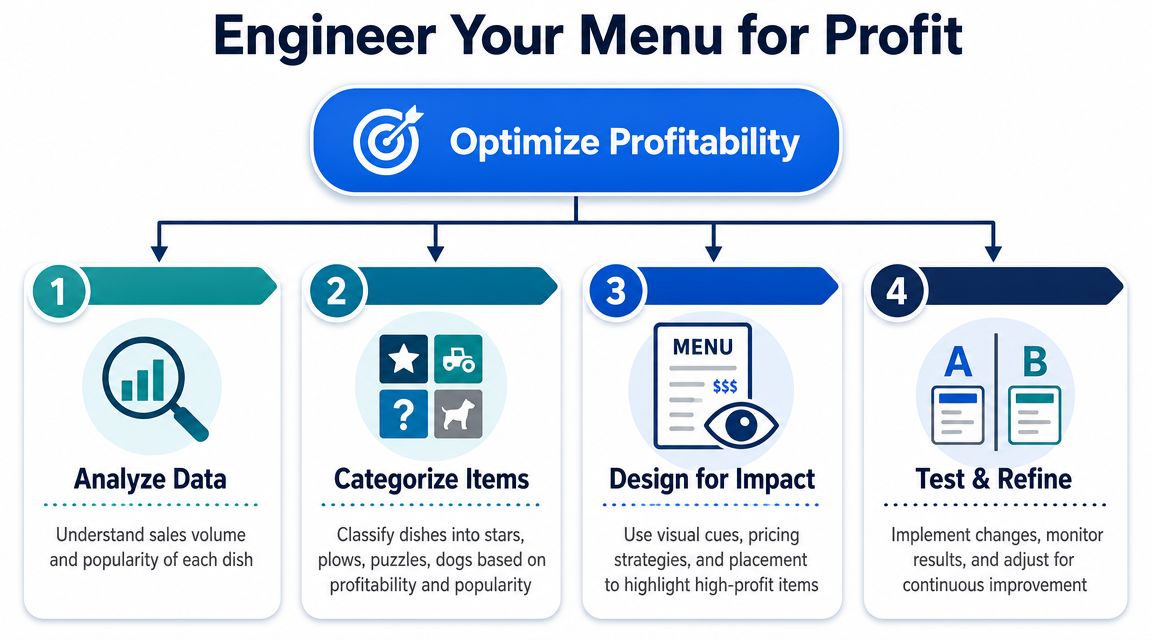
Industry guidance on menu engineering and contribution-margin pricing is clear on the core move: rank items by popularity and gross margin, then place high-margin performers in prime visual positions to optimize revenue per guest, not just unit sales.
Start with contribution margin, not food cost
Too many operators obsess over food cost percentage and miss the bigger point. A dish can look “efficient” on paper and still contribute less real profit than another item with a higher ingredient cost.
The better question is simple: After the direct cost of the dish, how much money is left?
That's contribution margin. It changes how you think.
A practical workflow:
- Cost each item accurately. Don't guess. Include the actual build.
- Pull sell-through data. Look at what moves and what stalls.
- Compare popularity with gross margin. That shows what deserves promotion.
- Change one thing at a time. Position, naming, bundle, price, or description.
- Watch revenue per guest. That's the metric that matters.
Price based only on food cost percentage and you'll protect the wrong dishes.
A burger that sells constantly but leaves little behind may need a smarter bundle, a better add-on path, or a price adjustment. A pasta dish with a stronger margin but weaker visibility may need better placement and a more vivid description.
Use a simple menu engineering matrix
You don't need fancy theory. You need a disciplined way to classify items and act on them.
| Category | Description (Popularity/Profitability) | Action |
|---|---|---|
| Stars | High popularity, high profitability | Feature prominently, protect quality, train staff to recommend |
| Plowhorses | High popularity, lower profitability | Adjust portion, pricing, or add-on strategy |
| Puzzles | Lower popularity, high profitability | Improve naming, placement, photos, or staff recommendations |
| Dogs | Low popularity, low profitability | Remove, reformulate, or replace |
This matrix forces better decisions.
A lot of owners keep Dogs because they're emotionally attached to them. Guests aren't ordering them, and the kitchen is carrying the complexity anyway. Cut them.
Plowhorses are trickier. These are often guest favorites. Don't kill them if they drive traffic or brand identity. Just stop letting them operate without a margin plan. Tighten the plate cost, attach profitable sides, or reposition them as part of a bundle.
Design the menu to direct decisions
Layout matters. Eye flow matters. Clutter kills sales.
High-margin items should sit where attention naturally lands: near the top of categories, in clean visual blocks, or in featured sections that don't look like ad space. Bundles should be obvious and anchored around an item guests already want. If the value isn't immediately clear, the bundle won't convert.
A few menu rules I use repeatedly:
- Lead with profitable demand: Put strong-margin items where scanning starts.
- Trim choice overload: Too many similar options slow decisions and hide winners.
- Write like a human: Specific, appetite-building descriptions beat generic labels.
- Make bundles easy to understand: One glance should tell the guest why it's worth it.
- Protect readability on mobile: If guests pinch and zoom, you're already losing.
For operators revisiting structure and placement, a focused approach to restaurant menu optimization usually pays back faster than another round of blanket promotions.
One real-world pattern shows up constantly. A restaurant has a signature seller everyone loves. Instead of surrounding it with profitable choices, they bury the premium side, leave the beverage pairing disconnected, and let dessert stand alone at the bottom like an afterthought. That's not menu design. That's a missed sales path.
Turn Service into a Revenue Engine with Smart Upselling
Servers shouldn't sound like salespeople. They should sound like hosts who know what goes well together.
That's the difference between awkward upselling and profitable service.
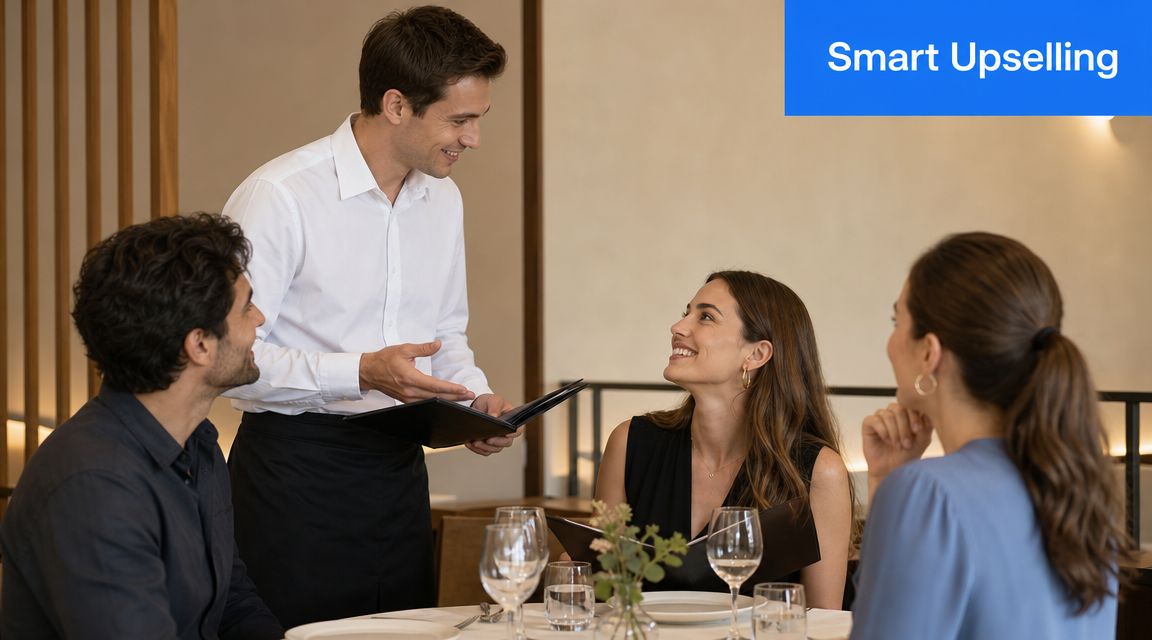
A common mistake involves teaching lines instead of judgment. “Do you want fries with that?” is lazy. It ignores what the guest ordered, what the kitchen needs, and what genuinely improves the experience.
Train for recommendations, not scripts that sound robotic
A good recommendation is specific and relevant.
If a guest orders a steak, a strong server doesn't ask a generic add-on question. They say, “The peppercorn sauce works really well with that, and a lot of guests pair it with the roasted potatoes.” That feels helpful because it is helpful.
Give your team a short list of pairings tied to actual menu logic:
- For high-demand mains: suggest one side that lifts margin and fits naturally
- For drinks: offer a premium pour or a second-round cue at the right moment
- For desserts: connect it to the pace of the meal, not the printed menu
- For takeout: recommend items that travel well and complete the order
Guests say yes more often when the recommendation feels tailored to what they already chose.
I've seen this change service culture fast. Before training, a server asks broad, forgettable questions and gets short answers. After training, they use cues. Family table ordering shareables. Couple ordering cocktails. Office lunch ordering quick, clean add-ons. Same team. Better reads.
Use bundles and add-ons that fit the order
The best upsell isn't always an upsell. Sometimes it's a cleaner decision.
That's why bundles work so well when they're built around popular items. Industry guidance on reservation and sales strategy also stresses that offers close to the decision window can outperform broad campaigns, and that operational choices should match real guest behavior rather than assumptions. The same logic applies on the floor. Match the offer to the moment.
Use this structure:
- Anchor around a popular item: Start with what guests already want.
- Make the value obvious: If they have to calculate, the bundle is too hard to buy.
- Keep the script soft: “Most guests add…” works better than hard closes.
- Respect the pace of service: Don't force a longer pitch during a slammed turn.
A before-and-after example:
- Weak version: “Would you like anything else?”
- Better version: “You've already got the chicken sandwich. Adding the soup makes it a more complete lunch, and it's the pairing most guests choose.”
That second line gives context. It reduces decision fatigue.
If you want your floor team to sell more without sounding pushy, train around pairing logic, timing, and confidence. A practical starting point is to build a short playbook of restaurant upselling techniques around your actual menu, not generic scripts from the internet.
For a visual breakdown of smart selling on the floor, this short video is worth a look:
Use Digital Tools and QR Menus to Increase Order Value
A printed menu can describe items. A good digital menu can also guide choices, reduce friction, and capture more of the order.
That distinction matters now because discovery is digital long before a guest sits down. DoorDash cites the 2026 Restaurant Industry Trends Report showing that 51% of consumers discover restaurants through Google search, making search visibility the largest reported discovery source in that dataset. A clear, mobile-friendly menu matters before the guest ever arrives, as noted in DoorDash's guide on increasing restaurant sales through better digital discovery.
Your digital menu is now part of the sale
Most operators still treat the online or QR menu like a digital photocopy of the print version. That's a mistake.
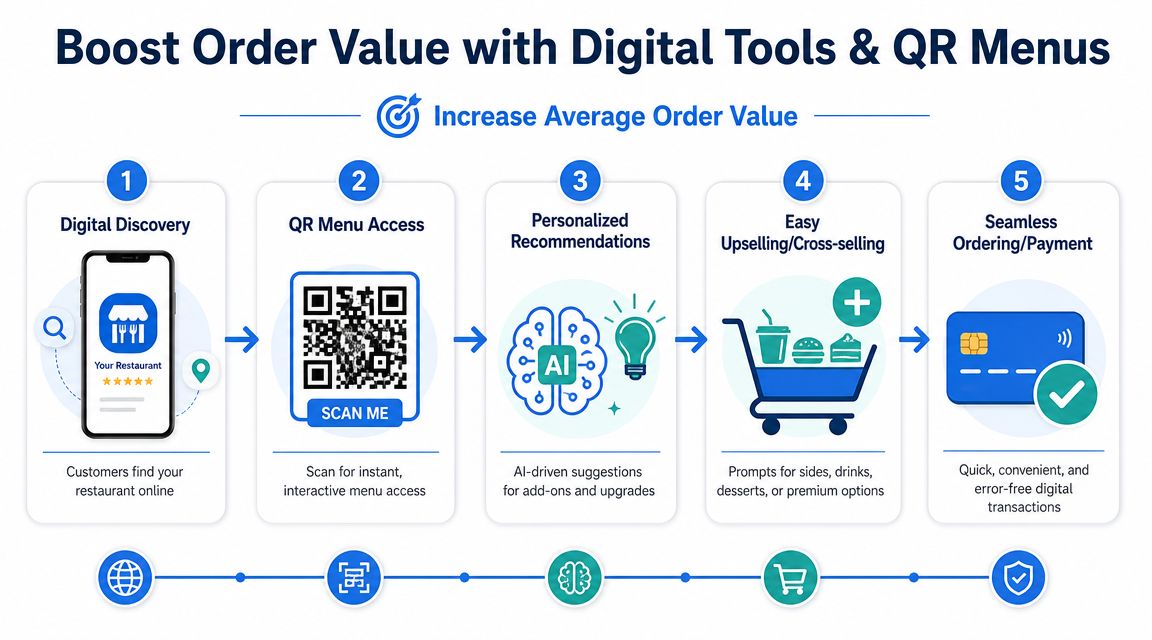
A PDF on a phone is dead weight. It's hard to scan, easy to abandon, and useless for steering behavior. A proper digital menu should do four jobs at once:
- Help guests decide faster
- Surface profitable items cleanly
- Make modifiers simple
- Prompt relevant add-ons at the right time
That last point is where order value moves.
If someone selects a burger, the system should make fries, upgraded sides, or beverage pairings easy to add. If someone orders a pastry and coffee, it should surface a second bakery item without creating extra clicks. If a family is browsing dinner, bundles should be visible before they build separate orders manually.
QR menus should reduce friction and sell at the same time
A lot of revenue disappears during decision moments. Not because guests don't want to buy, but because the process gets annoying.
That's why one of the more useful operational recommendations in recent industry guidance is to reduce unnecessary fields, minimize clicks, and make modifiers and payment effortless. Less friction means fewer abandoned orders and fewer incomplete orders.
A strong QR menu setup should include:
- Fast loading pages: Guests won't wait around for bloated menus
- Clear categories: Especially important for large menus and multi-daypart concepts
- Modifier logic that makes sense: No messy option trees
- Clean upsell prompts: Relevant, brief, and tied to the item selected
- Simple payment flow: Guests finish more often when checkout feels easy
The best digital menus don't just display products. They remove reasons not to order.
There's also a staffing benefit. When guests can browse clearly and build straightforward orders themselves, the team spends less time repeating basics and more time handling hospitality, timing, and exceptions. That's not replacing service. That's protecting it.
For operators reviewing QR strategy, a modern digital menu QR code system should be judged on speed, ease of editing, mobile usability, and how well it supports add-ons and bundles. Convenience alone isn't enough. It needs to drive better item mix.
Build a Simple System for Repeat Business and Loyalty
Loyalty isn't a punch card problem. It's an operating system problem.
Restaurants get repeat business when guests can trust the experience. The food arrives as expected. Ordering feels easy. The menu is clear. Service feels attentive, not chaotic. If those basics are shaky, no loyalty mechanic will save you.
Retention starts with operational consistency
The restaurants that hold guests best usually aren't the ones with the fanciest rewards. They're the ones with the fewest annoying moments.
Think about what pushes people away:
- Confusing online ordering
- Outdated menu information
- Missing modifiers or unclear customizations
- Slow payment flow
- Inconsistent service between shifts
- Offers that feel random or irrelevant
Fix those first.
Another often-missed growth lever is capacity and timing. SevenRooms advises operators to look closely at reservation turn times and slot spacing instead of treating the book like a static schedule. Their guidance on reservation and capacity optimization also notes that effective acquisition can happen close to the decision window, and Upside notes that the best marketing reaches diners about two hours before they decide where to eat. Used well, that means targeting slack periods instead of discounting peak demand.
Keep loyalty simple and behavior-based
A simple system beats an elaborate one nobody uses.
If someone orders lunch from you regularly, send a relevant reminder near their usual reorder window. If a guest repeatedly buys a certain category, feature that category first in future communication. If a regular tends to visit slower dayparts, reward that behavior because it helps the business.
A few practical ways to build repeat business without overcomplicating it:
- Collect permission-based contact details: Use direct channels responsibly.
- Reward useful behavior: Direct orders, off-peak visits, group orders, or repeat favorites.
- Use surprise perks sparingly: A thoughtful free add-on can feel more genuine than a blunt discount.
- Keep the redemption path easy: If staff need a manual workaround, it won't scale.
The key is alignment. Loyalty should reinforce profitable habits, not just stimulate random visits.
That's how to increase sales in restaurants over time. Better retention isn't separate from menu strategy, service quality, or digital ordering. It's what happens when those pieces work together often enough that guests stop comparing you with everyone else.
Measure What Matters and Test Your Way to Growth
If you only watch total sales, you'll miss the story.
Top-line growth can hide weak item mix, discount leakage, staff inconsistency, and operational strain. Profit-aware growth needs tighter measurement. Newer guidance on profit-focused restaurant sales improvement leans in the same direction: analyze sales data, identify top-performing items, watch changing customer habits, and build personalized, margin-aware offers instead of defaulting to generic discounts.
Track the metrics that expose profit quality
You don't need a giant dashboard. You need a short list you'll use.
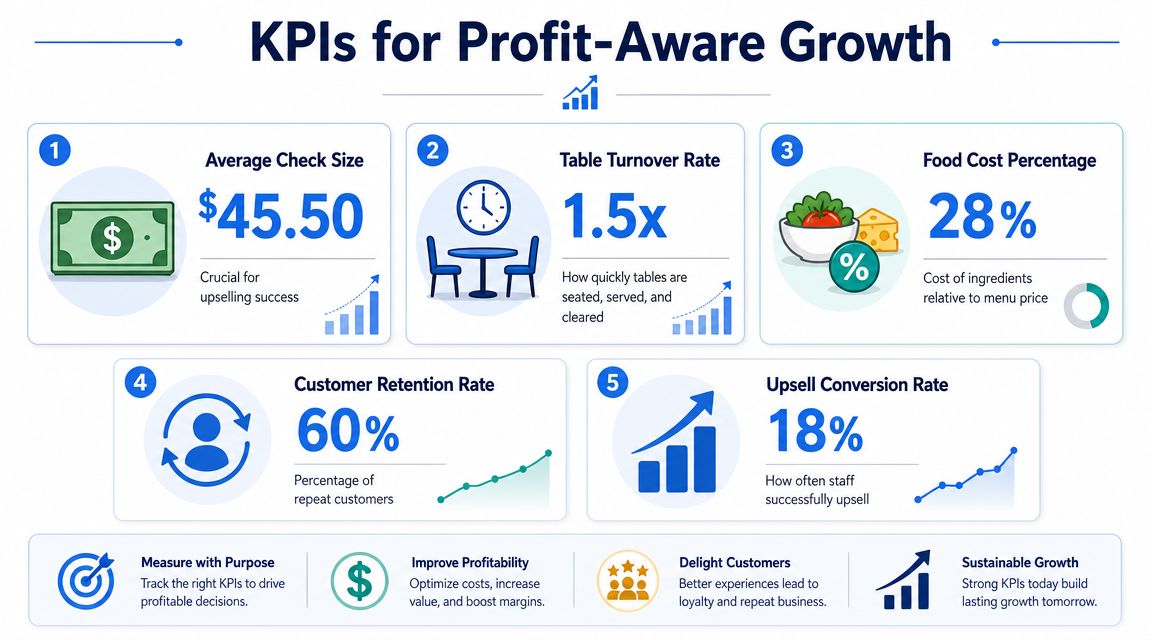
Watch these closely:
- Average check size: Are guests building fuller orders?
- Item-level profitability: Which dishes deserve promotion, repricing, or removal?
- Bundle attachment: Are meal deals and add-ons getting traction?
- Return behavior: Who comes back, what they buy, and when they lapse
- Daypart performance: Which windows need demand shaping, not blanket promos
What sells most isn't always what makes you the most money.
That's why average check alone isn't enough. A bigger ticket built on the wrong items can still disappoint. You need to compare order value with item mix and margin logic.
Test one change at a time
Most operators change too much at once. New menu layout, new promo, new scripting, new prices. Then they can't tell what worked.
Run smaller tests:
- Move one high-margin item to a stronger position
- Change one bundle offer
- Introduce one new upsell cue for staff
- Simplify one checkout step
- Review the result, then decide
This discipline matters because attribution matters. The best menu engineering guidance pushes the same idea. Test one intervention at a time so you can tie the outcome to the change.
That's how you build a repeatable system instead of chasing hunches. You learn which item descriptions convert, which bundles improve revenue per guest, which add-ons fit each daypart, and where friction is costing you orders.
If you want a cleaner way to turn menu scans into better item mix, higher-margin add-ons, and clearer revenue insight, take a look at RevMenue. It's built for operators who want faster menu updates, smarter digital selling, and profit-focused decisions without ripping out the rest of their stack.