
Most restaurants don't have a traffic problem. They have a monetization problem.
The dining room looks full. The bar feels busy. Tickets keep printing. But profit stays thin because guests are buying the wrong mix, tables sit too long at the wrong times, promotions attract low-value orders, and the menu does almost nothing to steer better decisions.
That's where hospitality revenue management matters for restaurants. Not as hotel theory. As an operating discipline for turning each seat, each hour, and each guest interaction into better revenue and cleaner margin.
The hotel world has spent years obsessing over room metrics. Restaurants need a more useful lens. The primary opportunity is total guest spend, not just covers or table occupancy.
Table of Contents
- Beyond Full Tables Turning Profit from Every Seat
- The Four Levers of Restaurant Revenue Management
- Measuring What Matters Revenue Per Available Seat-Hour
- Practical Strategies to Increase Revenue Today
- Using Digital Menus to Drive Smarter Decisions
- Common Pitfalls in Restaurant Revenue Strategy
- Frequently Asked Questions About Revenue Management
Beyond Full Tables Turning Profit from Every Seat
A full restaurant can still be underperforming.
That usually shows up in a few familiar ways. Peak hours are packed, but average checks stay soft. Bestselling items are popular but low margin. Staff spend time answering the same menu questions instead of moving service forward. Off-peak periods drag, then the kitchen gets slammed all at once.
This is exactly why hospitality revenue management matters. It gives operators a way to diagnose profit leaks instead of guessing. You stop asking, “How do I fill more seats?” and start asking, “How do I make each seat more productive?”
Academic research has pointed out a major gap in hospitality revenue thinking. The field has historically focused more on ADR than on total guest spend, with loyalty data used mainly for targeted offers rather than a full spend strategy. The bigger opportunity is monetizing each transaction through better timing, relevant offers, and margin-aware bundles, not just winning the booking, as discussed in this hospitality revenue management research on total guest spend.
Busy doesn't mean efficient
A restaurant can look healthy while hiding weak economics.
Common examples:
- Low-value peak demand: You're full at lunch, but most tables order the fastest, cheapest items.
- Slow table use: Dinner guests sit deep into the peak without ordering dessert, coffee, or another round.
- Poor menu steering: The menu gives equal visual weight to low-margin and high-margin items.
- Unstructured add-ons: Staff mention sides, pairings, or upgrades inconsistently.
Practical rule: If your team tracks covers but can't quickly explain which items, bundles, and dayparts drive the best margin, you're not managing revenue. You're just recording activity.
What to optimize instead
Restaurant revenue management should focus on a small set of practical questions:
- Which guest moments are under-monetized? Pre-drink, add-on, dessert, takeaway, late-night, second beverage.
- Which dayparts need stimulation? Slow windows need demand shaping, not generic discounts.
- Which menu items deserve more exposure? Popularity is not enough. Margin and prep flow matter.
- Where does friction kill spend? Long wait times, confusing menus, and weak prompts all reduce purchase intent.
That's the shift. Stop treating revenue as the byproduct of volume. Start treating it as the result of better orchestration.
The Four Levers of Restaurant Revenue Management
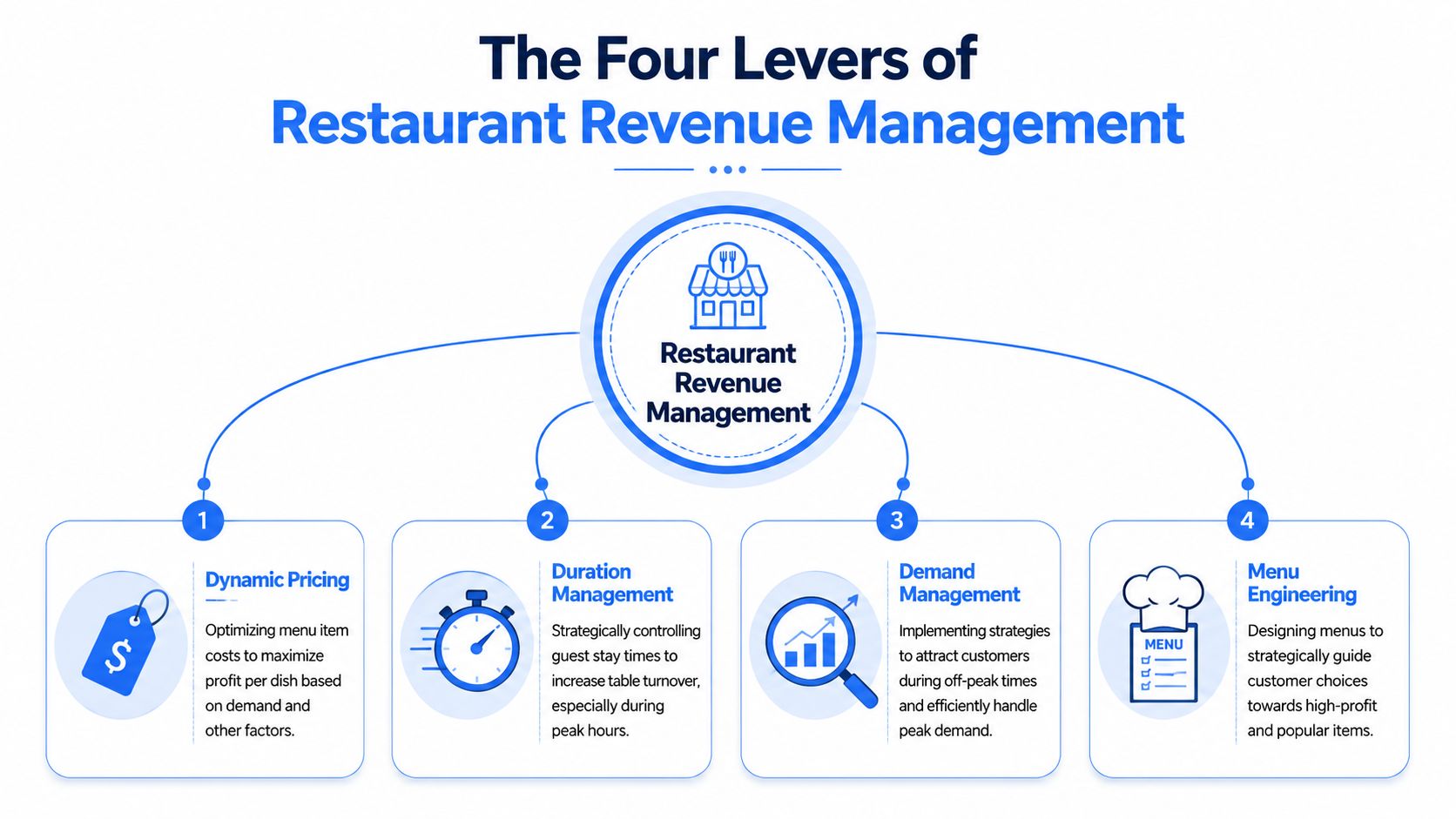
Hospitality revenue management isn't one tactic. It's a system. In restaurants, that system comes down to four levers you can control.
Start with total revenue, not just occupancy
Industry guidance draws a clear line between yield management and revenue management. Yield management focuses on guest rooms. Revenue management covers the property's full departments, including food and beverage. That distinction matters because a restaurant strategy should optimize total revenue, not just full tables, as outlined in this hospitality metrics guide from Mews.
That same mindset applies on the floor.
A packed patio with low checks and slow turns isn't a win. A slightly less crowded service with better pacing, stronger upsells, and smarter menu mix often produces better results.
How the four levers work on the floor
Customer segmentation
Not every guest should get the same offer.
Your weekday lunch crowd wants speed, clarity, and easy bundles. Your Friday dinner crowd may be more open to appetizers, cocktails, and premium add-ons. Your café regulars may respond well to simple repeat-order prompts. Your late-night bar traffic behaves differently again.
If you push one broad promotion to all of them, you dilute conversion and margin.
Use segmentation around:
- Daypart behavior: Breakfast, lunch, dinner, late night
- Visit purpose: Solo convenience, work meeting, date night, group social
- Channel: Dine-in, takeaway, delivery, QR ordering
- Order style: Fast staples versus exploratory spenders
Demand forecasting
Most operators already know their rushes. Fewer use that knowledge well.
Forecasting in a restaurant doesn't need to look academic. It means spotting patterns early enough to adjust staffing, menu emphasis, and promotions before service starts. Local events, weather shifts, and reservation pacing all change demand quality, not just demand volume.
A practical example:
- Rainy weekday afternoon. Push comfort items and hot drinks.
- Event night nearby. Surface quick-fire items, premium drinks, and group-friendly bundles.
- Quiet midweek dinner. Promote high-margin pairings rather than broad discounts.
Strategic pricing
Pricing is more than raising prices.
Use price architecture to shape behavior:
- Daypart menus to fit demand and service speed
- Bundles that protect margin better than item-by-item discounting
- Timed offers that move traffic into softer windows
- Premium anchors that make profitable mid-tier choices feel reasonable
Don't slash prices because demand dips. Shape demand with better offer design.
If you want practical examples of add-ons and order-building prompts, review these restaurant upselling techniques for higher-margin orders.
Channel and inventory management
Restaurants have inventory too. It just looks different.
Your inventory includes:
- Seats
- Seat-hours
- Kitchen throughput
- Staff attention
- Delivery capacity
- High-demand menu items
If delivery orders flood the line during dine-in peaks, you've got a channel mix problem. If a signature item sells out early and drags down later-ticket quality, that's inventory management. If tables linger during your strongest hour without another spend moment, that's duration management.
A restaurant doesn't lose money only when seats are empty. It also loses money when high-value capacity gets used badly.
Measuring What Matters Revenue Per Available Seat-Hour
Most restaurant dashboards are too shallow. They report sales, covers, maybe labor, then stop. That doesn't tell you whether the room is productive.
The hotel world uses a foundational KPI stack built around ADR, occupancy, and RevPAR. In one standard example, an ADR of $100 and occupancy of 60% produce a RevPAR of $60, and the same result appears by dividing $180,000 in room revenue across 100 rooms over 30 nights, as shown in this revenue management measurement example. Restaurants need the equivalent lens for seats and time.
The metric most restaurants should watch
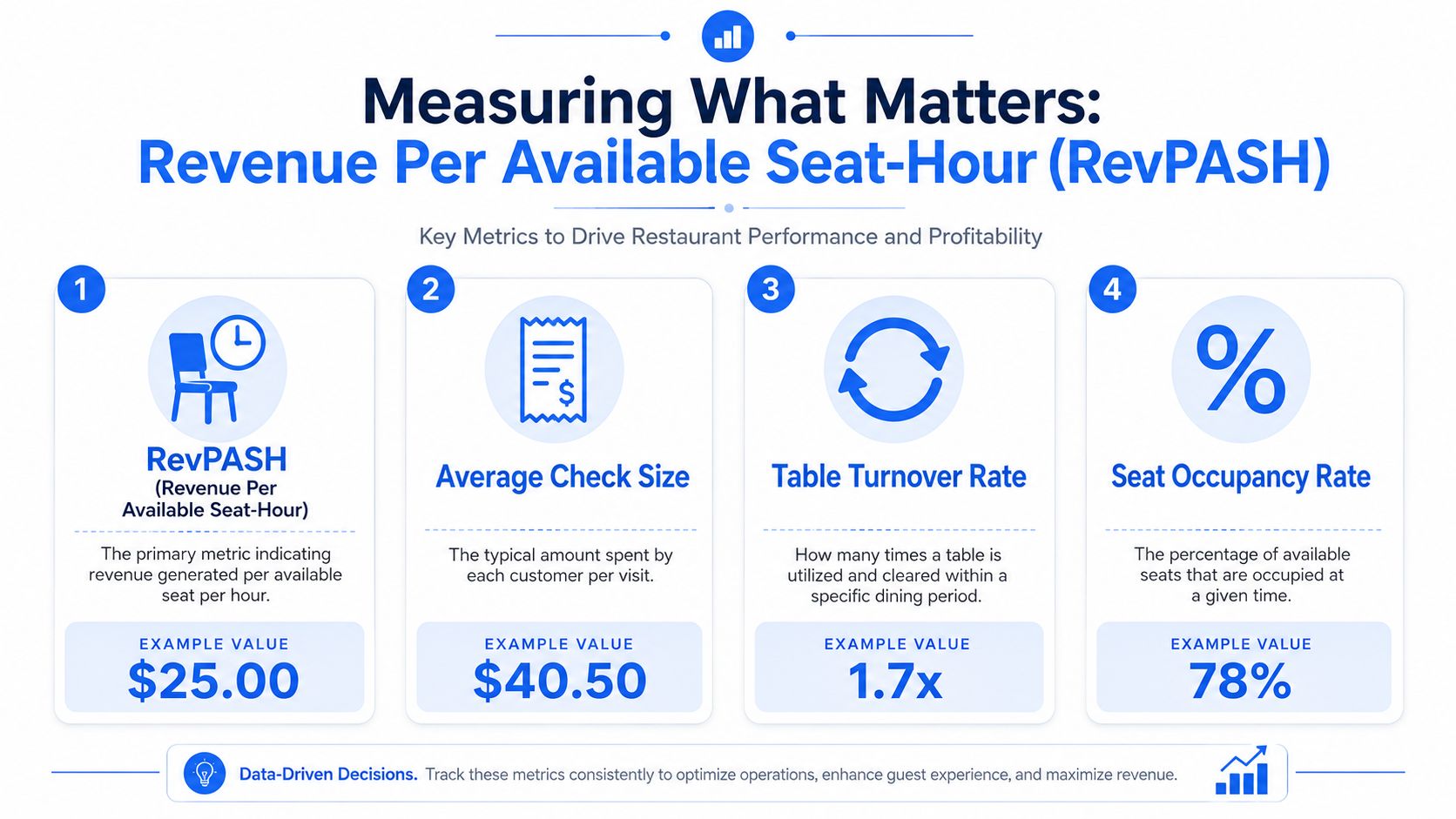
That metric is RevPASH, or Revenue Per Available Seat-Hour.
It matters because restaurants sell two perishable assets at once. Time and space. A seat that sits empty during peak dinner is lost revenue. A seat occupied for too long with low spend can also be lost revenue.
Use RevPASH to answer questions that sales totals hide:
- Is dinner underperforming because checks are low?
- Are guests spending well but staying too long during peak?
- Is lunch efficient operationally but weak on add-ons?
- Are certain service windows busy but badly monetized?
For a broader metric framework, this guide on restaurant KPIs that actually help operators decide faster is worth keeping close.
Here's a simple way to think about it.
| Scenario | What it looks like | Likely issue |
|---|---|---|
| Full room, weak RevPASH | Seats occupied, low guest spend | Low check average or weak menu mix |
| Strong checks, weak RevPASH | Good spending, slow table use | Duration problem |
| Strong occupancy, poor margin | Popular items dominate | Product mix problem |
| Good sales, poor profit | Revenue looks fine, cash doesn't | Cost leakage or operational inefficiency |
A simple diagnostic view
RevPASH works best with a few supporting numbers:
- Average check size: Are guests building worthwhile orders?
- Table turnover: How many productive uses does each table get in a service period?
- Item-level margin view: Which dishes sell well, and which dishes generate profit?
- Seat occupancy: Are you full at the right times, with the right guests, buying the right things?
Video walkthroughs can help teams explain this internally:
Operator note: Don't isolate one KPI and worship it. A higher average check can still hurt performance if service slows, turns fall, or the kitchen gets buried by complex low-margin dishes.
The point is diagnosis. If a Friday service feels hectic but profit looks disappointing, these metrics tell you where the problem sits. Pricing. Utilization. Or margin leakage.
Practical Strategies to Increase Revenue Today
Most restaurants don't need a full strategic overhaul to improve revenue. They need a tighter set of decisions made more consistently.
The fastest gains usually come from menu structure, offer timing, service flow, and add-on design.
Fix menu mix before you chase more traffic
If your current menu sends guests toward low-margin comfort choices by default, more traffic won't solve much.
Start here:
- Feature profitable favorites: Put high-margin, high-conversion items where eyes land first.
- Build bundles with intent: Pair mains with sides, drinks, or desserts that improve margin and simplify ordering.
- Trim menu clutter: Too many weak sellers create indecision, prep drag, and poor purchasing.
- Use descriptive prompts carefully: Clarify what makes an item worth choosing without turning the menu into a novel.
A practical before-and-after:
- Before: Guests order a main only because sides and pairings are buried.
- After: The menu frames a complete meal option with a relevant add-on path.
That changes average order value without making staff sound pushy.
Use demand, not habit, to shape offers
Modern revenue management is a real-time process. Industry guidance says AI-enabled systems can ingest signals like weather, local events, and pacing curves, automatically update rates and inventory, and deliver RevPAR gains in the 5% to 15% range when integrated with core systems, according to this hospitality revenue management decision guide. Restaurants should borrow the logic, not blindly copy hotel mechanics.
That means:
- On slow afternoons, push offers that increase relevance, not blanket discounting.
- On peak nights, highlight high-throughput items and profitable pairings.
- During event traffic, reduce menu friction and spotlight quick premium choices.
- When ingredient pressure hits, rebalance what gets promoted.
What to do this week
- Review one quiet daypart: Identify a specific offer that fits guest intent there.
- Review one overloaded daypart: Pull attention toward items that support kitchen flow.
- Swap broad discounts for guided offers: “Add a side and drink” usually beats “everything off.”
- Update highlighted items more often: Static menus make stale decisions.
Better promotions don't start with “What discount should we run?” They start with “What behavior do we want to create?”
Speed matters when demand is already there
At peak, your problem often isn't demand. It's service friction.
Focus on:
- Faster first decisions: Make high-confidence menu choices easier
- Clear modifier design: Reduce confusion at ordering
- Pre-batched high-volume winners: Help the kitchen absorb peaks
- Table turn discipline: Tighten payment, clearing, and handoff processes
- Low-friction reorder moments: Dessert, coffee, second drinks, takeaway add-ons
A full dining room with sloppy pacing wastes revenue twice. First in missed turns. Then in missed attachment sales.
A simple profit screen for every tactic
Before changing anything, ask:
- Does this increase total guest spend?
- Does this protect or improve margin?
- Does this help service flow, or hurt it?
- Will staff execute it consistently?
If the answer to the last two is no, skip it.
Using Digital Menus to Drive Smarter Decisions
Restaurants can't run modern hospitality revenue management on static PDFs, laminated menus, and staff memory.
That setup is too slow for real optimization. You can't test positioning quickly. You can't adapt offers by daypart without operational hassle. You can't spot item-level patterns fast enough to act before the next rush.
Static menus block fast decisions
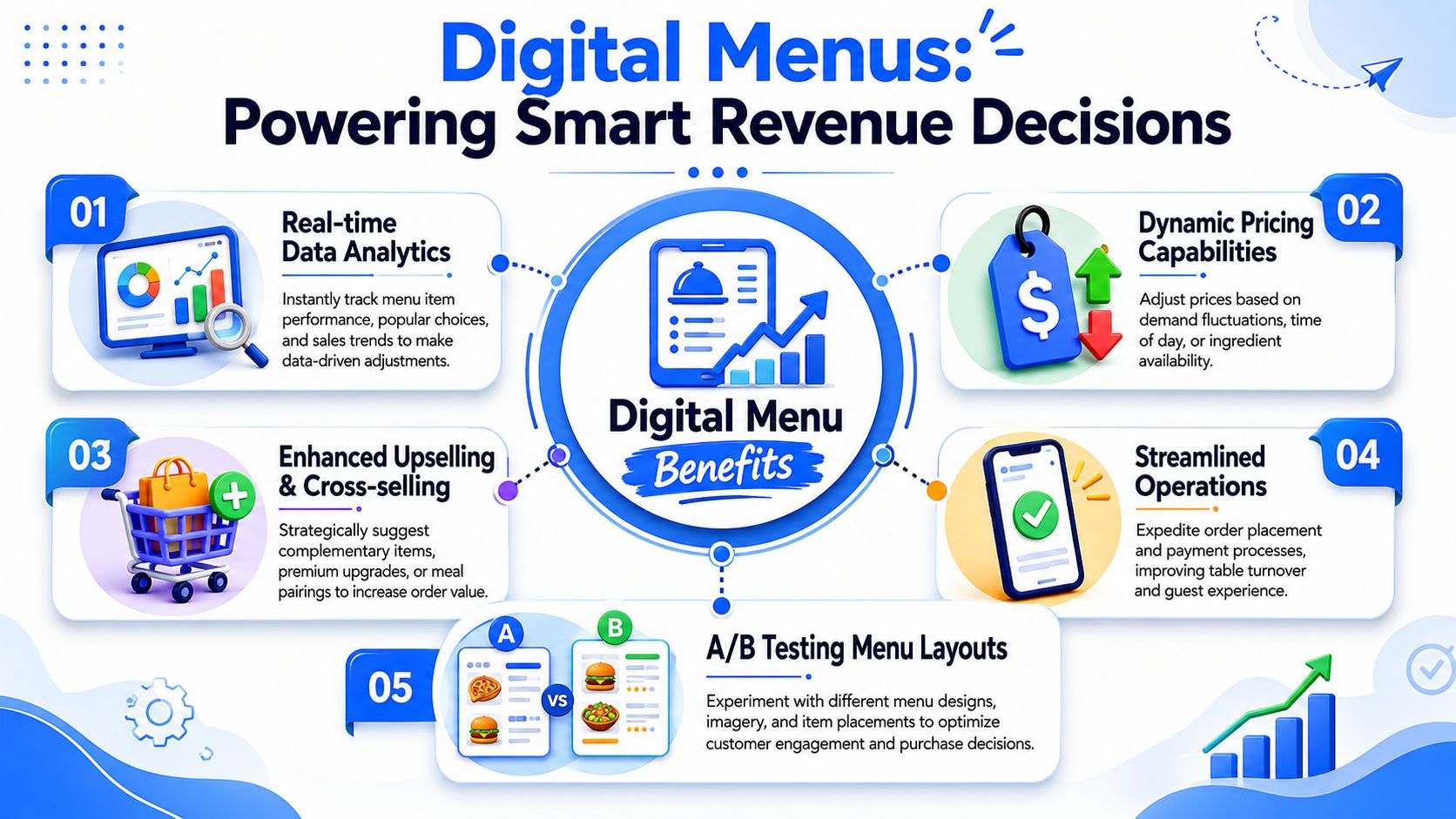
Digital menus solve a very practical problem. They let operators change what guests see without reprinting, retraining, or waiting.
That matters because item visibility shapes sales. If a profitable dish, bundle, or add-on deserves more attention tonight, a digital menu lets you act immediately. If a slow seller needs a better placement or cleaner description, you can adjust it. If a special should appear only during a certain window, you can control that too.
Digital menu tools also reduce pressure on staff. Instead of relying on every server to remember every ideal upsell, the menu itself can guide the next step.
For operators evaluating modern QR workflows, this overview of a digital menu QR code system for restaurant ordering and updates shows the operational side clearly.
What good digital menu data should tell you
Core KPI logic matters here. Industry guidance notes that metrics like RevPAR, RevPASH, and GOPPAR help diagnose whether underperformance comes from weak pricing, low utilization, or high operating costs. The same logic becomes more useful when digital menu analytics show item-level performance, helping managers see which dishes drive revenue and which support margin, as explained in this hotel revenue metrics breakdown with GOPPAR and total-revenue logic.
For restaurants, that means your menu system should help answer:
- Which items get viewed but not ordered?
- Which add-ons convert consistently?
- Which bundles lift spend without slowing service?
- Which categories perform differently by daypart?
- Which items are popular but weak on margin?
A good digital menu should support:
- Real-time edits
- A/B testing of layout and item placement
- Upsell prompts that feel relevant
- Cleaner reporting by item, category, and time period
- Faster deployment across multiple locations
If your menu can't help you test, learn, and adjust quickly, it isn't just old-fashioned. It's blocking revenue decisions.
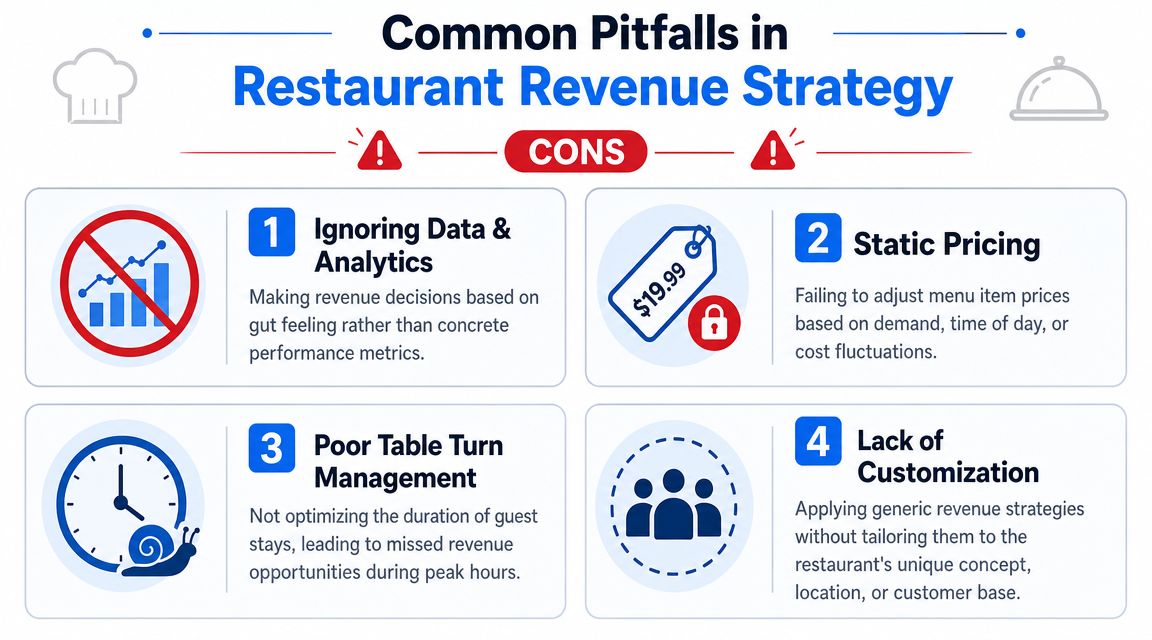
Common Pitfalls in Restaurant Revenue Strategy
Most revenue mistakes in restaurants don't come from doing nothing. They come from doing the wrong thing with confidence.
Operators often copy one visible tactic, like discounting or price increases, without fixing the system around it.
The discount trap
The easiest bad decision is broad discounting.
It feels active. It fills some quiet periods. It gives marketing something to post. But it often trains guests to wait for deals, lowers perceived value, and pulls demand toward low-margin behavior.
Smarter alternatives:
- Use bundles instead of blanket discounts
- Target soft dayparts, not all traffic
- Attach offers to profitable combinations
- Protect premium items from unnecessary markdowns
Another common error is focusing only on average order value. If checks rise but tables turn slower or the kitchen gets clogged, your headline metric improves while actual performance worsens.
Pricing without capacity is bad strategy
Labor and service capacity matter more than many operators admit.
Hospitality research has argued that revenue management should extend to labor, even suggesting dynamic wage adjustments during shortages to attract staff when needed. The important point for operators is broader: staff shortages cap sellable capacity and reduce realized revenue, so pricing decisions fail when service delivery can't support them, as explored in this hospitality labor shortage and revenue management analysis.
That shows up in restaurants all the time:
- You run a promotion with no line capacity.
- You raise menu complexity during an understaffed shift.
- You push table volume when the bar can't keep up.
- You optimize for demand captured instead of capacity delivered.
Four traps to watch
| Pitfall | What operators do | Smarter move |
|---|---|---|
| Data neglect | Go by instinct only | Use item, time, and channel patterns |
| Static pricing | Leave the same offers in place too long | Adjust by daypart and demand conditions |
| Poor table management | Ignore seat duration during peak | Tighten pacing and payment flow |
| One-size-fits-all strategy | Apply the same approach to every location | Tailor by concept, guest mix, and service model |
If your team is stretched, adding demand can make the guest experience worse and the economics weaker. Capacity is part of revenue strategy.
Frequently Asked Questions About Revenue Management
Is hospitality revenue management only for hotels or large chains
No. Independent restaurants, cafés, bars, and small groups need it just as much.
The principles are simple. Match pricing, offers, menu design, and capacity to actual demand. Big brands may have more systems, but smaller operators often move faster once they start looking at the right signals.
How do I start if I don't have an analyst or revenue manager
Start small and stay practical.
Track one core measure of seat productivity, one measure of order value, and one view of item performance. Then review them by daypart. You don't need a complex model to spot obvious leaks like weak add-ons, slow turns, or over-promoted low-margin items.
A good first move is to pick one service period and answer three questions:
- Which items should sell more often there?
- Where does service friction reduce spend?
- Which offer could improve guest value without discounting everything?
Won't dynamic pricing or changing offers annoy regulars
Only if you do it clumsily.
Guests usually accept price and offer changes when they feel logical, visible, and fair. What frustrates them is inconsistency, confusion, or obvious gouging. Most restaurants don't need aggressive dynamic pricing. They need better daypart offers, smarter bundles, cleaner premium framing, and menus that adapt to demand without creating friction.
Done well, revenue management feels like a better experience, not a pricing trick.
If you want to put these ideas into daily operation, RevMenue is built for exactly that. It helps restaurants, cafés, and hospitality teams turn QR menus into revenue tools with fast updates, smarter upsells, and clearer menu analytics, so you can increase guest spend, reduce staff friction, and make better decisions without overcomplicating service.