
Most restaurants lose money in the exact hours that look successful.
The dining room is full. The kitchen is slammed. Staff are moving fast. Then you check the numbers and realize the busy shift sold too many low-margin items, too few add-ons, and left you with waste at close. That's the gap between sales and revenue management.
If you've ever asked, “How can we be this busy and still not make enough money?” this is the answer. Revenue management isn't a hotel concept you can ignore. In a restaurant, it means using pricing, menu design, timing, and ordering channels to make every seat, every hour, and every item work harder.
Table of Contents
- Stop Selling Seats and Start Selling Profit
- The Core Principles of Restaurant Revenue Management
- Key Metrics That Reveal Your True Profitability
- Practical Strategies That Increase Average Checks
- The Right Tech for Smart Revenue Management
- Your First Steps to Higher Margins
Stop Selling Seats and Start Selling Profit
A packed dining room can still hide a weak business.
That happens when operators focus on covers, table turns, and total sales, but ignore what each seat hour produces. If your best tables are tied up by guests ordering lightly, or your menu pushes volume instead of contribution, busyness becomes expensive.
The formal definition of revenue management comes from hospitality. It's the application of information systems and pricing strategies to allocate the right capacity to the right customer at the right price and time to maximize net revenues, a framework first established by Kimes in 1989, as outlined in this hospitality revenue management reference.
For restaurants, that idea needs translating.
Restaurants don't sell rooms. They sell time, attention, and perishable inventory
You're not managing room nights. You're managing:
- Seat time: A two-top at 7:30 p.m. has a different commercial value than the same table at 3:00 p.m.
- Menu mix: Not every plate helps the P&L equally.
- Channel behavior: Dine-in, QR ordering, takeaway, and direct digital orders don't produce the same margin.
- Waste risk: Unsold ingredients don't wait until tomorrow politely. They spoil.
Practical rule: In restaurants, revenue management means selling the right item to the right guest, at the right price, through the right channel, while protecting margin and reducing waste.
That's why the usual hotel phrase, “right room, right guest,” misses the point for food service. A better restaurant version is this: right offer, right moment, right seat hour.
What this changes on the floor
When you think this way, you stop asking only “How do we fill tables?” and start asking better questions:
- Which items should we steer guests toward tonight?
- Which dayparts need a different offer, not more discounting?
- Where are staff missing easy add-ons because service is too busy?
- Which dishes are creating waste because demand is too uneven?
Owners who understand what revenue management is stop treating the menu like a static list. They treat it like a live commercial tool.
The Core Principles of Restaurant Revenue Management
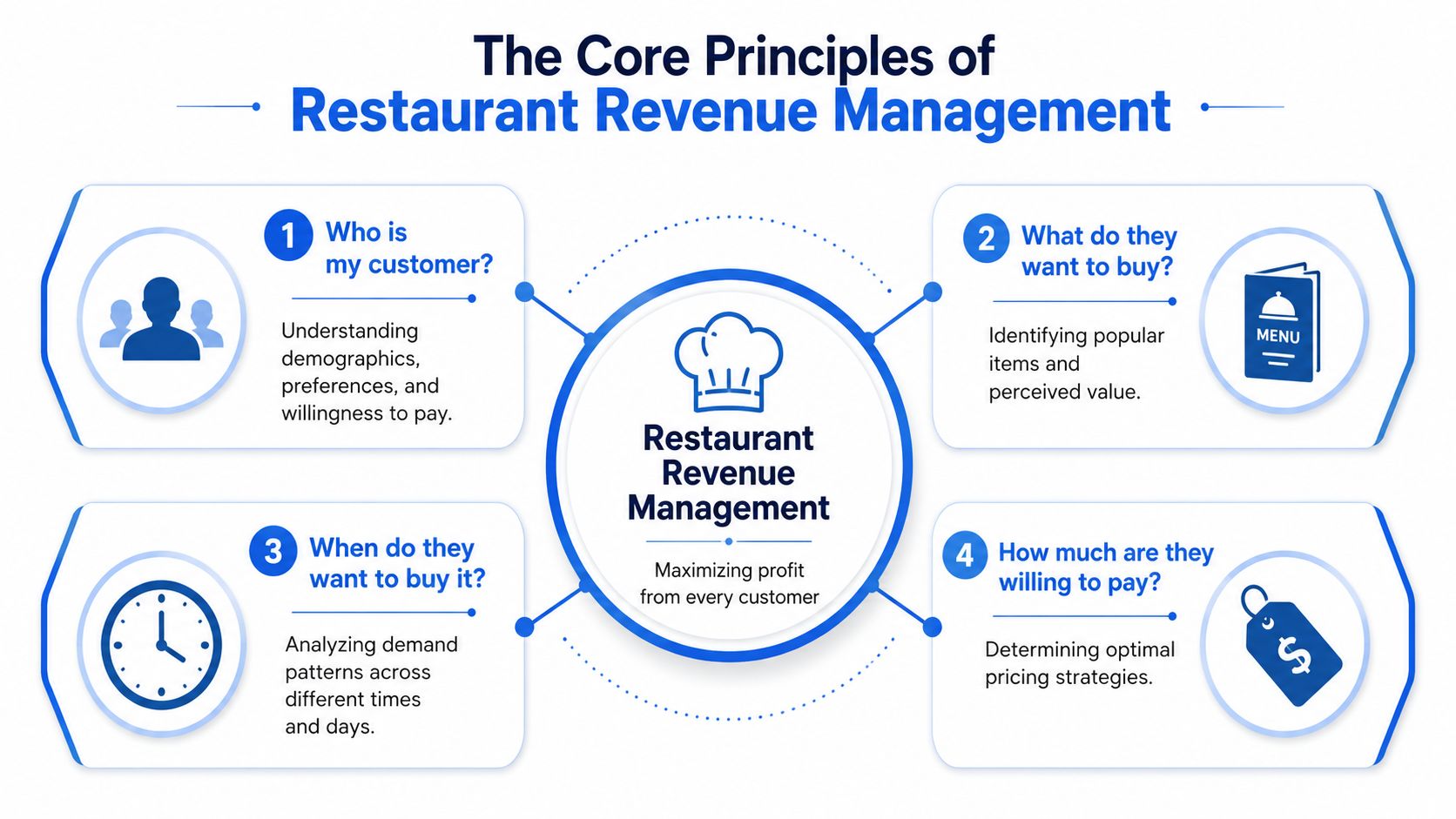
The simplest way to understand revenue management in a restaurant is to ask four hard business questions. Not abstract ones. Commercial ones.
Start with the real definition
Most operators already do parts of revenue management without calling it that. You adjust staffing around demand. You push specials when inventory is heavy. You know Friday dinner is worth more than Monday lunch.
The difference is discipline. Hotels built a system around it long ago. Restaurants need to do the same, but with food, service pace, and customer psychology at the center.
Four questions that matter in restaurants
Who is my customer
A weekday coffee buyer isn't the same as a Saturday brunch table. A family ordering for delivery doesn't behave like a couple dining in.
Segment your guests by behavior, not by vague demographics alone. Look at what they buy, when they buy, how often they return, and whether they respond to bundles, upgrades, or speed. That tells you what they value.
What do they want to buy
Your menu has stars, sleepers, and dead weight. Customers vote with orders, but they also react to placement, wording, photos, and framing.
A prime-time table is like a premium airline seat. Don't waste that demand on items that consume labor, slow the kitchen, and contribute little. Feature the products that give you strong contribution and a clean service flow.
A menu isn't just a list of food. It's the sales script your staff uses when they're too busy to talk.
When do they want to buy it
Demand forecasting sounds technical. In practice, it means knowing your patterns before service starts.
Look at lunch versus dinner. Weekday versus weekend. Rainy afternoons versus sunny terrace hours. Event nights versus normal trade. Once you know where demand naturally shows up, you can stop using one-size-fits-all pricing and promos.
How much are they willing to pay
Weak operators often panic and discount too early.
Good revenue management doesn't mean random price hikes. It means matching price to demand, perceived value, and context. Guests will pay differently for speed, convenience, exclusivity, bundles, and timing. A premium add-on at dinner can feel natural. The same price point at 11 a.m. might fall flat.
Here's the working model:
| Question | Restaurant meaning | Immediate action |
|---|---|---|
| Who is buying? | Segment by behavior and channel | Build offers for distinct guest types |
| What are they buying? | Identify high-margin, high-demand items | Push profitable stars visually |
| When are they buying? | Track daypart and demand pattern | Adjust promos by time and traffic |
| What will they pay? | Test pricing against value perception | Use bundles and premium options |
Restaurant revenue management isn't complicated. It's commercial awareness applied consistently.
Key Metrics That Reveal Your True Profitability
Friday night feels full. The printer is running nonstop. Sales look strong by close.
Then you review the shift and find the problem. Too many low-margin dishes sold, drinks attach rates were weak, and tables sat too long during your best hour. Busy service does not guarantee healthy profit. In restaurants and cafés, revenue management means measuring what each seat, menu item, and labor hour earns before perishables, waste, and slow turns eat the gain.
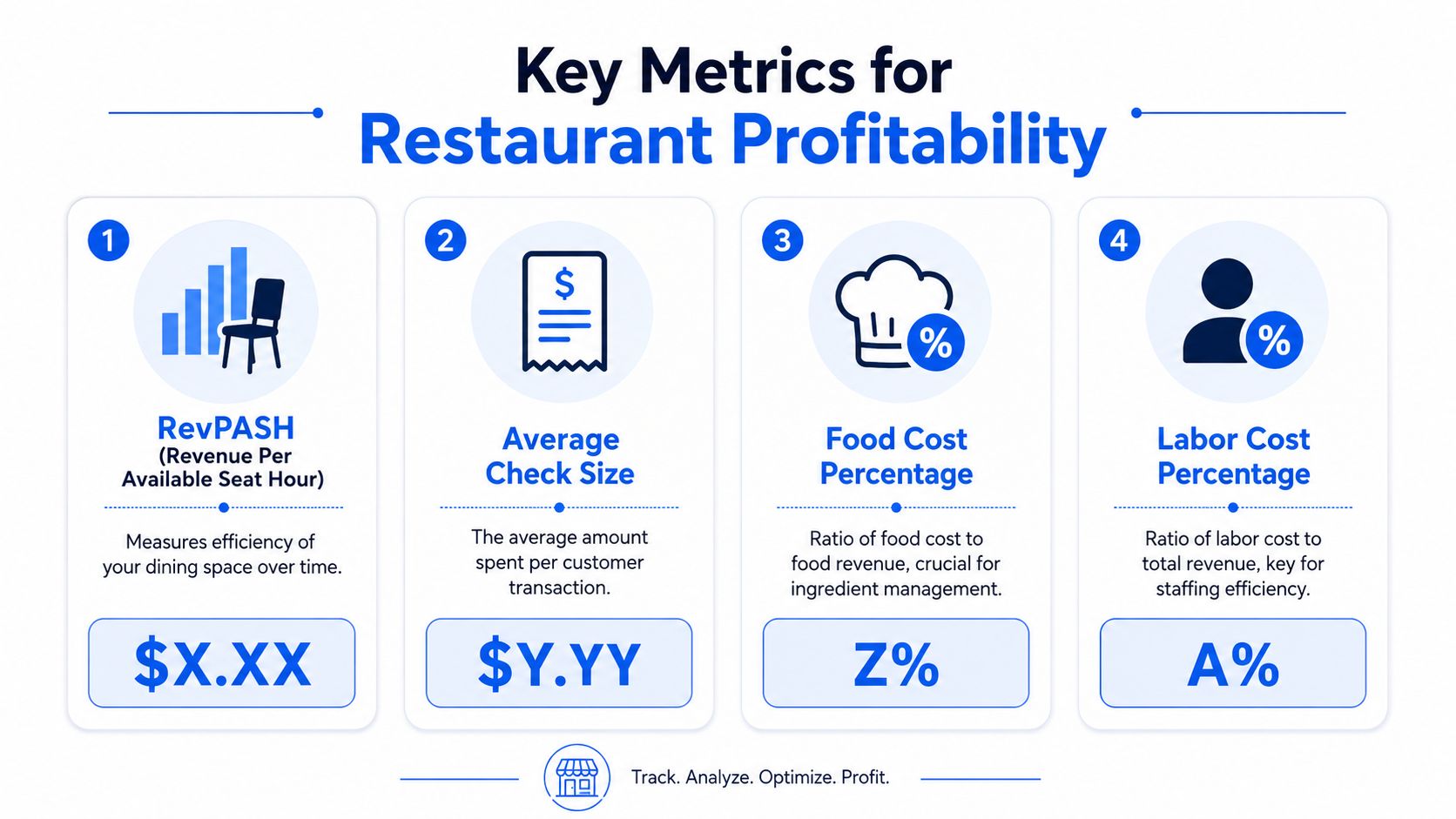
RevPASH shows whether your room is earning
For restaurants, RevPASH is one of the clearest capacity metrics. It measures total revenue against seat count and hours open, and this restaurant metrics guide on RevPASH explains why it matters more than raw cover counts.
Covers can fool you. A full dining room with cheap orders and slow table turns can underperform a calmer shift with better pacing, stronger drink sales, and cleaner add-ons.
Use RevPASH by daypart, not as one weekly average. Lunch, mid-afternoon café traffic, and peak dinner all behave differently. Hotel guides rarely deal with this level of service mix. Restaurant operators have to, because one dead hour with staffed seats and prepped inventory costs money fast.
For a broader breakdown of the restaurant KPIs that matter, review these restaurant KPI benchmarks.
Menu profitability exposes what deserves attention
Every owner should track menu item profitability. The point is simple. Find out which dishes create contribution dollars consistently and which ones only create work.
TouchBistro's explanation of restaurant metrics and menu engineering covers the logic well. You need both margin and volume on the same page. Popular does not mean profitable, and high price does not mean high contribution if the plate is loaded with waste, labor, or expensive ingredients.
Sort your menu into four groups:
- Star: High margin, high volume. Keep it visible and keep execution tight.
- Puzzle: High margin, lower volume. Rename it, reprice it, or position it better.
- Plowhorse: Strong volume, weaker margin. Tighten portion cost or improve what gets sold with it.
- Dog: Low volume, low margin. Cut it or rebuild it.
If an item complicates prep, slows the pass, and doesn't make money, it's not a signature. It's a problem.
Restaurant revenue management's practical nature comes into focus. A hotel can sell the same room again tomorrow. You may be sitting on dairy, greens, pastry, or protein that loses value by the hour. That makes menu profitability a daily operating tool, not a quarterly finance exercise.
AOV matters only if margin holds
Average order value is useful. On its own, it can also be misleading.
A bigger check helps only if the extra revenue survives food cost, labor pressure, and service friction. If bundles increase ticket size but trigger remakes, longer waits, or production bottlenecks, you did not improve profitability. You just made the shift harder to run.
Watch AOV alongside:
- Prime cost
- Order accuracy
- Prep time
OrderOut's guide to restaurant performance metrics notes the operational value of tracking measures like order accuracy and speed. That matters in restaurants more than in hotel-style revenue models because your upsell strategy lives or dies in the kitchen and at the handoff point. If the line cannot execute the extra item cleanly, the extra sale is not worth much.
Start with a practical definition of success. Higher sales from the same seats, with controlled cost and less waste. Those are the metrics worth checking every week.
Practical Strategies That Increase Average Checks
The 12:15 rush hits. Seats are full, the line is tight, and tickets are flying. One guest orders a sandwich only. Another orders the sandwich, adds chips, upgrades the drink, and takes a cookie to go. Same seat time. Very different profit.
That gap is restaurant revenue management in practice. Hotels talk about rate and occupancy. You need to manage menu mix, perishable inventory, and profit per seat hour while the clock is running.
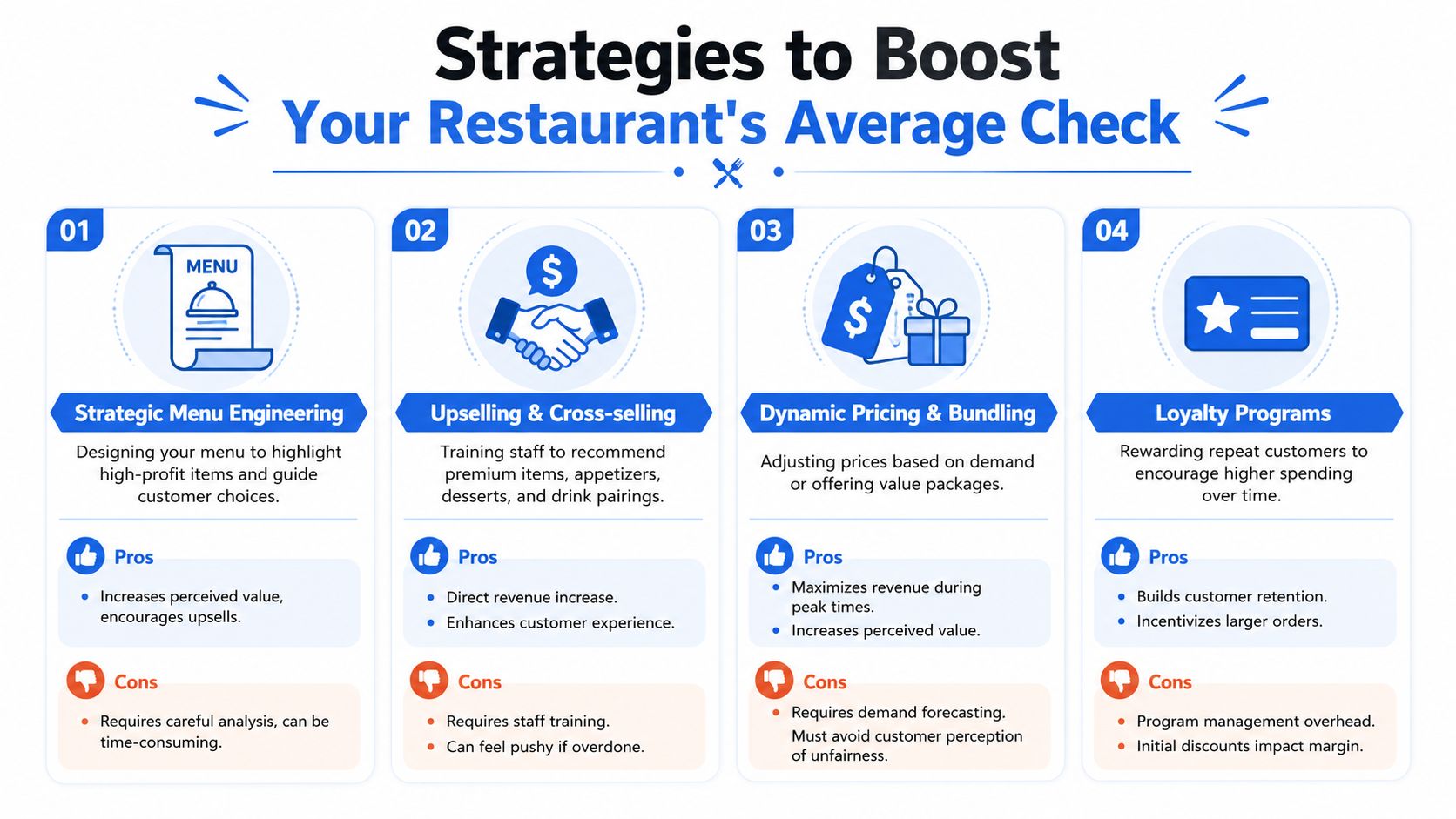
Fix the menu before you train the staff
If the menu is doing a poor job, staff has to compensate table by table. That is expensive and inconsistent.
Guests buy what they notice first and understand fastest. If your best-margin items are buried under long descriptions, while low-margin fillers are easy to spot, your menu is pushing demand in the wrong direction. Clean that up first.
Do this tomorrow:
- Put high-margin items in high-attention spots: Top right, first section position, and visual focal points still matter.
- Cut weak choices: Extra options do not create more sales. They slow decisions and spread demand across too many SKUs.
- Rename items for clarity: Guests respond to obvious flavor, format, and portion cues.
- Use design to direct the eye: Spacing, callouts, and photos should support profitable choices, not decorate the page.
Build bundles around contribution margin, not just value
Bundles work because they reduce decision fatigue. They also help you move inventory that would otherwise sit, spoil, or get discounted later.
A café lunch set should pair items with shared prep and strong margin, not just whatever looks generous on a chalkboard. A burger combo should raise total contribution without creating extra assembly drag at the pass. The best bundle is easy to say yes to and easy for the kitchen to execute.
Keep one rule in place. Every bundle needs a cost check before it goes live. The National Restaurant Association explains prime cost as the combined total of labor and cost of goods sold, and that measure should stay under control even after you package items together, in its restaurant operations data and guidance. If a combo lifts sales but pushes food cost up and labor with it, scrap it or rebuild it.
For more practical ideas, review these restaurant upselling techniques that work in real service settings.
Let digital ordering handle the repeatable upsells
Busy staff miss prompts. Digital ordering does not.
That matters more in restaurants than in hotel-style revenue models because your selling window is short. The guest is deciding in seconds, often while distracted, hungry, or rushing back to work. A well-built digital menu can place the right add-on in front of them every time.
Use QR and digital ordering to:
- Suggest pairings with context: Fries with burgers. Oat milk with iced coffee. Dessert after an entrée.
- Offer premium swaps clearly: Larger size, better side, stronger drink, extra protein.
- Standardize the prompt: Every guest gets the same selling opportunity.
- Protect speed of service: The screen handles simple upsells so staff can focus on accuracy and hospitality.
This is how restaurants raise sales from the same seats without adding tables, extending hours, or squeezing the floor harder.
Guests accept guidance when it is relevant, fast, and easy to act on.
Sell each daypart differently
A slow 3 p.m. should not get the same menu and offer strategy as a packed 7 p.m.
Use off-peak periods to move inventory with purpose. Push bundles that use ingredients already prepped and at risk of waste. Tighten the dinner menu when the kitchen is under pressure. If an item sells at lunch but drags at dinner, stop forcing the same product into both dayparts with the same presentation and price.
Here is the operating difference:
| Situation | Weak response | Better response |
|---|---|---|
| Slow mid-afternoon | Blanket discount | Timed combo built around items you need to move |
| Busy dinner rush | Full menu with scattered choices | Shorter menu with obvious premium add-ons |
| Ingredient overhang | Wait and hope | Run a focused special that uses the excess |
| Staff under pressure | Depend on verbal upsells | Put prompts into the ordering flow |
Good revenue management for restaurants is specific. You are not trying to raise spend in theory. You are trying to sell the right item, at the right time, with the right margin, before that inventory loses value.
The Right Tech for Smart Revenue Management
You don't need an enterprise system or an analyst to run smarter revenue management. You need tools that remove manual work and make better decisions easier.
The wider hospitality industry is moving in that direction fast. The Hospitality Revenue Management & Pricing Analytics market is projected to grow from USD 4.1 billion in 2024 to USD 13.1 billion by 2034, driven by AI-enabled pricing automation and cloud adoption, according to this market projection on revenue management and pricing analytics.
Good tech removes manual work
Restaurant owners get into trouble when they try to run pricing, promotions, menu updates, and add-on logic through print menus, staff memory, and spreadsheets.
Smart restaurant tech should handle the repetitive parts:
- Instant menu updates: Change an item, price, or offer without reprinting.
- Cross-location consistency: Push updates across multiple sites quickly.
- Add-on logic: Suggest relevant extras based on what's already in the basket.
- Live analytics: Spot what's selling, when demand shifts, and where margin is leaking.
That's what makes revenue management practical for real operators. You don't need more dashboards for the sake of it. You need fewer missed opportunities during service.
What to look for in a restaurant revenue tool
The best setup supports commercial decisions without disrupting the floor.
Look for software that gives you:
- Fast mobile ordering: Guests shouldn't need an app or account.
- Menu analytics you'll use: Item performance, timing, repeat behavior.
- Promotion control: Test offers by daypart, item group, or location.
- Operational visibility: Enough insight to improve prep flow and service speed.
- Compatibility: It should work alongside your current POS and payment stack.
A closer look at restaurant analytics software will help if you're comparing options.
This kind of tool matters because good revenue management lives in daily execution, not theory.
Here's a short walkthrough of what modern restaurant revenue tooling looks like in practice:
Your First Steps to Higher Margins
Don't turn this into a six-month project. Start small and get commercial wins fast.
Step one: analyze your winners and losers
Pull your menu data and identify the items that combine strong contribution with steady demand. Then find the items that sell weakly and earn weakly. Promote the first group. Rework or remove the second.
Step two: run one pricing experiment
Pick one daypart or one category. Test a better bundle, a premium version, or a timed special built around an item you want to move. Don't test everything at once. Clean experiments are easier to judge.
Step three: add one upsell path to your digital menu
Choose a top seller and attach a relevant add-on. A side, dessert, topping, or drink pairing is enough. Keep it natural and obvious.
Start where staff already struggle. If your team forgets the same add-on every shift, automate that prompt first.
That's the practical answer to what revenue management is for restaurants. It's not theory. It's disciplined control over price, product, timing, and capacity so you earn more from the demand you already have.
If you want a simpler way to put this into practice, RevMenue gives restaurants and cafés a revenue-focused digital menu system built to increase average checks, improve menu decisions, and reduce manual workload without changing how the whole operation runs.