
Most restaurants lose revenue through their menus without realizing it. You look at a competitor's prices, copy a few numbers, and hope the margin works out. That's not strategy. That's guesswork.
A Hawaiian BBQ menu is a useful operator case study because it's built to do three jobs at once: keep production simple, push customers toward bigger orders, and make bundle pricing feel generous instead of expensive. If you run a café, fast-casual concept, bar kitchen, or multi-location restaurant, that logic is worth stealing.
Table of Contents
- Why Analyzing a Hawaiian BBQ Menu Matters for Your Profit
- The Anatomy of a Standard Hawaiian BBQ Plate Lunch
- Pricing Core Entrées for Steady Profitability
- Combo Plates The Engine for Higher Average Order Value
- Using Family Packs and Catering to Maximize Order Volume
- Translating Menu Strategy to Your Digital Menu
- Navigating Regional Price Variations and Delivery Fees
- Your Hawaiian BBQ Menu Engineering Checklist
Why Analyzing a Hawaiian BBQ Menu Matters for Your Profit
Most owners read a Hawaiian BBQ menu and prices page like a customer. That's the mistake. An operator should read it like a margin map.
The primary value isn't whether BBQ chicken costs more or less than a comparable bowl or sandwich in your market. The value is in the structure. Hawaiian BBQ menus are usually disciplined. They rely on repeatable plate formats, obvious upgrade paths, and bundles that increase ticket size without forcing staff to hard-sell every table.
What operators usually miss
Owners tend to focus on the visible number and ignore the pricing logic behind it.
They ask:
- What does the competitor charge?
- Should I match that price?
- Will guests complain if I go higher?
They should be asking different questions:
- Which item is the traffic driver?
- Which item nudges guests into a higher spend?
- Which bundle reduces kitchen friction while raising the check?
- Which menu format makes ordering faster on a phone screen?
Practical rule: Don't copy the price. Copy the decision architecture.
A strong Hawaiian BBQ menu and prices layout works because it gives the guest a simple path. Start with a familiar base plate. Move up to a combo for variety. Trade up again to a group pack when more people are involved. That's menu engineering doing its job.
Why this matters beyond Hawaiian BBQ
You can apply the same model to almost any concept:
- Burger shop: Single burger, premium combo, share pack
- Bowl concept: Base bowl, double-protein bowl, meal bundle
- Bakery café: Core sandwich, lunch combo, office platter
- Mexican fast-casual: Burrito, duo combo, family taco kit
The point is simple. Your menu shouldn't just list food. It should direct buying behavior.
If your menu forces guests to think too much, compare too much, or build everything from scratch, you create friction. Friction slows ordering, increases staff questions, and leaves money on the table.
The Anatomy of a Standard Hawaiian BBQ Plate Lunch
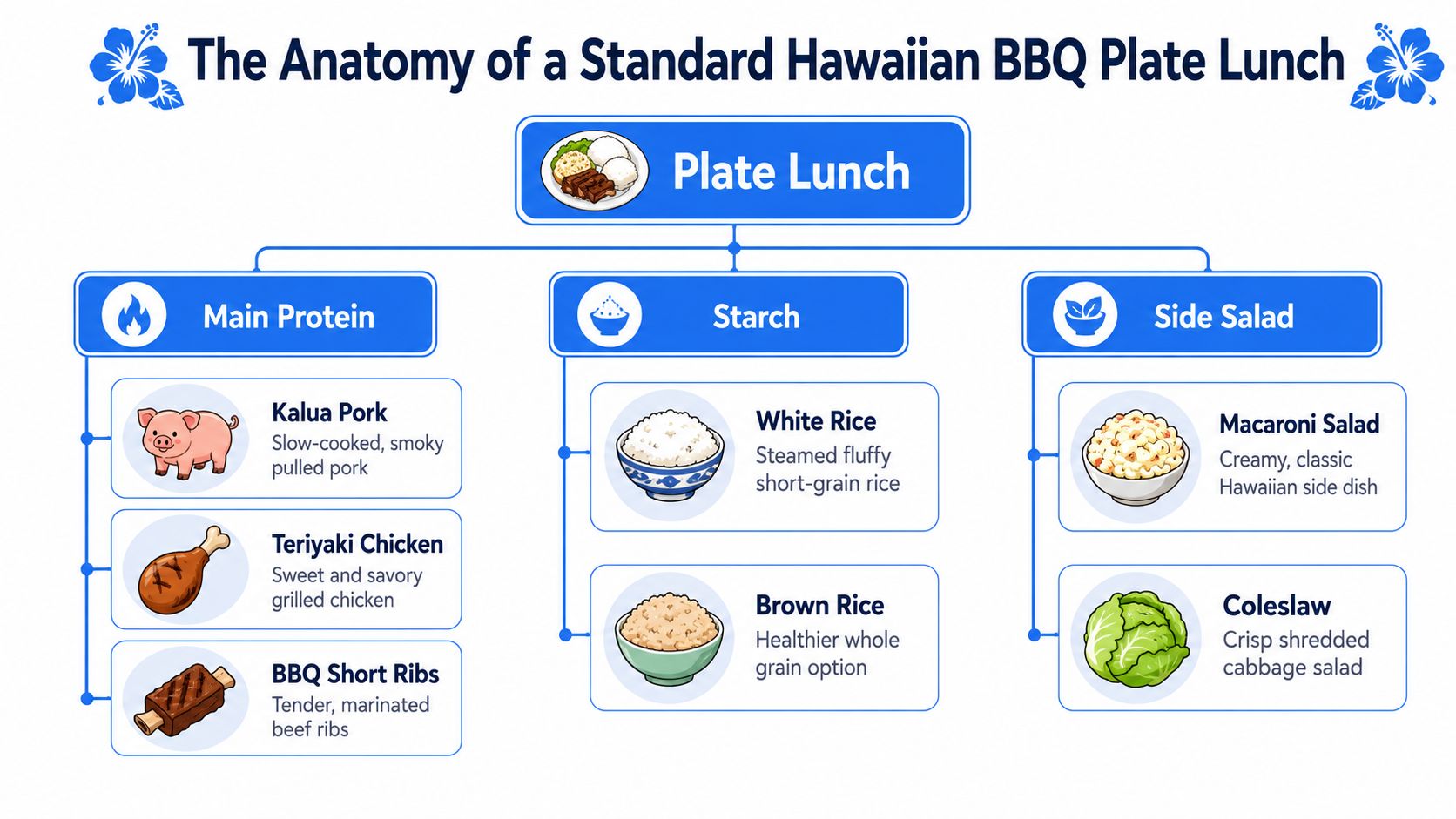
The engine of the format is the plate lunch. According to This Hawaii Life's description of Hawaiian barbeque, the standard Hawaiian BBQ plate lunch uses a fixed triad: a grilled barbecue entrée, two scoops of white rice, and one scoop of macaroni salad. That consistency is the entire business model in miniature.
Why the fixed format works
This setup does more than satisfy tradition. It creates operational control.
A standardized base item gives you:
- Predictable assembly: Staff don't have to rethink the plate every time.
- Cleaner prep planning: Rice, salad, and proteins move in known volumes.
- Faster training: New team members learn one core build before learning variations.
- Clear guest expectations: People know what “plate lunch” means before they order.
That's why this format scales so well across independent shops and larger operators. Guests order quickly because the decision is narrow. The kitchen moves quickly because the build is familiar.
How to apply this model outside Hawaiian BBQ
You don't need to sell Kalua pork to use this.
Build your own version of a fixed-format base:
| Concept | Standard base item |
|---|---|
| Café | Sandwich + side + drink |
| Salad brand | Base greens + protein + one standard dressing |
| Burrito shop | Burrito + rice + chips |
| Pub kitchen | Main + fries + slaw |
The key is to standardize the frame, not every ingredient. Let the guest choose the hero item, but keep the supporting structure stable.
A menu becomes easier to sell when the kitchen can build it without hesitation.
That stability also reduces cognitive load on staff during rush periods. If every order is a fresh customization project, labor gets dragged into explanation instead of execution. Plate lunch logic fixes that.
For digital menus, this matters even more. A guest scanning a QR code wants to order fast. A clear base format helps them understand the offer within seconds. That improves customer experience and cuts back on table-side clarification.
Pricing Core Entrées for Steady Profitability
A guest scans your menu, wants one dependable plate, and decides in under ten seconds whether your prices feel fair. That decision sets the ceiling for the rest of the order. Get the core entrée wrong and every combo, add-on, and family pack has to fight against a weak starting point.
Single-protein plates do the heavy lifting. They establish your opening price, anchor value perception, and protect volume. On Hawaiian BBQ menus, that role usually sits in the mid-tier of the menu, high enough to cover labor and fixed sides, low enough to keep the first purchase easy.
The pricing job is simple. Your core plate must feel like the safe choice while still leaving room above it for upgrades.
Price for margin discipline and trade-up potential
Operators often underprice these items because they fear resistance on the first click. That creates a worse problem. The guest gets trained to stop at the cheapest complete meal, and your combo strategy loses force.
Use cost-plus math and make the plate earn its place. CloudKitchens' menu pricing guide frames the formula as (Food ingredient costs + Overhead) × Mark up % = Price of the menu item. ChowNow's restaurant pricing guidance says operators commonly target food cost between 28% and 35% of menu price, which often lands near three times ingredient cost.
That gives you a practical filter for every core entrée:
- Keep the base build tight. A plate with fixed sides and a controlled protein portion is easier to price correctly.
- Protect your margin on popular proteins. If chicken, katsu, or BBQ beef carries higher demand, do not let popularity justify weak pricing.
- Leave visible room for the next step up. The single plate should make the combo look like a reasonable upgrade, not a pricing shock.
- Cut hidden subsidy. If one entrée needs oversized portions to satisfy guests, fix the portion spec or raise the price.
Treat core entrées as anchors, not heroes
Core plates are usually Plowhorses in menu engineering. They sell often, carry broad appeal, and keep traffic flowing. Their real value goes beyond item-level margin. They set the reference price for the entire menu.
That matters even more on a QR menu.
On a printed menu, a server can explain differences and recommend upgrades. On a digital menu, the price ladder has to do that work by itself. If your first complete entrée is priced too low, the rest of the menu looks expensive. If it is priced correctly, the guest sees the combo, extra protein, or premium side as a natural next step. That is the discipline behind a good restaurant pricing strategy.
A strong core entrée price does three things at once. It covers the build. It keeps entry friction low. It makes the upsell path believable. That is how steady profitability gets built.
Combo Plates The Engine for Higher Average Order Value
A guest scans your QR menu, lands on a chicken plate, then notices a combo with two proteins for a moderate step up in price. That is where margin gets made. Hawaiian BBQ operators use combo plates to raise ticket size without adding ordering friction, and that logic is worth copying.
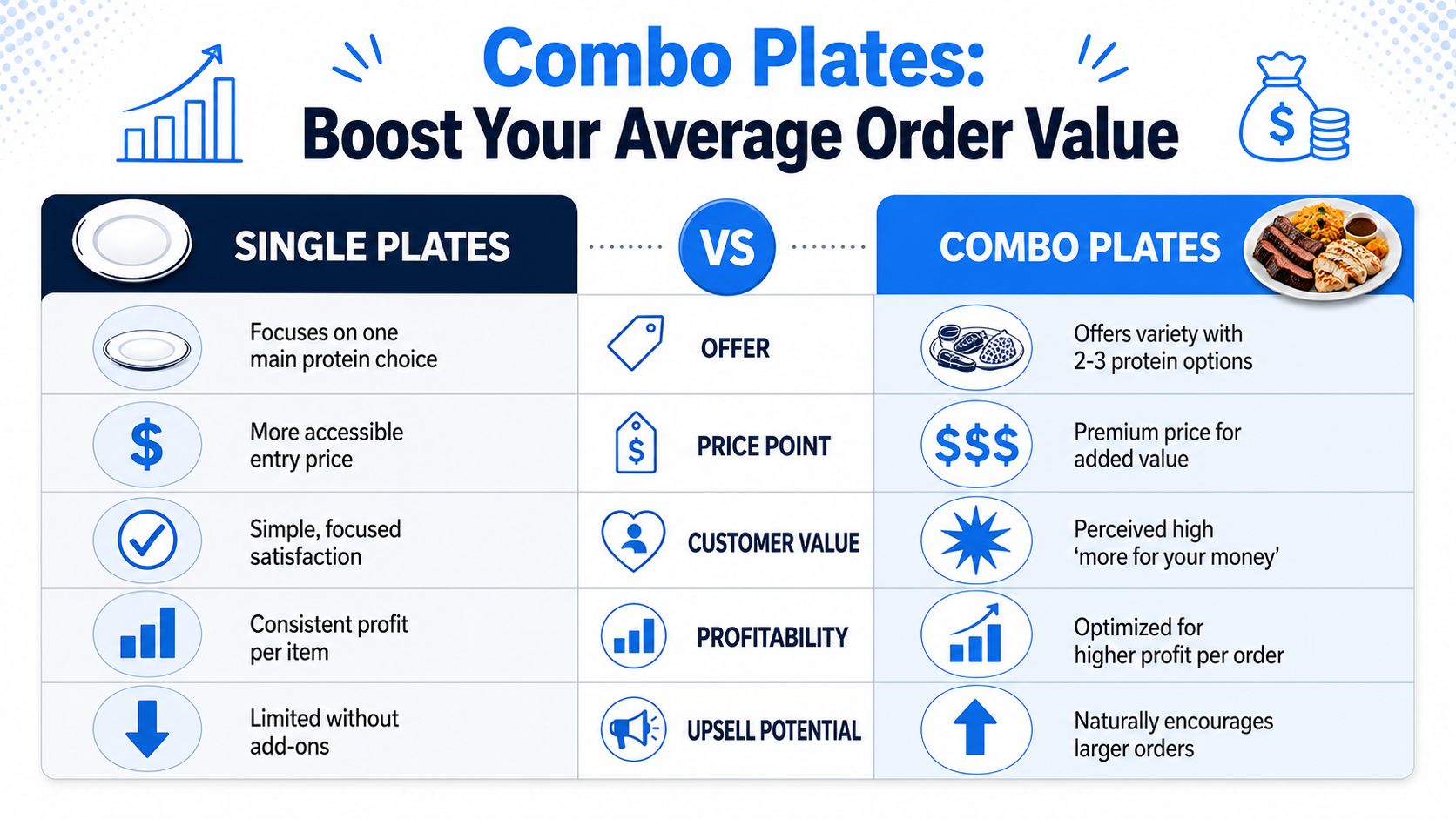
Single plates establish the entry point. Combo plates create the trade-up path. The guest is not buying extra food alone. The guest is buying relief from choosing just one protein, plus the feeling of getting a better deal than ordering items separately.
Why combo pricing works so well
The operator gains more than a higher check.
Combos also let you protect food cost by pairing a premium protein with a lower-cost one, keeping the guest focused on variety instead of portion math. On Hawaiian BBQ menus, that matters because rice and mac salad already make the plate feel substantial. The second protein increases perceived value faster than it increases actual cost, especially when the portions are controlled and the sides stay fixed.
That gives combo plates four jobs at once:
- Raise average order value: The guest moves up from the base plate without needing a cashier prompt.
- Protect margin mix: You can balance higher-cost proteins against lower-cost proteins inside the same bundle.
- Reduce custom ordering: A preset combo is faster to choose and easier for the kitchen to execute.
- Create a stronger digital upsell: On a QR menu, the price jump looks logical because the value difference is visible.
Premium singles still matter. A short rib plate or another signature protein can sit above a combo and act as a price anchor. That setup makes the combo look disciplined, not expensive. The best Hawaiian BBQ menus use three price signals at the same time: an accessible single, a profitable combo, and a premium single that makes both look reasonable.
If you want staff scripts and digital prompts to support that structure, use these restaurant upselling techniques for higher check averages.
How to build your own combo ladder
Use a simple ladder:
| Offer type | Guest message | Operator outcome |
|---|---|---|
| Single item | Quick, affordable entry | Base volume |
| Combo upgrade | More variety, better value | Higher ticket |
| Premium single | Signature or premium ingredient | Price anchor |
On a digital menu, placement matters as much as price. Put the combo directly beside or directly under the best-selling single. Show the proteins visually. Keep modifiers limited. If guests have to build the combo from scratch, you lose the speed and certainty that make the format profitable in the first place.
Place the video below where your team can study how visual framing affects ordering behavior.
Don't force the upsell. Build it so the customer talks themselves into it.
The lesson applies far beyond Hawaiian BBQ. Bowl shops, cafés, Mediterranean counters, and fast casual grills all benefit from the same ladder. Give guests a clear entry point, a credible upgrade, and one premium anchor. That structure does more work than a long list of add-ons ever will.
Using Family Packs and Catering to Maximize Order Volume
The smartest Hawaiian BBQ menus don't stop at the individual guest. They build for households and group ordering.
A benchmark example from the Eagle Rock, Los Angeles market prices a Family Pack at $60.00, including 4 pieces of BBQ chicken, 4 pieces of BBQ beef, 4 pieces of Chicken Katsu, 8 scoops of rice, and 4 scoops of macaroni salad according to Hawaiian BBQ LA's menu. That bundle is described there as a strategic package designed to increase average ticket size by 20% to 30% compared with single plate orders.
Why group bundles outperform separate orders
This kind of offer works because it solves two customer problems at once.
First, it reduces decision friction. A group doesn't need to build multiple separate meals from scratch. Second, it frames the purchase as a complete solution rather than a stack of line items.
Operationally, that matters:
- Fewer ordering decisions means faster checkout
- A tighter production pattern helps the kitchen execute large orders with less chaos
- Bundled sides make portioning easier
- A bigger one-shot transaction is easier to justify than repeated upsells
There's also a real content gap here. Diners often ask whether Hawaiian BBQ is cost-effective for groups, but most menus don't break down bulk value clearly. Verified background notes point out that a Hawaiian BBQ feast for two in Michigan costs under $120, while many brands still present single plates in the $13 to $19 range without making group value easy to compare in practice, as summarized from the verified TikTok example about group meal cost questions. Operators should pay attention to that confusion because unclear bundle value suppresses bigger orders.
What operators should copy
If you're building your own family pack or catering set, keep it disciplined:
- Lead with a fixed package: Don't make guests build everything from scratch.
- Mix familiar proteins: Use broad-appeal items first.
- Bundle sides aggressively: Sides make the offer feel complete.
- Name the use case: Family meal, office lunch, game-day pack, team dinner.
A group bundle should feel easier than ordering multiple individual meals. If it doesn't, it won't sell consistently.
Translating Menu Strategy to Your Digital Menu
A static menu can show prices. A digital menu can shape behavior.
That matters because the best Hawaiian BBQ menu and prices strategy isn't only about what you charge. It's about what guests see first, what they compare, and what they add before checkout. On a printed menu, you get one layout. On a QR menu, you can guide the order path much more precisely.
Use digital placement to guide choice
BIMPOS explains anchor pricing clearly. Put a high-priced item next to a slightly lower-priced target item so the target feels like the better deal, and support that with upselling of add-ons and higher-priced items.
In a digital menu, that principle gets easier to execute because you control sequence and visibility.
Use it like this:
- Show premium singles near target combos so the combo feels stronger
- Feature bundles before long item lists so guests see value first
- Pin best-sellers high in the category instead of burying them
- Prompt add-ons at the right moment instead of expecting staff to remember
Operator move: Put your expensive anchor where it makes the intended item look sensible, not cheap.
What a QR menu should automate
A strong QR menu should reduce staff workload while increasing order quality.
That means it should help you:
- Highlight profitable bundles
- Suggest relevant add-ons
- Present categories in a clean sequence
- Update pricing instantly across shifts or locations
- Track which items guests tap, view, and order
The old print-menu problem is simple. Once it's printed, it's frozen. If a combo underperforms, if a seasonal item should be pushed higher, or if you need to simplify a category, your only option is reprinting or waiting.
A better digital flow gives you room to test. You can revise the order of offers, clean up wording, and make sure your high-value items aren't buried below low-impact ones. If you're reviewing digital execution, look at this example of a digital menu QR code system to see how the menu itself can do some of the upselling work that staff often miss during service.
Navigating Regional Price Variations and Delivery Fees
Guests notice price differences immediately. Operators often pretend they won't.
That's a bad habit, especially in Hawaiian BBQ, where identical or near-identical items can look wildly different depending on location or ordering channel. Verified pricing notes show that Ono Hawaiian BBQ plates start at $13 in Los Angeles, while L&L lists $18.95+ for similar items, with neither menu clearly explaining whether the higher number reflects delivery, packaging, or platform effects in the verified YouTube pricing comparison example.
Why guests get confused
Customers don't separate your brand from the platform very well. They just see two numbers and assume one of them is unfair.
That confusion usually comes from a mix of factors:
- Regional cost differences
- Third-party delivery markups
- Packaging costs
- Service or convenience fees shown late in checkout
If you don't manage that carefully, guests think your menu is inconsistent. That weakens trust.
A practical channel pricing policy
Don't let channel pricing drift. Set rules.
A clean policy looks like this:
- Dine-in and pickup menu: Use your core brand pricing
- Delivery menu: Build pricing that protects margin on that channel
- Large-format delivery bundles: Create delivery-friendly items instead of forcing dine-in plates into the wrong channel
- Customer messaging: Be transparent about why some channels cost more
You don't need to explain every line of your cost structure. You do need to make the experience feel intentional.
For example, if a plate travels poorly, don't list it exactly the same way for delivery. Package it differently, rename it if needed, and make sure the delivery version earns its price. Channel-specific menu design is better than pretending one menu fits every use case.
If customers keep asking why the app price is higher, the problem isn't the customer. The pricing architecture is unclear.
Your Hawaiian BBQ Menu Engineering Checklist
Most operators don't need more theory. They need a fast audit.
Use this checklist against your own menu this week.
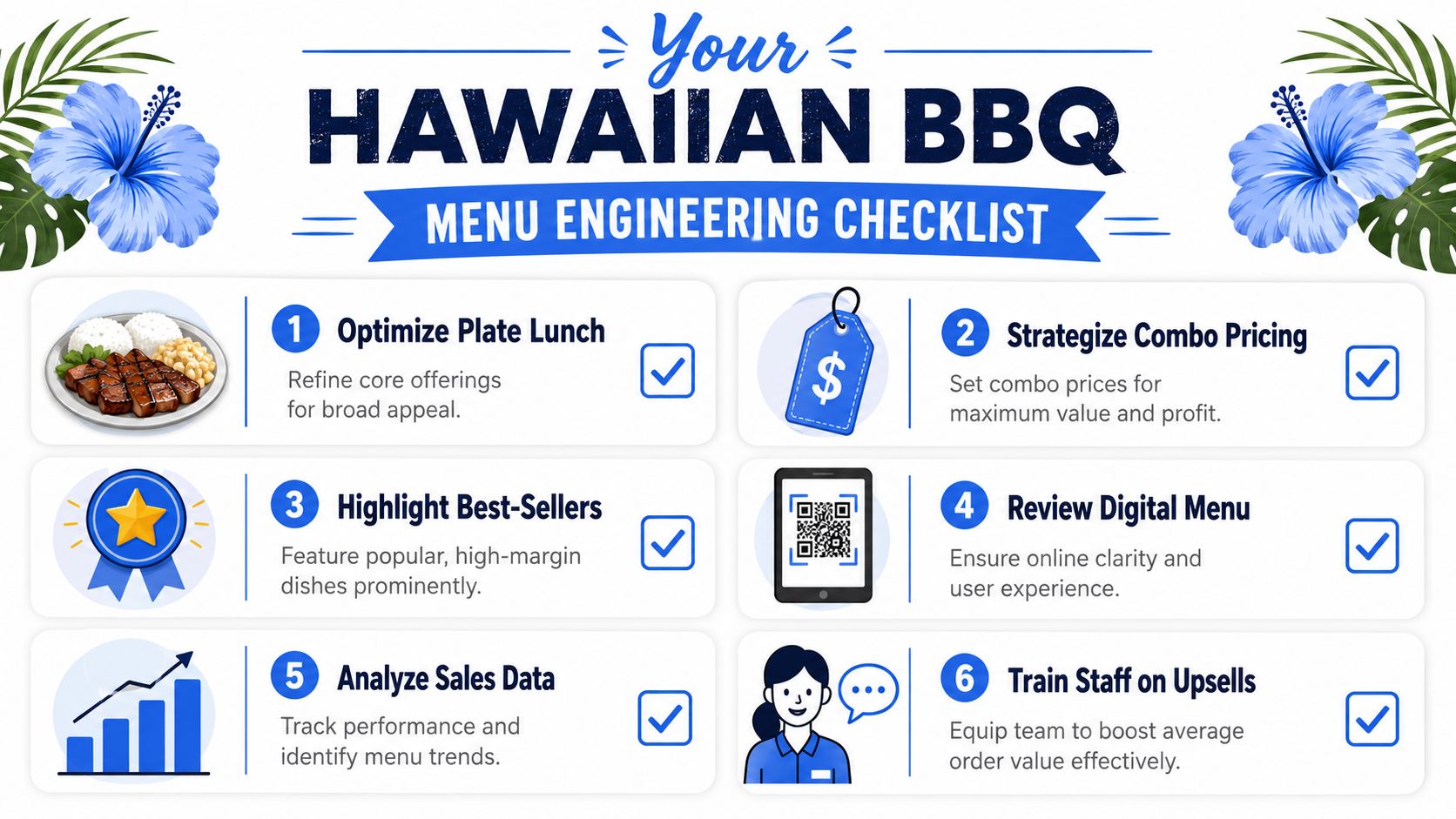
Audit your menu like an operator
- Define one standardized base item. Give guests a simple default order path.
- Price your core entrée from real costs. Don't guess. Cost it properly and make sure it can carry its role.
- Build a clear combo ladder. Create an obvious upgrade that feels like better value, not a forced upsell.
- Use a premium item as an anchor. Let one expensive item make the target item look smart.
- Offer a fixed group bundle. Make family packs, office meals, or share bundles easier than separate ordering.
- Separate channel logic. Dine-in, pickup, and delivery shouldn't be managed as if they behave the same.
Tighten operations while lifting the check
Ask your team these questions:
- Can a first-time guest understand the menu quickly?
- Can a cashier explain the top three offers without improvising?
- Can the kitchen execute the most popular items fast during a rush?
- Can your digital menu push the right add-ons automatically?
- Can you see which items deserve more visibility?
If the answer to any of those is no, your menu isn't finished. It's just published.
If you want to turn these menu principles into a practical digital system, RevMenue is worth a look. It helps restaurants, cafés, and hospitality teams turn QR menus into revenue tools with faster updates, smarter upsells, cleaner bundle presentation, and analytics that show what's driving margin.