
Most restaurants are sitting on the same problem right now. Sales are coming in, the dining room is moving, online orders keep pinging, and you still can't answer a basic question with confidence: which items put money in the bank?
That's where operators get trapped. They look at top sellers, assume those items are carrying the business, and keep pushing them harder. Meanwhile, a high-volume dish may be eating margin through waste, prep time, discounting, or ingredient volatility. A digital combo may look successful until you realize it drags average spend down because guests swap out better add-ons.
Restaurant analytics software matters because it stops that kind of blind decision-making. It shows what sells, what pays, what slows service, what drives repeat visits, and what should disappear from the menu. Used well, it helps you lift average order value, reduce staff workload, tighten menu design, and make QR ordering more profitable instead of just more convenient.
Table of Contents
- Your Bestseller Might Be Costing You Money
- What Is Restaurant Analytics Software Really
- The Core Features and KPIs That Drive Profit
- Analytics in Action Real World Scenarios
- How Different Restaurants Use Analytics
- Your Roadmap to Choosing and Implementing Software
- From Data Points to Dinner Plates
Your Bestseller Might Be Costing You Money
Most owners can name the bestseller without looking at a report.
Far fewer can name the most profitable item, the most useful upsell, or the dish that inadvertently creates kitchen drag while looking successful on the surface.
That's the gap that hurts restaurants.
A burger can be your volume hero and still be the wrong item to push. If it takes too long to build, relies on inconsistent prep, triggers more modifiers, and keeps guests from ordering a stronger-margin plate, it may be hurting the P&L while looking great in the POS summary. The same thing happens with coffee bundles, lunch specials, family deals, and delivery-only offers.
Sales volume can hide bad decisions
Operators usually fall into a few predictable traps:
- They reward popularity over margin. A busy item gets featured again and again, even if it contributes less profit than quieter menu items.
- They ignore cannibalization. One cheap favorite can pull orders away from better dishes.
- They miss labor impact. A plate with okay food cost can still be a poor business choice if it slows service and increases staff pressure.
- They trust static reports. End-of-day sales totals don't explain why guests bought, what they skipped, or which prompts improved the check.
Practical rule: If an item sells well but doesn't improve margin, speed, or guest experience, it isn't doing enough.
Gut feel stops working as you grow
Gut instinct helps in hospitality. It doesn't replace analysis.
Once you're running QR menus, online ordering, delivery channels, promotions, and changing dayparts, there are too many moving parts to manage by memory. You need item-level visibility. You need to know which menu layout gets more add-ons, which bundles raise spend, and which shifts underperform because of staffing, not demand.
That's why restaurant analytics software isn't a nice extra. It's an operating tool. It turns menu decisions into commercial decisions, not creative guesses.
What Is Restaurant Analytics Software Really
Your POS is useful, but it's not enough.
Think of your POS like a fuel gauge. It tells you how much revenue came in. That's helpful, but it doesn't tell you whether you're moving efficiently, heading in the right direction, or about to run into a margin problem.
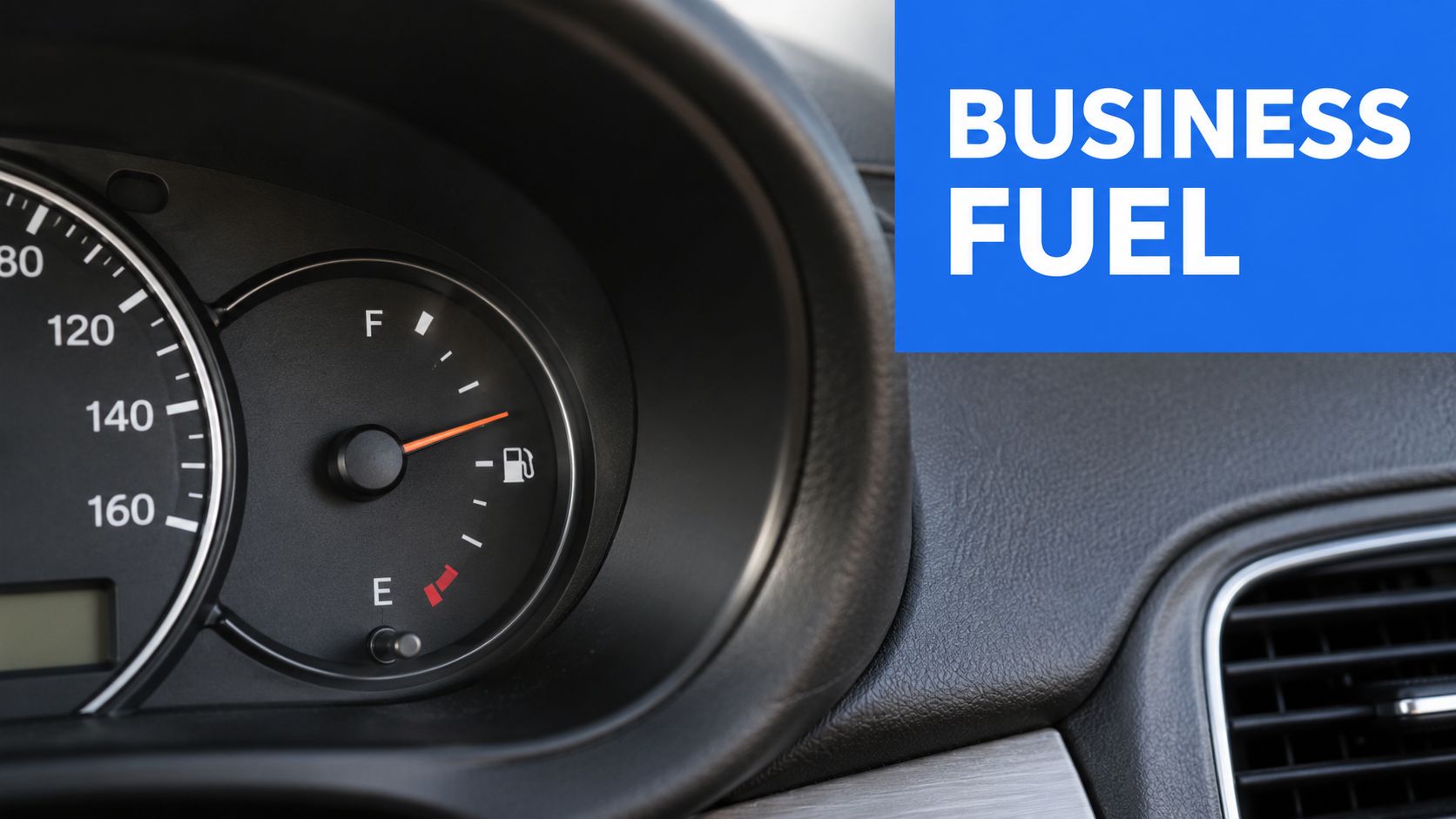
Your POS shows revenue, not the full picture
A car dashboard gives you more than fuel. It shows speed, warnings, engine status, and navigation. Restaurant analytics software does the same job for your business.
It connects signals that usually live in separate places:
- Sales behavior from POS and digital ordering
- Menu performance by item, category, modifier, and bundle
- Guest patterns such as repeat orders, timing, and preferences
- Operational signals like prep pressure, staffing strain, and peak periods
That matters because revenue alone can mislead you. A busy Friday can still be sloppy. A strong lunch can still be discount-heavy. A popular QR menu can still bury your highest-margin items where nobody clicks them.
What good analytics software actually answers
Good software doesn't drown you in charts. It answers operator questions fast.
You should be able to ask:
- Which upsell prompts are working?
- Which categories lift average order value?
- What items get viewed often but ordered less?
- Where does the digital menu create friction?
- Which dayparts justify more labor?
- What dishes should move higher on the menu?
- Which offers bring guests back, and which just train them to wait for discounts?
If a platform can't answer those questions clearly, it isn't analytics. It's reporting.
For operators who want a sharper breakdown of the metrics layer, this guide to restaurant data analytics for revenue decisions is worth reading alongside your software evaluation.
The best restaurant analytics software doesn't make you feel smarter. It helps your team act faster.
The practical test is simple. Can a manager use it before service, during service, and after service to make a better call on menu placement, staffing, promotion timing, or guest experience? If the answer is yes, that's a real tool. If not, it's just another login.
The Core Features and KPIs That Drive Profit
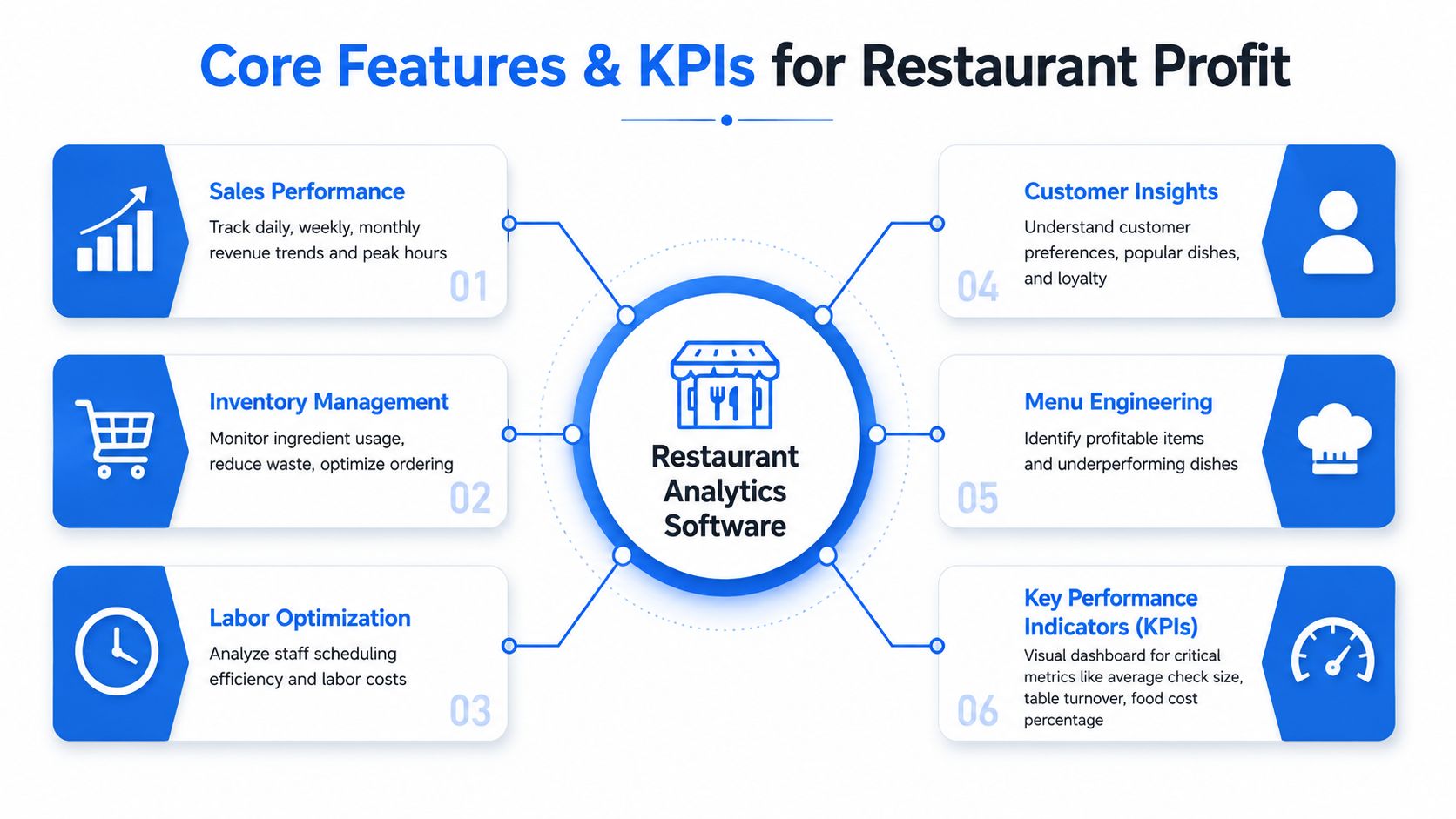
The right platform should tie every major feature to a business outcome. If a vendor can't explain the P&L impact in plain language, move on.
Features worth paying for
Some features look impressive in demos and do almost nothing in service. Others steadily improve margin every day.
Focus on these:
- Menu engineering tools help you compare popularity against profitability so you can stop overpromoting weak items and give better visibility to stronger ones.
- Digital menu tracking shows where guests tap, hesitate, abandon, and add extras, which is essential if you're using QR menus or mobile ordering.
- Customer segmentation separates regulars from first-timers, high-value guests from deal chasers, and dine-in behavior from off-premise habits.
- Real-time dashboards let managers react during service instead of reviewing mistakes after close.
- Labor and shift visibility helps you see whether sales quality justifies staffing levels.
- Inventory-linked reporting exposes waste patterns and lets you adjust ordering and menu design before shrink hits hard.
- Promotion analysis shows whether an offer raised ticket size, shifted traffic to a weak daypart, or discounted orders guests would have placed anyway.
Here's the standard I use. Every feature should improve one of these outcomes:
| Feature | P&L impact |
|---|---|
| Menu engineering | Better item mix and stronger margins |
| QR menu analytics | Higher add-on sales and cleaner ordering flow |
| Customer insights | Better targeting and more relevant offers |
| Labor reporting | Smarter scheduling and less wasted payroll |
| Inventory visibility | Lower waste and tighter purchasing |
KPIs operators should actually watch
Most restaurants track sales. That's the starting line, not the finish line.
Watch these instead:
Contribution margin per dish
This is the money left after the direct cost of that item. It matters because high sales don't help much if each plate contributes too little.Average order value
This is the typical spend per order. It matters because smart bundles, upsells, and menu design can grow revenue without needing more covers.Revenue per available seat hour
This measures how effectively you turn seating capacity into revenue over time. It matters because full tables don't guarantee strong performance if spend and turnover are weak.Item profitability index
This compares how well a menu item performs across sales and profit contribution. It matters because it helps you spot stars, passengers, and items that should be repositioned or removed.Modifier attachment rate
This shows how often guests add extras or upgrades. It matters because many restaurants leave easy margin on the table by presenting add-ons poorly.Promotion quality
This tells you whether an offer improved the mix of what people bought, not just how many orders came in. It matters because bad promotions create activity without profit.
A strong dashboard should help a manager decide what to push, what to hide, what to reprice, and what to staff for.
If you're reviewing vendors, don't just ask what reports they provide. Ask what actions those reports support. That's the difference between software that looks modern and software that drives profit.
Analytics in Action Real World Scenarios
Operators don't buy software for dashboards. They buy it to fix real problems in real shifts.
A café fixes a popular weak-margin item
A neighborhood café had a toast plate that sold all day. Staff liked it because guests knew it, food runners recognized it, and it looked busy on the board. But the numbers told a different story. The item had decent volume, weak contribution, and almost no profitable add-on behavior.
The owner made three changes. They lifted the item's menu position, adjusted the wording so the premium ingredients read more clearly, and paired it digitally with a coffee offer that made sense for the guest. They also stopped letting it sit as a standalone hero item.
The result wasn't magic. It was smarter structure. The dish stopped acting like a margin drain and started pulling profitable drinks with it.
A quick-service brand repairs a soft daypart
A fast casual operator noticed an afternoon slump that staff had already felt for months. The mistake would have been to run a blanket discount. Instead, they used daypart data from their digital ordering flow to isolate when traffic softened, what guests still browsed, and which snack items had room for attachment.
They launched a limited drink-and-snack combo visible only during that window on the digital menu. That matters because timed menu visibility beats all-day clutter. Guests saw the right offer at the right moment, and the team didn't have to explain it manually at the counter.
If you're running multiple sites and need tighter control over timing, rollout, and pattern tracking, this overview of restaurant forecasting software for multi-location operators gives a good framework.
Don't fix a weak daypart with a broad discount if a targeted bundle can do the job with less margin damage.
A full-service team sells smarter, not harder
A full-service restaurant had regulars who consistently ordered wine, but servers treated every recommendation like a fresh guess. Management looked at guest history, repeat behavior, and common pairings. They didn't turn the floor into a script. They gave the team a clearer read on preference.
That changed the conversation tableside. Instead of vague upselling, servers made tighter recommendations based on what guests already responded to. The guest experience improved because the suggestion felt useful, not pushy. The business benefited because better recommendations usually land better than aggressive selling.
Three patterns show up across all these examples:
- The fix started with behavior, not software features
- The menu changed before the marketing did
- The best wins reduced friction for both guests and staff
That's what good analytics looks like in practice. Cleaner decisions, not more noise.
How Different Restaurants Use Analytics
The same platform won't solve the same problem for every operator. A café, a pizzeria, a fast casual chain, and a hospitality group should not stare at the same dashboard all day.
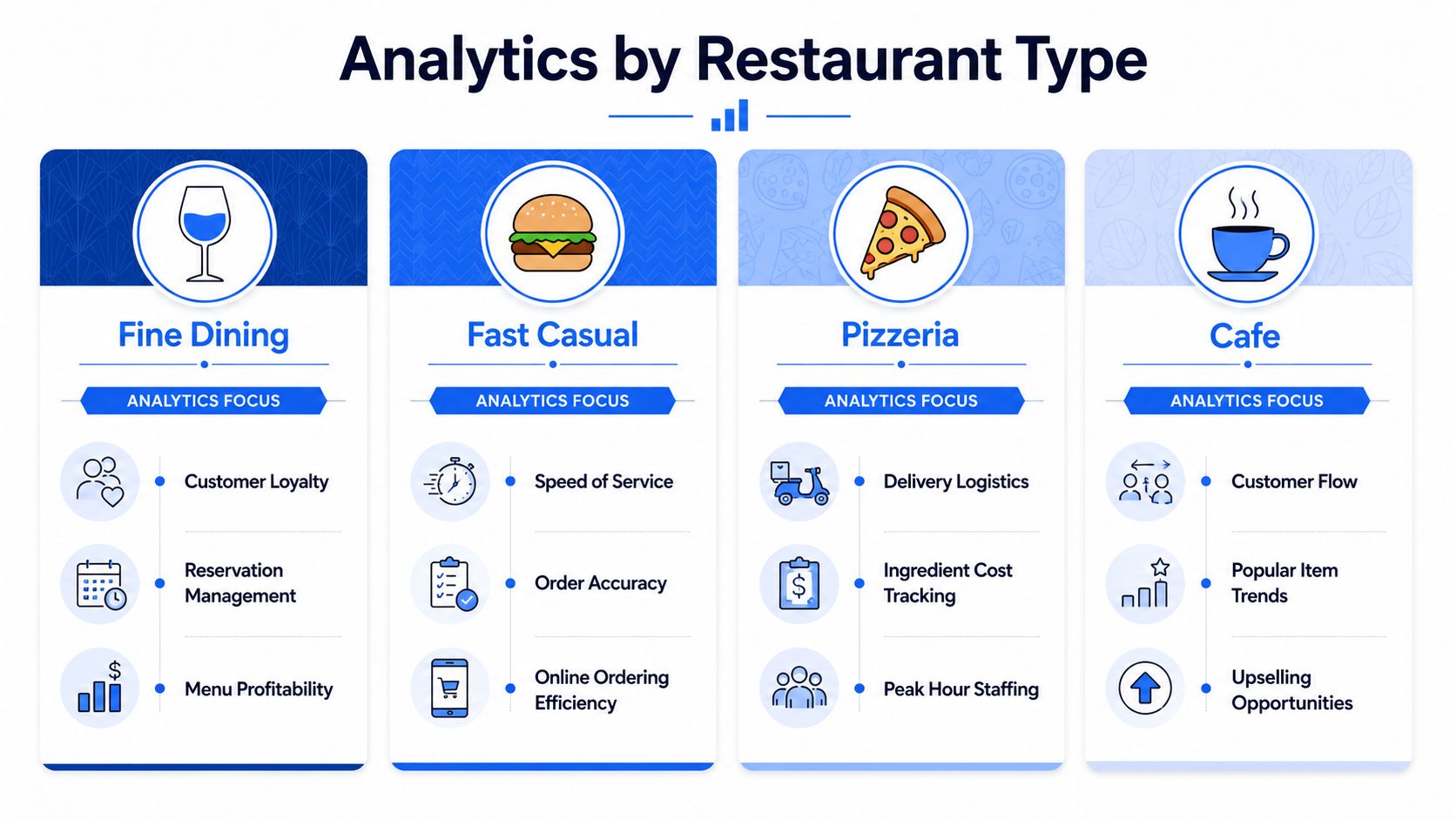
Independent restaurants and cafés
Independents need focus, not complexity.
Your biggest wins usually come from menu profitability, labor efficiency, and cleaner guest flow. You don't need a giant enterprise stack to figure out that one pastry sells well but weakens the morning margin, or that one QR menu layout gets more breakfast combos than another.
Pay attention to:
- Dish contribution so popular items don't fool you
- Bundle performance for coffee, pastry, lunch add-ons, and desserts
- Shift-specific sales quality so you know when extra hands pay off
- Guest ordering patterns that support better menu placement
Typical win: removing clutter from the menu, pushing better pairings, and helping a small team handle more volume without feeling rushed.
Quick-service chains
Chains need speed, consistency, and attachment.
In this model, restaurant analytics software should help you tighten throughput and grow average order value without slowing the line. Counter prompts, kiosk design, app flow, and digital combo logic matter more here than long-form guest profiles.
Look for visibility into:
- Order completion friction
- Combo and add-on attachment
- Daypart strength by location
- Menu consistency across stores
- Operational deviations that hurt speed or accuracy
The goal isn't just to sell more. It's to sell the right extra item, at the right moment, with the least labor involved.
Hospitality groups
Groups need portfolio-level control.
If you run multiple concepts or multiple full-service venues, you need to compare performance without flattening the differences between brands. A wine-forward bistro and an all-day café shouldn't be judged by the same menu strategy, but they should still roll into one clear commercial view.
Watch for:
- Location-level item performance
- Regional preferences and menu drift
- Promotion impact by concept
- Brand standard compliance
- Guest retention patterns across venues
Typical win: spotting where one location is outperforming another with the same core menu, then fixing execution instead of blaming demand.
Here's the most direct approach to understanding:
| Restaurant type | Primary goal | Key metric to watch | Typical win |
|---|---|---|---|
| Independent restaurant or café | Protect margin with a lean team | Contribution margin per dish | Better menu mix and less wasted effort |
| Quick-service chain | Increase throughput and ticket size | Add-on and combo attachment | Faster service with stronger average spend |
| Hospitality group | Compare concepts and locations intelligently | Portfolio performance by venue | More consistent execution across the estate |
Different formats need different answers. The software should adapt to the operation, not force the operation to adapt to the software.
If a platform gives every business the same static view, it won't stay useful for long.
Your Roadmap to Choosing and Implementing Software
Buying the wrong system creates more work than having no system at all. The best rollout is the one your managers use and your staff barely has to fight.
A practical roadmap keeps you out of expensive detours.
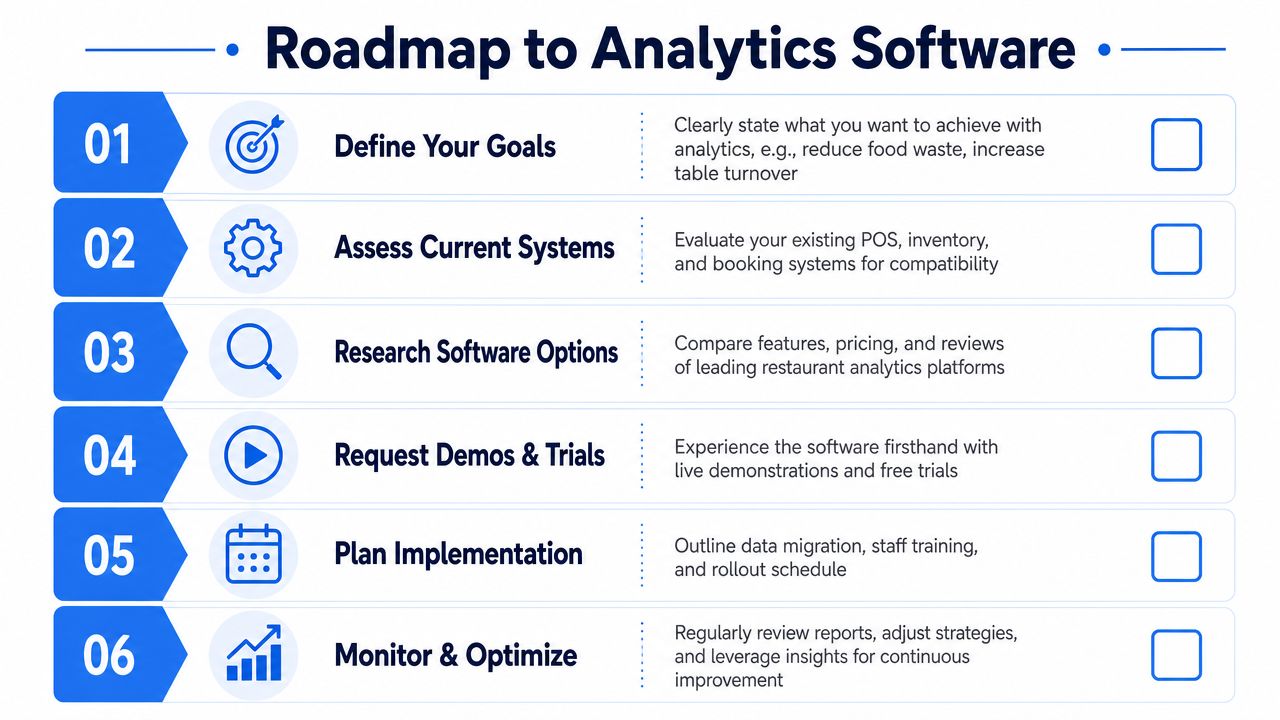
Start with the business problem
Don't begin with software demos. Begin with the bottleneck.
Ask yourself:
- What do we need to improve first? Average order value, food waste, menu mix, labor efficiency, repeat visits, or QR ordering performance?
- What decision do we struggle to make today? Pricing, staffing, promo timing, item placement, or menu cuts?
- What report are we missing? If your managers can't answer a question quickly, that's where the tool needs to deliver.
Then pressure-test vendors with plain questions:
- How does it integrate with our POS, ordering, and payment setup?
- What does setup involve for our team?
- What support do we get after launch?
- Can managers use it during service, not just in office hours?
- What is included in the full cost, including training and support?
Choose software that fits your stack
Most restaurants don't need another closed system. They need something that works with what already runs the business.
That means the software should sit comfortably alongside your POS, digital menu, online ordering, and payment flow. If it forces major operational disruption, skip it. Clean integration usually beats feature overload.
This short walkthrough is useful before vendor calls:
For operators evaluating live dashboards and decision speed, this guide to restaurant KPI software for real-time performance is a practical next read.
A good rollout usually follows this sequence:
Pick one priority use case
Start with one outcome, such as raising average check through digital upsells.Connect core systems first
POS, menu, ordering, and payments should speak to each other before you expand scope.Test with one location or one service window
Pilot before full rollout. It's easier to fix menu logic than retrain every team twice.Review the first actions, not just the first reports
Your first success should be a better decision, such as reordering categories or removing a dead offer.
Protect guest trust and train the team
Data handling matters because hospitality runs on trust. If you're collecting guest preferences, ordering behavior, or feedback, you need clear consent, clean privacy communication, and a platform that doesn't treat compliance like an afterthought.
Training matters just as much. Staff won't use analytics because management says it's important. They'll use it when it helps them answer guest questions faster, recommend better add-ons, and run a smoother shift.
Use this approach:
- Show the team what gets easier rather than what gets measured
- Keep training tied to real service moments such as menu recommendations or handling QR ordering questions
- Give managers one weekly review habit so reporting becomes operational, not theoretical
Staff adopt tools faster when they can see how the tool helps them serve guests better and earn better.
That's the implementation standard. Less disruption. Faster clarity. More useful action.
From Data Points to Dinner Plates
Restaurant analytics software isn't about collecting more information. It's about making better calls while the business is moving.
Used properly, it helps you redesign menus around profit, not sentiment. It helps you use QR ordering to raise spend instead of just replacing paper. It helps managers schedule smarter, teams upsell more naturally, and guests get a cleaner experience with less friction.
The point of every report is simple. Better decisions should show up on the plate, in the shift, and in the numbers that matter.
If your current setup only tells you what sold, you're missing the bigger opportunity. You need to know what sold well, what sold profitably, what created drag, and what should happen next. That's where modern restaurant analytics software earns its place.
If you want a platform built around margin growth, smarter QR menus, and practical revenue insights without ripping out your existing systems, take a look at RevMenue. It's a strong fit for operators who want clearer menu performance, cleaner upsells, and better day-to-day decisions from the data they're already generating.